Thirty-six officers problem
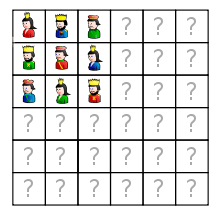
The thirty-six officers problem is a mathematical puzzle proposed by Leonhard Euler in 1782.[1][2]
The problem asks if it is possible to arrange six regiments consisting of six officers each of different ranks in a 6 × 6 square so that no rank or regiment will be repeated in any row or column. Such an arrangement would form a Graeco-Latin square. Euler correctly conjectured there was no solution to this problem, and Gaston Tarry proved this in 1901,[3][4] but the problem has led to important work in combinatorics.[5]
Besides the 6 × 6 case the only other case where the equivalent problem has no solution is the 2 × 2 case, i.e. when there are four officers.
See also
References
- ↑ Euler, L., Recherches sur une nouvelle espece de quarres magiques (1782).
- ↑ P. A. MacMahon (1902). "Magic Squares and Other Problems on a Chess Board". Proceedings of the Royal Institution of Great Britain. XVII: 50–63.
- ↑ Tarry, Gaston (1900). "Le Probléme de 36 Officiers". Compte Rendu de l'Association Française pour l'Avancement de Science Naturel. Secrétariat de l'Association. 1: 122–123.
- ↑ Tarry, Gaston (1901). "Le Probléme de 36 Officiers". Compte Rendu de l'Association Française pour l'Avancement de Science Naturel. Secrétariat de l'Association. 2: 170–203.
- ↑ van Lint, J.H.; Wilson, R.M. (1992), "Chapter 22. Orthogonal Latin squares", A Course in Combinatorics, Cambridge University Press, ISBN 0-521-42260-4
External links
- Leonhard Euler's Puzzle of the 36 Officiers AMS featured column archive (Latin Squares in Practice and Theory II)
- Weisstein, Eric W. "36 Officer Problem". MathWorld.
This article is issued from Wikipedia - version of the 9/26/2016. The text is available under the Creative Commons Attribution/Share Alike but additional terms may apply for the media files.