Aleutia
 | |
| Privately held, for-profit company | |
| Industry | Computer hardware |
| Founded | October, 2006 |
| Founder | Michael Rosenberg, Founder |
| Headquarters | London, UK |
Number of locations | 1[1] |
Area served | Products in 64+ countries[2] |
| Products | desktop computers, thin clients, nettops, workstations, embedded systems, set-top boxes, servers, computer monitors, and solar panels[2] |
| Services | eClinic software as a service[3] |
Number of employees | 4+[4] |
| Website | www.aleutia.com |
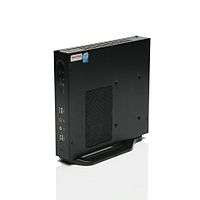
Aleutia Computers Ltd.[5] (pronounced al-oo-sha[2]) is a privately owned computer manufacturer based in London, United Kingdom. Its product range consists of low-power desktop and server computers. Its products are used in the developing world and as original base designs for externally branded products.[2] Its computers have been purchased by Unicef, Tesco, Schlumberger, Pret a Manger, Virgin Media, and the National Health Service.[2] All computers come with the option to ship a version of Ubuntu or Linux Mint, alongside the mainstream choice of Microsoft Windows.[6]
History
Aleutia was founded in London by Michael Rosenberg in October 2006,[7] motivated by the unreliability, inefficiency, and expense of the Hewlett-Packard PCs in the internet cafe he had set up in Takoradi, Ghana in the summer of 2006.[8][9]
Its first product was the E1, which was introduced for public sale in October 2007, was a fanless, low-power computer targeting the need for energy efficient computers in Africa.[10]
Products
T series
The T series of Atom-based nettop PCs is the longest-running and most popular. It comprises the T1 and the All-in-One, and the discontinued T1-R and T2.
D series
The discontinued D series of desktop PCs are more powerful than the T series. It comprises the D1, D2, and D3.
Product list
| Product name | Description | Introduced | Discontinued |
|---|---|---|---|
| T1 / Tango 1[11] | An Atom-based Mini-ITX computer that is aimed at nettop and thin-client use by both individuals and businesses. | ? | no |
| All In One | The T1 with an integrated 21.5-inch LED display.[6] | 2013 | no |
| R50 | Server in a "sealed chassis".[6] | 2013 | no |
| T1-R | Similar to the T1, but "ruggedized".[12] | >=2010 | 2013 |
| T2 / Tango 2[11] | Similar to the T1, but with a dual-core Atom processor and a larger case to accommodate the larger heatsink. | ? | Before 2013-03-14 |
| H1 | A product was introduced in 2006 with this name as "a handheld, low-powered, extremely affordable linux-based computer";[13] it was discontinued around 2007. Another product, the "H1 Hotel PC", was introduced in 2010.[14] | 2010 | Before 2013-03-14 |
| H3 | VESA-mountable high-performance thin client.[15] | 2008-2010 | Before 2013-03-14 |
| E1 | A desktop "designed for Rural Africa".[16] | 2006/7 | 2007/8 |
| E2 | VESA-mountable mini computer.[17] | 2007/8 | 2010/11 |
| D1 / Delta 1[11] | Silent desktop office PC.[18] | 2008-2010 | Before 2013-03-14 |
| D2 / Delta 2[11] | "Designed for power users".[18][19] | 2010 | Before 2013-03-14 |
| D3 / Delta 3 | Dual/quad-core mini desktop.[11] | 2010/11 | Before 2013-03-14 |
| P1 | "Perfect as server or for Boats."[20] | 2008-10 | 2010/11 |
| X1 | Low-power server.[12] | >=2010 | 2013 |
| Relia | Industrial media PC.[12] | >=2011 | 2013 |
| M1 | Industrial server.[12] | >=2010 | 2013 |
| Solar Classroom In A Box | All the IT equipment required for a solar-powered rural classroom.[12] | >=2011 | 2013 |
| 12V Monitor | 11-watt 20-inch LED display.[21] | 2010/11 | Before 2013-03-14 |
| M200 | Industrial server. Fanless 2U rack mount, no moving parts, waterproof and with solid-state drives. | 2014 | No |
Clients
Aleutia supplies the T1 computers used as point-of-sale servers in every Pret a Manger store in the United Kingdom, United States and Hong Kong running Omnico Hospitality software.[22]
A project being run by the Uganda Communications Commission to provide ICT to all Ugandan schools has chosen the T1 over the Asus Eee due to the T1's fan-less design.[23]
The Ethiopia ConnectED project aimed to "build a solar-powered computer learning center that integrated the technology, theories of change, and pedagogical practices from the Hole-in-the-Wall, Education for All, and One Laptop Per Child initiatives."[24] Aleutia supplied T1 PCs running Edubuntu, along with LED monitors, and solar kits.[25]
Aleutia supplies the hardware and "eClinic" software used on the ground by the "Access to Basic Care" (ABC) programme, which runs 12 healthcare clinics in Oyo State, Nigeria.[3]
References
- ↑ "Contact". Aleutia. Retrieved 13 November 2013.
- 1 2 3 4 5 "About Us". Aleutia. Retrieved 12 November 2013.
- 1 2 "Enabling Free Healthcare in Rural Clinics". Aleutia. Retrieved 12 November 2013.
- ↑ "The Team". Aleutia. Retrieved 13 November 2013.
- ↑ "WebCHeck". Retrieved 13 November 2013.
- 1 2 3 "Products". Aleutia. Retrieved 13 November 2013.
- ↑ "Overview". Aleutia. Retrieved 19 December 2011.
- ↑ "About Us". Archived from the original on 26 July 2010. Retrieved 2013-11-12.
- ↑ "About Us". Archived from the original on 20 April 2013. Retrieved 2013-11-12.
- ↑ "Aleutia E1". ZDNet. Retrieved 19 December 2011.
- 1 2 3 4 5 "Products". Archived from the original on 7 July 2011. Retrieved 2013-11-13.
- 1 2 3 4 5 "All products". Archived from the original on 14 March 2013. Retrieved 2013-11-13.
- ↑ "Products". Archived from the original on 21 December 2006. Retrieved 2013-11-13.
- ↑ "H1 Hotel PC". Archived from the original on 10 August 2010. Retrieved 2010-04-15.
- ↑ "H3 VESA PC". Archived from the original on 10 August 2010. Retrieved 2013-11-13.
- ↑ "Products". Archived from the original on 15 December 2007. Retrieved 2013-11-13.
- ↑ "Products". Archived from the original on 17 December 2008. Retrieved 2013-11-13.
- 1 2 "Products". Archived from the original on 10 August 2010. Retrieved 2013-11-13.
- ↑ "D1 Mini Atom PC". Archived from the original on 10 August 2010. Retrieved 2013-11-13.
- ↑ "Products". Archived from the original on 23 July 2010. Retrieved 2013-11-13.
- ↑ "12V Monitor". Archived from the original on 28 September 2011. Retrieved 2013-11-13.
- ↑ "Pret Point Of Sale servers worldwide". Aleutia. Retrieved 13 November 2013.
- ↑ "Solar ICT Classrooms at 113 Rural Uganda Schools". Aleutia. Retrieved 13 November 2013.
- ↑ Jason R.Atwood, USA; Davis Projects for Peace. "Ethiopia ConnectED". Retrieved 13 November 2013.
- ↑ "Solar Computers in Rural Ethiopia Used by 700 Students". Aleutia. Retrieved 13 November 2013.