Apolipoprotein D
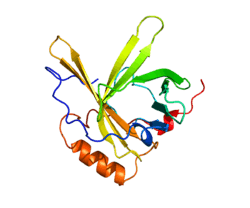
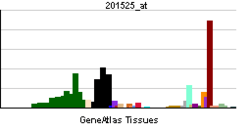
| View/Edit Human | View/Edit Mouse |
Apolipoprotein D is a protein that in humans is encoded by the APOD gene.[3][4][5] Unlike other lipoproteins, which are mainly produced in the liver, apolipoprotein D is mainly produced in the brain and testes.[6]
Function
Apolipoprotein D (Apo-D) is a component of high-density lipoprotein that has no marked similarity to other apolipoprotein sequences. It has a high degree of homology to plasma retinol-binding protein and other members of the alpha 2 microglobulin protein superfamily of carrier proteins, also known as lipocalins. It is a glycoprotein of estimated molecular weight 33 KDa. Apo-D is closely associated with the enzyme lecithin:cholesterol acyltransferase - an enzyme involved in lipoprotein metabolism.[5] ApoD has also been shown to be an important link in the transient interaction between HDL and LDL particles and between HDL particles and cells.[7]
Clinical significance
APOD is a biomarker of androgen insensitivity syndrome (AIS). APOD is an androgen up-regulated gene in normal scrotal fibroblast cells in comparison to CAIS labia majora cells.[8]
APOD is associated with neurological disorders and nerve injury, especially related to myelin sheath. APOD was shown to be elevated in a rat model of stroke.[6] APOD is elevated in patients with schizophrenia, bipolar disorder, and Alzheimer's disease.[6]
References
- ↑ "Human PubMed Reference:".
- ↑ "Mouse PubMed Reference:".
- ↑ Drayna DT, McLean JW, Wion KL, Trent JM, Drabkin HA, Lawn RM (Aug 1987). "Human apolipoprotein D gene: gene sequence, chromosome localization, and homology to the alpha 2u-globulin superfamily". DNA. 6 (3): 199–204. doi:10.1089/dna.1987.6.199. PMID 2439269.
- ↑ Drayna D, Fielding C, McLean J, Baer B, Castro G, Chen E, Comstock L, Henzel W, Kohr W, Rhee L, et al. (Jan 1987). "Cloning and expression of human apolipoprotein D cDNA". J Biol Chem. 261 (35): 16535–9. PMID 3453108.
- 1 2 "Entrez Gene: APOD apolipoprotein D".
- 1 2 3 Muffat J, Walker DW (2010). "Apolipoprotein D: an overview of its role in aging and age-related diseases". Cell Cycle (journal). 9 (2): 269–273. doi:10.4161/cc.9.2.10433. PMC 3691099
 . PMID 20023409.
 - ↑ Braesch-Andersen S; et al. (December 2014). "ApoD Mediates Binding of HDL to LDL and to Growing T24 Carcinoma". PLOS ONE. 9 (12): e115180. doi:10.1371/journal.pone.0115180. PMID 25513803.
- ↑ Appari M, Werner R, Wünsch L, Cario G, Demeter J, Hiort O, Riepe F, Brooks JD, Holterhus PM (June 2009). "Apolipoprotein D (APOD) is a putative biomarker of androgen receptor function in androgen insensitivity syndrome". J. Mol. Med. 87 (6): 623–32. doi:10.1007/s00109-009-0462-3. PMID 19330472.
Further reading
- Rassart E, Bedirian A, Do Carmo S, et al. (2000). "Apolipoprotein D". Biochim. Biophys. Acta. 1482 (1–2): 185–98. doi:10.1016/S0167-4838(00)00162-X. PMID 11058760.
- Peitsch MC, Boguski MS (1991). "Is apolipoprotein D a mammalian bilin-binding protein?". New Biol. 2 (2): 197–206. PMID 2083249.
- Balbín M, Freije JM, Fueyo A, et al. (1990). "Apolipoprotein D is the major protein component in cyst fluid from women with human breast gross cystic disease". Biochem. J. 271 (3): 803–7. PMC 1149635. PMID 2244881.
- Drayna D, Scott JD, Lawn R (1988). "Multiple RFLPs at the human apolipoprotein D (APOD) locus". Nucleic Acids Res. 15 (22): 9617. doi:10.1093/nar/15.22.9617. PMC 306509. PMID 2891117.
- Fielding PE, Fielding CJ (1980). "A cholesteryl ester transfer complex in human plasma". Proc. Natl. Acad. Sci. U.S.A. 77 (6): 3327–30. doi:10.1073/pnas.77.6.3327. PMC 349608. PMID 6774335.
- Schindler PA, Settineri CA, Collet X, et al. (1995). "Site-specific detection and structural characterization of the glycosylation of human plasma proteins lecithin:cholesterol acyltransferase and apolipoprotein D using HPLC/electrospray mass spectrometry and sequential glycosidase digestion". Protein Sci. 4 (4): 791–803. doi:10.1002/pro.5560040419. PMC 2143102. PMID 7613477.
- Yang CY, Gu ZW, Blanco-Vaca F, et al. (1994). "Structure of human apolipoprotein D: locations of the intermolecular and intramolecular disulfide links". Biochemistry. 33 (41): 12451–5. doi:10.1021/bi00207a011. PMID 7918467.
- Holzfeind P, Merschak P, Dieplinger H, Redl B (1996). "The human lacrimal gland synthesizes apolipoprotein D mRNA in addition to tear prealbumin mRNA, both species encoding members of the lipocalin superfamily". Exp. Eye Res. 61 (4): 495–500. doi:10.1016/S0014-4835(05)80145-9. PMID 8549691.
- Zeng C, Spielman AI, Vowels BR, et al. (1996). "A human axillary odorant is carried by apolipoprotein D". Proc. Natl. Acad. Sci. U.S.A. 93 (13): 6626–30. doi:10.1073/pnas.93.13.6626. PMC 39076. PMID 8692868.
- Cargill M, Altshuler D, Ireland J, et al. (1999). "Characterization of single-nucleotide polymorphisms in coding regions of human genes". Nat. Genet. 22 (3): 231–8. doi:10.1038/10290. PMID 10391209.
- Liu Z, Chang GQ, Leibowitz SF (2001). "Apolipoprotein D interacts with the long-form leptin receptor: a hypothalamic function in the control of energy homeostasis". FASEB J. 15 (7): 1329–31. doi:10.1096/fj.00-0530fje. PMID 11344130.
- Sánchez D, Ganfornina MD, Martínez S (2002). "Expression pattern of the lipocalin apolipoprotein D during mouse embryogenesis". Mech. Dev. 110 (1–2): 225–9. doi:10.1016/S0925-4773(01)00578-0. PMID 11744388.
- Mahadik SP, Khan MM, Evans DR, Parikh VV (2002). "Elevated plasma level of apolipoprotein D in schizophrenia and its treatment and outcome". Schizophrenia Research. 58 (1): 55–62. doi:10.1016/S0920-9964(01)00378-4. PMID 12363390.
- Strausberg RL, Feingold EA, Grouse LH, et al. (2003). "Generation and initial analysis of more than 15,000 full-length human and mouse cDNA sequences". Proc. Natl. Acad. Sci. U.S.A. 99 (26): 16899–903. doi:10.1073/pnas.242603899. PMC 139241. PMID 12477932.
- Desai PP, Hendrie HC, Evans RM, et al. (2003). "Genetic variation in apolipoprotein D affects the risk of Alzheimer disease in African-Americans". Am. J. Med. Genet. B Neuropsychiatr. Genet. 116 (1): 98–101. doi:10.1002/ajmg.b.10798. PMID 12497622.
- Kang MK, Kameta A, Shin KH, et al. (2003). "Senescence-associated genes in normal human oral keratinocytes". Exp. Cell Res. 287 (2): 272–81. doi:10.1016/S0014-4827(03)00061-2. PMID 12837283.
- Thomas EA, Laws SM, Sutcliffe JG, et al. (2003). "Apolipoprotein D levels are elevated in prefrontal cortex of subjects with Alzheimer's disease: no relation to apolipoprotein E expression or genotype". Biol. Psychiatry. 54 (2): 136–41. doi:10.1016/S0006-3223(02)01976-5. PMID 12873803.
External links
- Apolipoproteins D at the US National Library of Medicine Medical Subject Headings (MeSH)
- Applied Research on Apolipoproteins