Berbalang
| Berbalang | |
|---|---|
 | |
| Characteristics | |
| Alignment | Chaotic evil |
| Type | Monstrous humanoid |
In the Dungeons & Dragons fantasy role-playing game, the berbalang (/ˈbɜːrbəlæŋ/ BUR-bə-lang)[1] is a monstrous humanoid.
Publication history
The berbalang was first published in White Dwarf #11 (February/March 1979), in the "Fiend Factory" column, originally submitted by Albie Fiore. The berbalang also appeared in Albie Fiore's scenario "The Halls of Tizun Thane" in White Dwarf #18 (April/May 1980),[2] which was later reprinted in Best of White Dwarf Scenarios (1980). The berbalang then appears in 1981 in the first edition Fiend Folio (1981).[3] In the second edition of AD&D, the berbalang appears in the first Monstrous Compendium Forgotten Realms Appendix (1989),[4] and is reprinted in the Monstrous Manual (1993).[5] A Guide to the Astral Plane (1996) describes Berbalang society for the Planescape setting. The berbalang also appears in the Monster Manual for the fourth edition (2008).[6]
Description
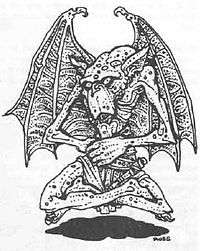
The berbalang is a bipedal gargoyle-like creature with leathery skin and bat-like wings. It spends most of its life in a state of hibernation while its spirit astral travels. For a few days each month, it sends a projection out into the world to kill and feed.
Other publishers
The berbalang appeared in Paizo Publishing's book Pathfinder Roleplaying Game Bestiary 3 (2011), on page 40.[7]
References
- ↑ Mentzer, Frank. "Ay pronunseeAY shun gyd" Dragon #93 (TSR, 1985)
- ↑ Fiore, Albie (April–May 1980). "The Halls of Tizun Thane". White Dwarf. Games Workshop (18): 14–19.
- ↑ Turnbull, Don, ed. Fiend Folio (TSR, 1981)
- ↑ Conners, William, et al. Monstrous Compendium Forgotten Realms Appendix (TSR, 1989)
- ↑ Stewart, Doug, ed. Monstrous Manual (TSR, 1993)
- ↑ Mearls, Mike, Stephen Schubert, and James Wyatt. Monster Manual (Wizards of the Coast, 2008)
- ↑ Bulmahn, Jason (lead designer). Pathfinder Roleplaying Game Bestiary 3 (Paizo Publishing, 2011)