Buddleja fallowiana
| Buddleja fallowiana | |
|---|---|
 | |
| Buddleja fallowiana | |
| Scientific classification | |
| Kingdom: | Plantae |
| (unranked): | Angiosperms |
| (unranked): | Eudicots |
| (unranked): | Asterids |
| Order: | Lamiales |
| Family: | Buddlejaceae |
| Genus: | Buddleja |
| Species: | B. fallowiana |
| Binomial name | |
| Buddleja fallowiana Balf. f. & W. W. Sm. | |
| Synonyms | |
| |
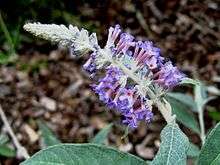
Buddleja fallowiana is a species of flowering plant endemic to the Yunnan province of western China, where it grows in open woodland, along forest edges and watercourses.[1] The plant was collected in China by Forrest in 1906, and named in 1917 by Balfour & Smith for George Fallow, a gardener at the Royal Botanic Garden Edinburgh who had died in Egypt in 1915 from wounds sustained fighting in the Gallipoli Campaign.[2]
Description
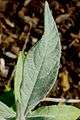
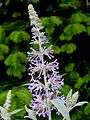
B. fallowiana is a deciduous shrub typically growing to a height of 4 m (13 ft); of loose habit, the young shoots are clothed with a dense white felt. The ovate to narrowly elliptic leaves are 4 – 13 cm long by 1 – 6 cm wide, acuminate or acute at the apex; the upper and lower surfaces densely tomentose, bestowing a silvery grey sheen. The inflorescences are slender thyrsoid, sometimes interrupted, panicles at the ends of the current year's shoots, 5 – 15 cm long by 2 – 3 cm wide, comprising fragrant lavender - blue flowers with orange throats, the corollas 2 – 3.5 mm wide by 9 – 14 mm long with erect lobes. The flowers bloom in late summer and autumn. [3]
Growth is significantly slower than that of B. davidii; Bean considered the species more closely allied to B. nivea,[1] although its chromosome number, 2n = 76 (tetraploid), places it alongside the similarly tetraploid B. davidii. [4]
Cultivation
Somewhat tender, B. fallowiana is best grown against a wall. However, if cut to the ground by frost, it will grow again from the base. Hardiness: USDA zones 8–9.[5]
Varieties
The variety was considered horticulturally superior to B. fallowiana by Bean, who thought it one of the most attractive of all Buddlejas;[1] it was accorded the Royal Horticultural Society's Award of Garden Merit in 1993.[6] However, its varietal status was challenged by Leeuwenberg, who considered its colouration insufficient to justify it as a variety, and sank it as simply B. fallowiana.[3]
Hybrid cultivars
A number of hybrid cultivars have been raised, invariably through a crossing of the species with Buddleja davidii:
- Buddleja 'Ingeborg'
- Buddleja 'Lochinch'
- Buddleja 'Mayford Purple'
- Buddleja 'Vashon Skies'
- Buddleja 'West Hill'
References
- 1 2 3 Bean, W. J. (1917). Trees and shrubs hardy in Great Britain, 7th edition. Murray, London.
- ↑ Sabourin, L. (1929). Le Buddleja fallowiana et sa variété alba. Revue Horticole, pp. 418-420, Vol. 101. 1929.
- 1 2 Leeuwenberg, A. J. M. (1979) The Loganiaceae of Africa XVIII Buddleja L. II, Revision of the African & Asiatic species. H. Veenman & Zonen, Wageningen, Nederland.
- ↑ Chen, G, Sun, W-B, & Sun, H. (2007). Ploidy variation in Buddleja L. (Buddlejaceae) in the Sino - Himalayan region and its biogeographical implications. Botanical Journal of the Linnean Society. 2007, 154, 305 – 312. The Linnean Society of London.
- ↑ Stuart, D. D. (2006). Buddlejas. RHS Plant Guide. Timber Press, Oregon. ISBN 978-0-88192-688-0
- ↑ "RHS Plant Selector - Buddleja fallowiana var. alba". Retrieved 13 June 2013.
- Li, P. T. & Leeuwenberg, A. J. M. (1996). Loganiaceae, in Wu, Z. & Raven, P. (eds) Flora of China, Vol. 15. Science Press, Beijing, and Missouri Botanical Garden Press, St. Louis, USA. ISBN 978-0915279371 online at www.efloras.org