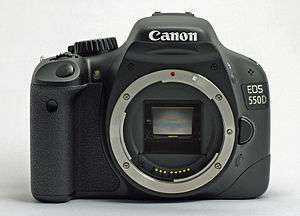
Canon EOS 550D
 | |
| Type | Digital single-lens reflex |
|---|---|
| Lens | Canon EF lens mount, Canon EF-S lens mount |
| Sensor | CMOS APS-C 22.3 × 14.9 mm (1.6x conversion factor) |
| Maximum resolution | 5,184 × 3,456 pixels (18.0 megapixels) |
| Flash | E-TTL II automatic built-in pop-up |
| Shutter | focal-plane |
| Shutter speed range | 1/4000 to 30 sec and bulb, 1/200 s X-sync |
| ASA/ISO range | ISO 100 to 6400 (expandable to 12800 with Canon Firmware, expandable to 24000 with Magic Lantern firmware) |
| Exposure metering | Full aperture TTL, 63-zone SPC |
| Exposure modes | Full Auto, Portrait, Landscape, Close-up, Sports, Night Portrait, No Flash, Program AE, Shutter-priority, Aperture-priority, Manual, Auto Depth-of-field, Movie |
| Metering modes | Evaluative, Spot (4% at center), Partial (9% at center), Center-weighted average |
| Focus areas | 9 AF points, f/5.6 cross-type center (extra sensitivity at f/2.8) |
| Focus modes | AI Focus, One-Shot, AI Servo, Live View |
| Continuous shooting | 3.7 frame/s for 34 JPEG or 6 raw frames |
| Viewfinder | Eye-level pentamirror SLR, 95% coverage, 0.87× magnification, and electronic (Live View) |
| Flash bracketing | No |
| Custom WB | Auto, Daylight, Shade, Cloudy, Tungsten, Fluorescent, Flash, Custom |
| WB bracketing | ± 3 stops for 3 frames |
| Rear LCD monitor | 3 in 3:2 color TFT LCD, 1,040,000 dots |
| Storage |
Secure Digital Card Secure Digital High Capacity Secure Digital Extended Capacity |
| Battery | LP-E8 Lithium-Ion rechargeable battery |
| Optional battery packs | BG-E8 grip |
| Dimensions | 129 mm × 98 mm × 62 mm |
| Weight | 530 g (19 oz) (including battery and card) |
| Made in | Japan |
The Canon EOS 550D is an 18.0 megapixel digital single-lens reflex camera, announced by Canon on the February 8, 2010.[1] It was available since 24 February 2010[2] and to US dealers from early March.[3] It is known as the EOS Kiss X4 in Japan, and as the EOS Rebel T2i in the Americas.[4] It is part of Canon's entry/mid-level digital SLR camera series, and was the successor model to the EOS 500D. It was succeeded by the EOS 600D (Kiss X5/Rebel T3i), but remained in Canon's lineup until being discontinued in June 2012 with the announcement of the EOS 650D (Kiss X6i/Rebel T4i).[5]
Features
- 18.0 effective megapixel CMOS sensor
- 1080p HD video recording at 24p (23.976 fps), 25p (25 fps), and 30p (29.97 fps) with drop frame timing
- 720p HD video recording at 50p (50 Hz) and 60p (59.94 Hz)[6]
- 480p ED video recording at 50p (50 Hz) and 60p (59.94 Hz)
- 3.5mm microphone jack for external microphones or recorders.
- PAL/NTSC video output
- DIGIC 4 image processor
- 14-bit analog to digital signal conversion
- 3.0-inch (76 mm) 3:2 aspect ratio LCD monitor
- Live view mode
- Built-in flash
- Wide, selectable, nine-point AF with centre cross-type sensor extra sensitive at f/2.8
- Four metering modes, using 63-zones: spot, partial, center-weighted average, and evaluative metering.
- Highlight tone priority
- EOS integrated cleaning system
- Internal monaural microphone
- sRGB and Adobe RGB colour spaces
- ISO 100–6,400 expandable to 12,800
- Continuous drive up to 3.7 frame/s (34 images (JPEG), 6 images (raw))
- SD, SDHC, and SDXC memory card file storage
- Raw and large JPEG simultaneous recording
- USB 2.0, HDMI control (CEC)
- LP-E8 battery
- Approximate weight 0.53 kg (1.2 lb) with battery and card
Bundled software
The 550D comes with following image processing and camera operating software: ZoomBrowser EX / ImageBrowser Image Processing, Digital Photo Professional, PhotoStitch, EOS Utility and Picture Style Editor.[7]

Optional accessories

The Canon 550D has available accessories such as:[8]
- All EF and EF-S Lenses
- Macro Ring Lite MR-14EX
- Macro twin lite MT-24EX
- E-series Dioptic Adjustment Lenses
- Angle Finder C
- Semi hard case EH19L
- Interface Cable IFC-200U/500U
- Original Data Security Kit OSK-E3
- Canon EX-series Speedlites & ST-E2
- AC Adapter Kit (AC Adapter CA-PS700 & DC Coupler – DR-E8)
- Battery grip BG-E8
- Battery Magazine BGME8A/L
- Eyepiece Extender EPEX15II
- HDMI Cable HTC-100
- Remote Switch RS-60E3
- Wireless Remote Controller RC-6
Firmware updates
In July 2010 Canon released firmware 1.0.8 that fixes a phenomenon in which the set aperture moves unexpectedly when shooting movies in manual exposure mode using some Canon lenses (such as macro lenses).[9] 25 December 2010[10] Canon offered firmware version 1.0.9 which should fix tone jumps in some images, depending on the shooting scene and when shooting with the Auto Lighting Optimizer settings (low/standard/strong).[11]
Custom firmware
Magic Lantern is an open source (GPL) firmware add-on for Canon DSLR cameras, which has enhancements for video and still photography without replacing the stock firmware.[12]
Reception
The British Journal of Photography was impressed by the 550D and said "the EOS 550D is a good match for the 7D at half the price".[13] On Digital Photography Review it got overall score of 77%.[14] For most of its product life, alternative cameras included the Nikon D5000, Nikon D3100, Canon 500D,[15] Nikon D90,[16] and Pentax K-7. Immediately before it was discontinued in 2012, the main competitors of the 550D were the Nikon D3200 and D5100 (respectively the replacements for the D3100 and D5000), Pentax K-r (replacement for the K-x), and the Sony Alpha 57, one of the company's SLT cameras. (The replacement for the Nikon D90, the D7000, is positioned upmarket from the 550D.)
See also
References
- ↑ Marc Chacksfield (2010). "Canon EOS 550D officially announced". techradar.com. Retrieved 6 January 2011.
- ↑ "18MP, 1080p HD Movies, ISO 6400: Canon redefines the boundaries of the consumer DSLR with the EOS 550D". 8 February 2010. Retrieved 8 February 2010.
- ↑ "The new Canon Rebel T2i digital SLR takes aspiring photographers beyond the still with advanced video features". 8 February 2010. Retrieved 8 February 2010.
- ↑ "Canon Rebel T2I/Canon EOS Kiss Digital X4/Canon EOS 550D". techgenie.com. 2010. Retrieved 6 January 2011.
- ↑ Westlake, Andy (2012-06-08). "Canon EOS 650D (Rebel T4i) Hands-on Preview". Digital Photography Review. Retrieved 2012-06-08.
- ↑ "Canon Rebel T2i / EOS 550D Compared to Nikon D90 Side by Side". digitalreview.ca. Archived from the original on 2011-12-04. Retrieved 15 December 2011.
- ↑ "canoneos550d (Rebel T2i) specifications". dpreview.com. Retrieved 6 January 2011.
- ↑ "EOS 550D" (PDF). canon.com.au. 2010. Retrieved 20 November 2011.
- ↑ "EOS-1D Mark IV and 550D firmware updates". cpn.canon-europe.com. Retrieved 2 January 2011.
- ↑ "EOS Digital". canon.com. Retrieved 2 January 2011.
- ↑ "Canon EOS 550D Firmware 1.0.9". photographyblog.com. Retrieved 6 January 2011.
- ↑ "Magic Lantern Firmware Wiki". Magiclantern.wikia.com. Retrieved 24 August 2011.
- ↑ David Kilpatrick (2010). "Canon 550D impresses". bjp-online.com. British Journal of Photography. Archived from the original on 2012-03-14. Retrieved 6 January 2011.
- ↑ "Canon EOS 550D / Rebel T2i". Digital Photography Review. Retrieved 6 January 2011.
- ↑ "Compared to...". dpreview.com. Retrieved 6 January 2011.
- ↑ "CANON EOS T2i/550D Review – Shoot to Kill?". digital-photography-school.com. Retrieved 6 January 2011.
External links
-
 Media related to Canon EOS 550D at Wikimedia Commons
 - Product Page
| Canon EOS digital camera timeline, 2010-present (comparison) | ||||||||||||||||||||||||||||||||||||||||||||||||||||||||||||||||||||||||||||||||||||||||||||||||||||||||||||||||||||||||||||||||||||||||||||||||||||||||||||||||||||||||||||||||||||||||||||||||||||||||||||||||||||||||||||||||||||||||||||||||||||||||||||||||||||||||||||||||||||||||||||||||||||||||||||||||||||||||||||||||||||||||||||||||||||||||||||||||||||||||||||||||||||||||||||||||||||||||||||||||||||||||||||||||||||||||||||||||||||||||||||||||||||||||||||||||||||||||||||||||||||||||
|---|---|---|---|---|---|---|---|---|---|---|---|---|---|---|---|---|---|---|---|---|---|---|---|---|---|---|---|---|---|---|---|---|---|---|---|---|---|---|---|---|---|---|---|---|---|---|---|---|---|---|---|---|---|---|---|---|---|---|---|---|---|---|---|---|---|---|---|---|---|---|---|---|---|---|---|---|---|---|---|---|---|---|---|---|---|---|---|---|---|---|---|---|---|---|---|---|---|---|---|---|---|---|---|---|---|---|---|---|---|---|---|---|---|---|---|---|---|---|---|---|---|---|---|---|---|---|---|---|---|---|---|---|---|---|---|---|---|---|---|---|---|---|---|---|---|---|---|---|---|---|---|---|---|---|---|---|---|---|---|---|---|---|---|---|---|---|---|---|---|---|---|---|---|---|---|---|---|---|---|---|---|---|---|---|---|---|---|---|---|---|---|---|---|---|---|---|---|---|---|---|---|---|---|---|---|---|---|---|---|---|---|---|---|---|---|---|---|---|---|---|---|---|---|---|---|---|---|---|---|---|---|---|---|---|---|---|---|---|---|---|---|---|---|---|---|---|---|---|---|---|---|---|---|---|---|---|---|---|---|---|---|---|---|---|---|---|---|---|---|---|---|---|---|---|---|---|---|---|---|---|---|---|---|---|---|---|---|---|---|---|---|---|---|---|---|---|---|---|---|---|---|---|---|---|---|---|---|---|---|---|---|---|---|---|---|---|---|---|---|---|---|---|---|---|---|---|---|---|---|---|---|---|---|---|---|---|---|---|---|---|---|---|---|---|---|---|---|---|---|---|---|---|---|---|---|---|---|---|---|---|---|---|---|---|---|---|---|---|---|---|---|---|---|---|---|---|---|---|---|---|---|---|---|---|---|---|---|---|---|---|---|---|---|---|---|---|---|---|---|---|---|---|---|---|---|---|---|---|---|---|---|---|---|---|---|---|---|---|---|---|---|---|---|---|---|---|---|---|---|---|---|---|---|---|---|---|---|---|---|---|---|---|---|---|---|---|---|---|---|---|---|---|---|---|---|---|---|---|---|---|---|---|---|---|---|---|---|---|---|---|---|---|---|---|---|---|---|---|---|---|---|---|---|---|---|---|---|---|
†The 1D series originally used an APS-H sensor, not a true full-frame sensor.
| ||||||||||||||||||||||||||||||||||||||||||||||||||||||||||||||||||||||||||||||||||||||||||||||||||||||||||||||||||||||||||||||||||||||||||||||||||||||||||||||||||||||||||||||||||||||||||||||||||||||||||||||||||||||||||||||||||||||||||||||||||||||||||||||||||||||||||||||||||||||||||||||||||||||||||||||||||||||||||||||||||||||||||||||||||||||||||||||||||||||||||||||||||||||||||||||||||||||||||||||||||||||||||||||||||||||||||||||||||||||||||||||||||||||||||||||||||||||||||||||||||||||||
| Canon EOS digital camera timeline, pre-2010 (comparison) | ||||||||||||||||||||||||||||||||||||||||||||||||||||||||||||||||||||||||||||||||||||||||||||||||||||||||||||||||||||||||||||||||||||||||||||||||||||||||||||||||||||||||||||||||||||||||||||||||||||||||||||||||||||||||||||||||||||||||||||||||||||||||||||||||||||||||||||||||||||||||||||||||||||||||||||||||||||||||||||||||||||||||||||||||||||||||||||||||||||||||||||||||||||||||||||||||||||||||||||||||||||||||
|---|---|---|---|---|---|---|---|---|---|---|---|---|---|---|---|---|---|---|---|---|---|---|---|---|---|---|---|---|---|---|---|---|---|---|---|---|---|---|---|---|---|---|---|---|---|---|---|---|---|---|---|---|---|---|---|---|---|---|---|---|---|---|---|---|---|---|---|---|---|---|---|---|---|---|---|---|---|---|---|---|---|---|---|---|---|---|---|---|---|---|---|---|---|---|---|---|---|---|---|---|---|---|---|---|---|---|---|---|---|---|---|---|---|---|---|---|---|---|---|---|---|---|---|---|---|---|---|---|---|---|---|---|---|---|---|---|---|---|---|---|---|---|---|---|---|---|---|---|---|---|---|---|---|---|---|---|---|---|---|---|---|---|---|---|---|---|---|---|---|---|---|---|---|---|---|---|---|---|---|---|---|---|---|---|---|---|---|---|---|---|---|---|---|---|---|---|---|---|---|---|---|---|---|---|---|---|---|---|---|---|---|---|---|---|---|---|---|---|---|---|---|---|---|---|---|---|---|---|---|---|---|---|---|---|---|---|---|---|---|---|---|---|---|---|---|---|---|---|---|---|---|---|---|---|---|---|---|---|---|---|---|---|---|---|---|---|---|---|---|---|---|---|---|---|---|---|---|---|---|---|---|---|---|---|---|---|---|---|---|---|---|---|---|---|---|---|---|---|---|---|---|---|---|---|---|---|---|---|---|---|---|---|---|---|---|---|---|---|---|---|---|---|---|---|---|---|---|---|---|---|---|---|---|---|---|---|---|---|---|---|---|---|---|---|---|---|---|---|---|---|---|---|---|---|---|---|---|---|---|---|---|---|---|---|---|---|---|---|---|---|---|---|---|---|---|---|---|---|---|---|---|---|---|---|---|---|---|---|---|---|---|---|---|---|---|---|---|---|---|---|---|---|---|---|---|---|---|---|
†The 1D series originally used an APS-H sensor, not a true full-frame sensor.
| ||||||||||||||||||||||||||||||||||||||||||||||||||||||||||||||||||||||||||||||||||||||||||||||||||||||||||||||||||||||||||||||||||||||||||||||||||||||||||||||||||||||||||||||||||||||||||||||||||||||||||||||||||||||||||||||||||||||||||||||||||||||||||||||||||||||||||||||||||||||||||||||||||||||||||||||||||||||||||||||||||||||||||||||||||||||||||||||||||||||||||||||||||||||||||||||||||||||||||||||||||||||||