Cartouche
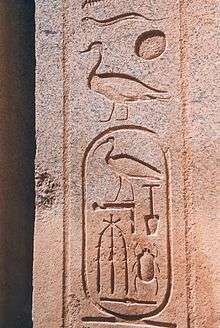
In Egyptian hieroglyphs, a cartouche /kɑːrˈtuːʃ/[1] is an oval with a horizontal line at one end, indicating that the text enclosed is a royal name,[1][2] coming into use during the beginning of the Fourth Dynasty under Pharaoh Sneferu. While the cartouche is usually vertical with a horizontal line, it is sometimes horizontal if it makes the name fit better, with a vertical line on the left.[3] The Ancient Egyptian word for it was shenu, and it was essentially an expanded shen ring. In Demotic, the cartouche was reduced to a pair of brackets and a vertical line.
Of the five royal titularies it was the prenomen, the throne name, and the "Son of Ra" titulary,[4] the so-called nomen name given at birth, which were enclosed by a cartouche.[5]
At times amulets were given the form of a cartouche displaying the name of a king and placed in tombs. Such items are often important to archaeologists for dating the tomb and its contents.[6] Cartouches were formerly only worn by Pharaohs. The oval surrounding their name was meant to protect them from evil spirits in life and after death. The cartouche has become a symbol representing good luck and protection from evil.[7] Egyptians believed that one who had their name recorded somewhere would not disappear after death. A cartouche attached to a coffin satisfied this requirement.[8] There were periods in Egyptian history when people refrained from inscribing these amulets with a name, for fear they might fall into somebody's hands conferring power over the bearer of the name.[9]
Etymology
| ||
| Cartouche in hieroglyphs |
|---|

The term cartouche was first applied by soldiers who fancied that the symbol they saw so frequently repeated on the pharaonic ruins they encountered resembled a muzzle-loading firearm's paper powder cartridge (cartouche in French).[10]
Hieroglyph use of cartouche
In the Rosetta Stone, the cartouche hieroglyph is used for the word "name", Egyptian rn.[11] For the cartouche cut in half, the "half-cartouche hieroglyph", Gardiner's sign listed no. V11, (the cartouche hieroglyph is V10), is used in the Egyptian language for words meaning: "to cut, to divide, to separate". It was the use of cartouches on the Rosetta Stone that was the biggest clue allowing Jean-François Champollion to decipher hieroglyphics.
See also
 |
Wikimedia Commons has media related to Cartouches. |
- Cartouche (hieroglyph)
- Serekh, a predecessor to the cartouche
- Shen ring
References
- General
- Budge. The Rosetta Stone, E. A. Wallis Budge, (Dover Publications), c. 1929, Dover edition(unabridged), 1989. (softcover, ISBN 0-486-26163-8)
- Specific
- 1 2 The New Oxford Dictionary of English (1998) ISBN 0-19-861263-X - p.281 "cartouche /kɑː'tuːʃ/ noun a carved tablet or drawing...Arcaeology an oval or oblong enclosing a group of Egyptian hieroglyphs, typically representing the name and title of a monarch.".
- ↑
 Chisholm, Hugh, ed. (1911). "Cartouche". Encyclopædia Britannica (11th ed.). Cambridge University Press.
 - ↑ "Ancient Egyptian Cartouche Lesson". Artyfactory.org. Retrieved 2013-08-22.
- ↑ Ancient-egypt.org
- ↑ Allen, James Peter, Middle Egyptian: An Introduction to the Language and Culture of Hieroglyphs, Cambridge University Press 2000, p.65
- ↑ cf. Thomas Eric Peet, William Leonard Stevenson Loat, The Cemeteries of Abydos. Part 3. 1912–1913, Adamant Media Corporation, ISBN 1-4021-5715-0, p.23
- ↑ "2. Ancient Egyptian Cartouche". Dcsd.org. Retrieved 2013-08-22.
- ↑ "Cartouche - Ancient Egypt for Kids". Egypt.mrdonn.org. Retrieved 2013-08-22.
- ↑ Alfred Wiedemann, Religion of the Ancient Egyptians, Adamant Media Corporation 2001, ISBN 1-4021-9366-1, pp.293-295
- ↑ White, Jon Manchip, Everyday Life in Ancient Egypt, Courier Dover 2002, p.175
- ↑ Budge, 1929, 1989. The Rosetta Stone, p. 124-169.
External links
- "Cartouches" (PDF) (in Arabic). Egypt State Information Service. Archived from the original (PDF, 8.87 MB) on June 15, 2011. Retrieved 13 July 2010.