Cytisus multiflorus
| Cytisus multiflorus | |
|---|---|
 | |
| Scientific classification | |
| Kingdom: | Plantae |
| (unranked): | Angiosperms |
| (unranked): | Eudicots |
| (unranked): | Rosids |
| Order: | Fabales |
| Family: | Fabaceae |
| Genus: | Cytisus |
| Species: | C. multiflorus |
| Binomial name | |
| Cytisus multiflorus (L'Hér.) Sweet | |
| Synonyms[1] | |
|
List
| |
Cytisus multiflorus is a species of legume known by the common names white broom[2] and white spanishbroom.[3]
Distribution
It is native to the Iberian Peninsula. It is better known as an introduced species on other continents, including Australia and North America, where it has become a weed in agricultural land and an invasive species in natural habitats.
Description
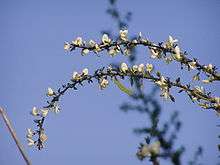
Cytisus multiflorus is a shrub growing up to 3 metres (9.8 ft) or 4 metres (13 ft) in sprawling height, with a broomlike array of many five-angled flexible branches. Leaves appear mainly on lower branches, each made up of three leaflets. Some leaves grow on the upper branches; these are generally made up of a single leaflet. Each leaflet is under a centimeter long and may be linear to oblong in shape and coated in soft silvery hairs.
The white, pea-like flower is up to a centimeter long and is often marked with a dark pinkish streak near the base. The fruit is a hairy legume pod up to 3 centimetres (1.2 in) long. The pods turn black with age and dehisce explosively to release their four to six seeds away from the parent plant.
Invasive species
This plant is a serious noxious weed of agricultural fields and a colonizing invasive plant in wild lands in parts of Australia and California,[4] where it was first introduced as an ornamental shrub for its prolific white flowers. It is still sometimes grown and sold for landscaping purposes despite its status as a pest plant, with new industry and public education programs resulting.[5][6]
References
- ↑ "The Plant List: A Working List of All Plant Species". Retrieved April 3, 2014.
- ↑ "BSBI List 2007". Botanical Society of Britain and Ireland. Archived from the original (xls) on 2015-02-25. Retrieved 2014-10-17.
- ↑ "Cytisus multiflorues". Natural Resources Conservation Service PLANTS Database. USDA. Retrieved 17 January 2016.
- ↑ Jepson
- ↑ "Weeds in Australia" (PDF). Australian Weed Management. Retrieved November 24, 2010.
- ↑ "What are invasive species and why are they a problem?". Calif. Invasive Species Program. Retrieved November 24, 2010.
External links
 |
Wikimedia Commons has media related to Cytisus multiflorus. |
- Jepson Manual Treatment - Cytisus multiflorus (introduced species)
- GRIN Species Profile
- Cal-IPC: California Invasive Plant Council - homepage
- Cytisus multiflorus - Photo gallery