Denmark–Italy relations
 |
|
 Denmark |
 Italy |
|---|---|
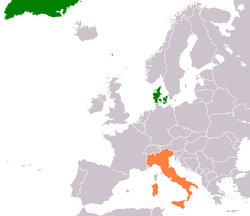
Denmark–Italy relations refers to the bilateral relationship between Denmark and Italy. Denmark has an embassy in Rome, and Italy has an embassy in Copenhagen.[1][2] Both countries are members of EU and NATO.
History
The first treaty between Denmark and Italy, was signed on 19 July 1873.[3] On 21 May 1885, an agreement on reciprocal relief was signed.[4]
Trade
In 1951, Denmark and Italy had a large surplus in trading balance. Italian imports, amounted 130 million DKK. Italian exports amounted 203 million.[5] In 2008, Danish exports to Italy, amounted 17,3 billion DKK, and Italian exports amounted 20,7 billion DKK.[6]
Cultural relations
Denmark and Italy signed a cultural agreement in 1956. The association Società Dante Alighieri has two committees in Denmark. There are Italian language studies at three Danish universities.[7]
Visits
Alfredo Mantica visited Denmark in October 2009; this was the first time that an Italian politician visited Denmark, and also the first bilateral discussion between Italy and Denmark that are not discussed in Brussels, Belgium.[8]
References
- ↑ "Danish Embassy in Rome". Ministry of Foreign Affairs of Denmark. Retrieved July 13, 2010. (Danish) (Italian)
- ↑ "Italian Embassy in Copenhagen". Ministry of Foreign Affairs of Italy. Retrieved July 13, 2010.
- ↑ The Consolidated treaty series 146
- ↑ Treaty series; publication of treaties and international engagements registered with the Secretariat of the League 147–148
- ↑ Denmark: economic and commercial conditions in Denmark. University of Minnesota. Great Britain. Commercial Relations and Exports Dept, Great Britain. Dept. of Overseas Trade. 1952. Retrieved January 29, 2011.
- ↑ Danish Foreign Affairs: Italy (Danish)
- ↑ "Cultural relations" (Italian)
- ↑ "First Italian bilateral visit to Denmark for eight years". The Copenhagen Post. October 13, 2009. Retrieved July 13, 2010.
| Africa |  | |
|---|---|---|
| Americas | ||
| Asia | ||
| Europe |
| |
| Oceania | ||
| Historical | ||
| Organisations | ||
| Missions | ||
| Africa |  | ||||||
|---|---|---|---|---|---|---|---|
| Americas | |||||||
| Asia |
| ||||||
| Europe | |||||||
| Oceania | |||||||
| Related topics | |||||||