Dirichlet's test
| Part of a series of articles about | ||||||
| Calculus | ||||||
|---|---|---|---|---|---|---|
|
||||||
|
Specialized |
||||||
In mathematics, Dirichlet's test is a method of testing for the convergence of a series. It is named after its author Peter Gustav Lejeune Dirichlet, and was published posthumously in the Journal de Mathématiques Pures et Appliquées in 1862.[1]
Statement
The test states that if is a sequence of real numbers and a sequence of complex numbers satisfying


- for every positive integer N
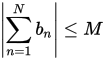
where M is some constant, then the series

converges.
Proof
Let and .
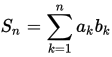

From summation by parts, we have that .
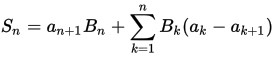
Since is bounded by M and , the first of these terms approaches zero, as n→∞.


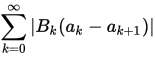
On the other hand, since the sequence is decreasing, is positive for all k, so . That is, the magnitude of the partial sum of Bn, times a factor, is less than the upper bound of the partial sum Bn (a value M) times that same factor.



But , which is a telescoping series that equals and therefore approaches as n→∞. Thus, converges.

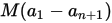

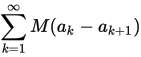
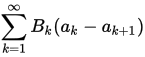
In turn, converges as well by the Direct comparison test. The series converges, as well, by the absolute convergence test. Hence converges.

Applications
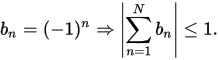
A particular case of Dirichlet's test is the more commonly used alternating series test for the case
Another corollary is that converges whenever is a decreasing sequence that tends to zero.

Improper integrals
An analogous statement for convergence of improper integrals is proven using integration by parts. If the integral of a function f is uniformly bounded over all intervals, and g is a monotonically decreasing non-negative function, then the integral of fg is a convergent improper integral.
Notes
- ↑ Démonstration d’un théorème d’Abel. Journal de mathématiques pures et appliquées 2nd series, tome 7 (1862), p. 253-255.
References
- Hardy, G. H., A Course of Pure Mathematics, Ninth edition, Cambridge University Press, 1946. (pp. 379–380).
- Voxman, William L., Advanced Calculus: An Introduction to Modern Analysis, Marcel Dekker, Inc., New York, 1981. (§8.B.13-15) ISBN 0-8247-6949-X.