Dōjō-ji
| Dōjō-ji 道成寺 | |
|---|---|
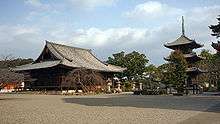 Hondō (1357) and Three-storey pagoda (1763) | |
| Basic information | |
| Location | 1738 Kanemaki, Hidakagawa, Wakayama Prefecture |
| Affiliation | Tendai |
| Deity | Senjū Kannon |
| Country | Japan |
| Website | http://www.dojoji.com/ |
| Architectural description | |
| Completed | 701 |
Dōjō-ji (道成寺) is a Tendai school Buddhist temple in Hidakagawa, Wakayama Prefecture, Japan. Founded in 701, it has given name to a number of plays, the statues of Senjū Kannon, Nikkō Bosatsu, and Gakkō Bosatsu are National Treasures, and there are a number of other Important Cultural Properties.[1][2]
Buildings
- Hondō (1357); 7x5 bay, single-storey, irimoya-zukuri, tiled roof; (Important Cultural Property)[3]
- Niōmon (1694); 3 bay, single-door rōmon, irimoya-zukuri, tiled roof; (Important Cultural Property)[4]
- Three-storey pagoda (1763) (Prefecturally-designated Cultural Property)[5]
- Shoin (1702) (Prefecturally-designated Cultural Property)[5]
Treasures
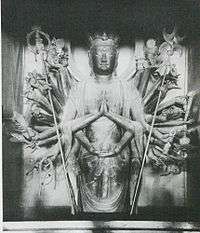
- Wooden statue of Senjū Kannon (木造千手観音立像) (Heian period) (National Treasure)[6]
- Wooden statues of Nikkō Bosatsu and Gakkō Bosatsu (木造菩薩立像 (伝日光・月光菩薩)) (Heian period) (National Treasures)[7]
- Wooden statue of Senjū Kannon (木造千手観音立像) (Nara period) (Important Cultural Property)[8]
- Wooden-core lacquer statue of Senjū Kannon (木心乾漆千手観音立像) (Nara period) (Important Cultural Property)[9]
- Wooden statue of Jūichimen Kannon (木造十一面観音立像) (Heian period) (Important Cultural Property)[10]
- Wooden statue of Bishamonten (木造毘沙門天立像) (Heian period) (Important Cultural Property)[11]
- Wooden statues of the Four Heavenly Kings (木造四天王立像) (Heian period) (Important Cultural Property)[12]
- Wooden statues of the Shaka Nyorai Triad (木造釈迦如来坐像及び両脇侍立像) (Nanboku-chō period) (Prefecturally-designated Cultural Property)[13]
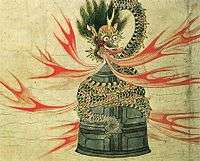
- Dōjō-ji Engi emaki (紙本著色道成寺縁起), two scrolls (Muromachi period) (Important Cultural Property)[14][15]
- Dōtaku (Yayoi period) (Prefecturally-designated Cultural Property)[13]
Anchin and Kiyohime
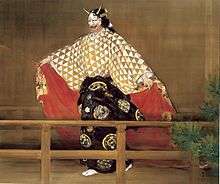
The story of the monk Anchin (安珍) and his spurned lover Kiyohime (清姫) who, devoured by her passion and jealousy, turns into a serpent and pursues him to his destruction, is the subject of the Noh play Dōjōji, known for the rare prominence of its dramatic prop, the temple bell;[16][17] as well as the Kabuki play Musume Dōjōji with its long onnagata buyō.[18]
See also
 |
Wikimedia Commons has media related to Dojoji. |
References
- ↑ "Dojoji Temple". Hidakagawa Town. Retrieved 22 May 2011.
- ↑ "Dojoji". Wakayama Prefecture. Retrieved 22 May 2011.
- ↑ "Database of National Cultural Properties". Agency for Cultural Affairs. Retrieved 22 May 2011.
- ↑ "Database of National Cultural Properties". Agency for Cultural Affairs. Retrieved 22 May 2011.
- 1 2 "Wakayama bunkazai". Wakayama Prefecture. Retrieved 22 May 2011.
- ↑ "Database of National Cultural Properties". Agency for Cultural Affairs. Retrieved 22 May 2011.
- ↑ "Database of National Cultural Properties". Agency for Cultural Affairs. Retrieved 22 May 2011.
- ↑ "Database of National Cultural Properties". Agency for Cultural Affairs. Retrieved 22 May 2011.
- ↑ "Database of National Cultural Properties". Agency for Cultural Affairs. Retrieved 22 May 2011.
- ↑ "Database of National Cultural Properties". Agency for Cultural Affairs. Retrieved 22 May 2011.
- ↑ "Database of National Cultural Properties". Agency for Cultural Affairs. Retrieved 22 May 2011.
- ↑ "Database of National Cultural Properties". Agency for Cultural Affairs. Retrieved 22 May 2011.
- 1 2 "Wakayama bunkazai". Wakayama Prefecture. Retrieved 22 May 2011.
- ↑ "Database of National Cultural Properties". Agency for Cultural Affairs. Retrieved 22 May 2011.
- ↑ Waters, Virginia Skord (1997). "Sex, Lies, and the Illustrated Scroll: The Dojoji Engi Emaki". Monumenta Nipponica. Sophia University. 52 (1): 59–84. doi:10.2307/2385487.
- ↑ Keene, Donald (1970). 20 Plays of the Nō Theatre. Columbia University Press. pp. 238–252. ISBN 0-231-03455-5.
- ↑ Klein, Susan Blakeley (1991). "When the Moon Strikes the Bell: Desire and Enlightenment in the Noh Play Dojoji". Journal of Japanese Studies. The Society for Japanese Studies. 17 (2): 291–322. doi:10.2307/132744.
- ↑ "Kabuki repertoire - Kyoganako musume dojoji". National Theatre of Japan. Retrieved 22 May 2011.
External links
- (Japanese) Dōjō-ji - homepage
- (English) Dōjō-ji - English language site
Coordinates: 33°54′52″N 135°10′28″E / 33.91444°N 135.17444°E
This article is issued from Wikipedia - version of the 10/23/2016. The text is available under the Creative Commons Attribution/Share Alike but additional terms may apply for the media files.