Dominant seventh flat five chord
| Component intervals from root | |
|---|---|
| minor seventh | |
| diminished fifth (tritone) | |
| major third | |
| root | |
| Forte no. / | |
|
4-25 / |
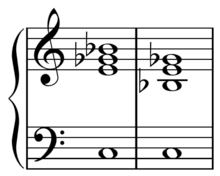
 Play
Play In music theory, the dominant seventh flat five chord is a seventh chord composed of a root note, together with a major third, a diminished fifth and a minor seventh from root (1, ♮3, ♭5 and ♭7). For example, the dominant seventh flat five built upon C (C7♭5) would be C-E-G♭-B♭. It can be represented by the integer notation {0, 4, 6, 10}. In diatonic harmony, the dominant seventh flat five chord does not naturally occur on any scale degree (as does, for example, the dominant seventh on the fifth scale degree: C7 in F major). This chord is enharmonically equivalent to its own second inversion.
 Play . F♯ = G♭.
The dominant seventh flat five may be considered an altered chord, created by diminishing the fifth of a dominant seventh chord, and may use the whole-tone scale,[1] as may the augmented minor seventh chord, or the Lydian ♭7 mode,[2] as well as most of the modes of the Neapolitan Major scale, such as Major Locrian, Leading Whole-Tone, and Lydian Minor. It is also used as a French augmented sixth, in second inversion (4/3), and is in fact enharmonic to its second inversion.
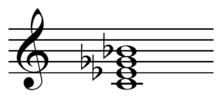
Minor seventh flat five
Similarly, a minor seventh flat five chord (m7♭5, also called as a half-diminished seventh chord) is constructed by diminishing the fifth of a minor seventh chord:[3]
- 1 ♭3 ♭5 ♭7
- C E♭ G♭ B♭.
The minor seventh flat five chord occurs in the diminished scale[4] on multiple scale degrees as well as on the seventh degree of the major scale (e.g., B-D-F-A in C major).
Dominant seventh flat five chord table
| Chord | Root | Major Third | Diminished Fifth | Minor Seventh |
|---|---|---|---|---|
| C7(♭5) | C | E | G♭ | B♭ |
| C♯7(♭5) | C♯ | E♯ (F) | G | B |
| D♭7(♭5) | D♭ | F | A (G) (G) |
C♭ (B) |
| D7(♭5) | D | F♯ | A♭ | C |
| D♯7(♭5) | D♯ | F (G) (G) |
A | C♯ |
| E♭7(♭5) | E♭ | G | B (A) |
D♭ |
| E7(♭5) | E | G♯ | B♭ | D |
| F7(♭5) | F | A | C♭ (B) | E♭ |
| F♯7(♭5) | F♯ | A♯ | C | E |
| G♭7(♭5) | G♭ | B♭ | D (C) |
F♭ (E) |
| G7(♭5) | G | B | D♭ | F |
| G♯7(♭5) | G♯ | B♯ (C) | D | F♯ |
| A♭7(♭5) | A♭ | C | E (D) |
G♭ |
| A7(♭5) | A | C♯ | E♭ | G |
| A♯7(♭5) | A♯ | C (D) |
E | G♯ |
| B♭7(♭5) | B♭ | D | F♭ (E) | A♭ |
| B7(♭5) | B | D♯ | F | A |
See also
Sources
- ↑ Manus and Hall (2008). Alfred's Basic Bass Scales & Modes/Alfred's Basic Bass Method, p.22/128. ISBN 0739055844/ISBN 0739055836.
- ↑ Berle, Annie (1996). Contemporary Theory And Harmony, p.100-101. ISBN 0-8256-1499-6.
- ↑ Morgen, Howard (1979). Concepts: Arranging for Fingerstyle Guitar, p.161. ISBN 0-7692-3075-X.
- ↑ Manus and Hall (2008), p.23/129.