Earthly Branches

The Earthly Branches (Chinese and Japanese: 地支; pinyin: dìzhī; Korean: 지지; or Chinese and Japanese: 十二支; pinyin: shí'èrzhī; Korean: 십이지; literally: "twelve branches") provide one Chinese system for reckoning time.
Origin
This system was built from observations of the orbit of Jupiter. Chinese astronomers divided the celestial circle into 12 sections to follow the orbit of 歲星 Suìxīng (Jupiter, the Year Star). Astronomers rounded the orbit of Suixing to 12 years (from 11.86). Suixing was associated with 攝提 Shètí (η Boötis) and sometimes called Sheti.
History
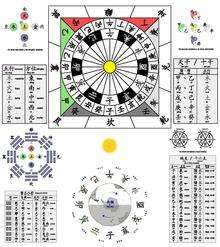
In correlative thinking, the twelve years of the Jupiter cycle also identify the twelve months of the year, twelve animals (mnemonics for the system), directions, seasons, and Chinese hour in the form of double-hours. When a Branch is used for a double hour, the listed periods are meant. When used for an exact time of a day, it is the center of the period. For instance, 午 (the Horse) means noon or a period from 11am to 1pm. (The jie qi system provided single hours and 15-degree arcs in time and space.)
Chinese seasons are based on observations of the sun and stars. Many Chinese calendrical systems have started the new year on the second new moon after the winter solstice.
The Earthly Branches are today used with the Heavenly Stems in the current version of the "traditional Chinese calendar" and in Taoism. The Ganzhi (Stem-Branch) combination is a fairly new way to mark time; in the second millennium BC, during the Shang era, it was the ten Heavenly Stems that provided the names of the days of the week. The Branches are as old as the Stems (and according to recent archaeology may actually be older), but the Stems were tied to the ritual calendars of Chinese kings. They were not part of the calendrical systems for the majority of Chinese people.
The twelve branches
Arctic Side
| Earthly Branch |
Chinese | Japanese | Korean (RR) |
Mongolian | Manchu | Vietnamese | Chinese zodiac |
Japanese zodiac |
Direction | Season | Lunar Month | Double Hour | ||||
|---|---|---|---|---|---|---|---|---|---|---|---|---|---|---|---|---|
| Mandarin Zhuyin |
Mandarin Pinyin |
Cantonese Jyutping |
on'yomi | kun'yomi | ||||||||||||
| 1 | 子 | ㄗˇ | zǐ | zi2 | し(shi) | ね(ne) | 자 (ja) | ᠬᠤᠯᠤᠭᠠᠨᠠ | ᠰᡳᠩᡤᡝᡵᡳ | tí (SV: tử) | 鼠 Rat | 鼠 | 0° (north) | winter | Month 11 | 11pm to 1am (midnight) |
| 2 | 丑 | ㄔㄡˇ | chǒu | cau2 | ちゅう(chū) | うし(ushi) | 축 (chuk) (SK: 추 (chu)) | ᠦᠬᠡᠷ | ᡳᡥᠠᠨ | sửu | 牛 Ox | 牛 | 30° | Month 12 | 1am to 3am | |
| 3 | 寅 | ㄧㄣˊ | yín | jan4 | いん(in) | とら(tora) | 인 (in) | ᠪᠠᠷᠰ | ᡨᠠᠰᡥᠠ | dần | 虎 Tiger | 虎 | 60° | spring | Month 1 | 3am to 5am |
| 4 | 卯 | ㄇㄠˇ | mǎo | maau5 | ぼう(bō) | う(u) | 묘 (myo) | ᠲᠠᠤᠯᠠᠢ | ᡤᡡᠯᠮᠠᡥᡡᠨ | mão (non-SV: mẹo) | 兔 Rabbit | 兎 | 90° (east) | Month 2 | 5am to 7am | |
| 5 | 辰 | ㄔㄣˊ | chén | san4 | しん(shin) | たつ(tatsu) | 진 (jin) (SK: 신 (sin)) | ᠯᠤᠤ | ᠮᡠᡩᡠᡵᡳ | thìn (SV: thần) | 龙(龍) Dragon | 竜 | 120° | Month 3 | 7am to 9 am | |
| 6 | 巳 | ㄙˋ | sì | zi6 | し(shi) | み(mi) | 사 (sa) | ᠮᠣᠭᠠᠢ | ᠮᡝᡳᡥᡝ | tị | 蛇 Snake | 蛇 | 150° | summer | Month 4 | 9am to 11am |
| 7 | 午 | ㄨˇ | wǔ | ng5 | ご(go) | うま(uma) | 오 (o) | ᠮᠣᠷᠢ | ᠮᠣᡵᡳᠨ | ngọ | 马(馬) Horse | 馬 | 180° (south) | Month 5 | 11am to 1pm (noon) | |
| 8 | 未 | ㄨㄟˋ | wèi | mei6 | び (bi) | ひつじ(hitsuji) | 미 (mi) | ᠬᠣᠨᠢ | ᡥᠣᠨᡳᠨ | mùi (SV: vị) | 羊 Goat | 羊 | 210° | Month 6 | 1pm to 3pm | |
| 9 | 申 | ㄕㄣ | shēn | san1 | しん(shin) | さる(saru) | 신 (sin) | ᠪᠡᠴᠢᠨ | ᠪᠣᠨᡳᠣ | thân | 猴 Monkey | 猿 | 240° | autumn | Month 7 | 3pm to 5pm |
| 10 | 酉 | ㄧㄡˇ | yǒu | jau5 | ゆう(yū) | とり(tori) | 유 (yu) | ᠲᠠᠬᠢᠶᠠ | ᠴᠣᡴᠣ | dậu | 鸡(雞) Rooster | 鶏 | 270° (west) | Month 8 | 5pm to 7pm | |
| 11 | 戌 | ㄒㄩ | xū | seot1 | じゅつ(jutsu) | いぬ(inu) | 술 (sul) | ᠨᠣᠬᠠᠢ | ᡳᠨᡩᠠᡥᡡᠨ | tuất | 狗 Dog | 犬 | 300° | Month 9 | 7pm to 9pm | |
| 12 | 亥 | ㄏㄞˋ | hài | hoi6 | がい(gai) | い(i) | 해 (hae) | ᠭᠠᠬᠠᠢ | ᡠᠯᡤᡳᠶᠠᠨ | hợi | 猪(豬) Pig | 猪 | 330° | winter | Month 10 | 9pm to 11pm |
Some cultures assign different animals: Vietnam replaces the Ox and Rabbit with the water buffalo and cat respectively; Japan replaces the Pig (豚) with the boar (猪) as the character 猪 means Pig in Chinese but "boar" in Japanese; Tibet replaces the Rooster with the bird. In the traditional Kazakh version of the 12-year animal cycle (Kazakh: мүшел, müşel), the Dragon is substituted by a snail (Kazakh: ұлу, ulw), and the Tiger appears as a leopard (Kazakh: барыс, barıs).[1]
Directions

Even though Chinese has words for the four cardinal directions, Chinese mariners and astronomers/astrologers preferred using the twelve directions of the Earthly Branches, which is somewhat similar to the modern-day practice of English-speaking pilots using o'clock for directions. Since twelve points were not enough for sailing, twelve midpoints were added. Instead of combining two adjacent direction names, they assigned new names as follows:
- For the four diagonal directions, appropriate trigram names of I Ching were used.
- For the rest, the Heavenly Stems were used. According to the Five Elements theory, east is assigned to wood, and the Stems of wood are 甲 (jiǎ) and 乙 (yǐ). Thus they were assigned clockwise to the two adjacent points of the east.
Following is a table of the 24 directions:
| Character | Mandarin name | Korean name | Japanese name | Vietnamese name | Direction | |
|---|---|---|---|---|---|---|
| 1 | 子 | ㄗˇ zǐ | 자 (ja) | ね (ne) | tí (SV: tử) | 0° (north) |
| 2 | 癸 | ㄍㄨㄟˇ guǐ | 계 (gye) (SK: 규 (gyu)) | みずのと (mizunoto) | quý | 15° |
| 3 | 丑 | ㄔㄡˇ chǒu | 축 (chuk) (SK: 추 (chu)) | うし (ushi) | sửu | 30° |
| 4 | 艮 | ㄍㄣˋ gèn | 간 (gan) | うしとら (ushitora) | cấn | 45° (northeast) |
| 5 | 寅 | ㄧㄣˊ yín | 인 (in) | とら (tora) | dần | 60° |
| 6 | 甲 | ㄐㄧㄚˇ jiǎ | 갑 (gap) | きのえ (kinoe) | giáp | 75° |
| 7 | 卯 | ㄇㄠˇ mǎo | 묘 (myo) | う (u) | mão (non-SV: mẹo) | 90° (east) |
| 8 | 乙 | ㄧˇ yǐ | 을 (eul) | きのと (kinoto) | ất | 105° |
| 9 | 辰 | ㄔㄣˊ chén | 진 (jin) (SK: 신 (sin)) | たつ (tatsu) | thìn (SV: thần) | 120° |
| 10 | 巽 | ㄒㄩㄣˋ xùn | 손 (son) | たつみ (tatsumi) | tốn | 135° (southeast) |
| 11 | 巳 | ㄙˋ sì | 사 (sa) | み (mi) | tị | 150° |
| 12 | 丙 | ㄅㄧㄥˇ bǐng | 병 (byeong) | ひのえ (hinoe) | bính | 165° |
| 13 | 午 | ㄨˇ wǔ | 오 (o) | うま (uma) | ngọ | 180ㄑ° (south) |
| 14 | 丁 | ㄉㄧㄥ dīng | 정 (jeong) | ひのと (hinoto) | đinh | 195° |
| 15 | 未 | ㄨㄟˋ wèi | 미 (mi) | ひつじ (hitsuji) | mùi (SV: vị) | 210° |
| 16 | 坤 | ㄎㄨㄣ kūn | 곤 (gon) | ひつじさる (hitsujisaru) | khôn | 225° (southwest) |
| 17 | 申 | ㄕㄣ shēn | 신 (sin) | さる (saru) | thân | 240° |
| 18 | 庚 | ㄍㄥ gēng | 경 (gyeong) | かのえ (kanoe) | canh | 255° |
| 19 | 酉 | ㄧㄡˇ yǒu | 유 (yu) | とり (tori) | dậu | 270° (west) |
| 20 | 辛 | ㄒㄧㄣ xīn | 신 (sin) | かのと (kanoto) | tân | 285° |
| 21 | 戌 | ㄒㄩ xū | 술 (sul) | いぬ (inu) | tuất | 300° |
| 22 | 乾 | ㄑㄧㄢˊ qián | 건 (geon) | いぬい (inui) | càn (SV: kiền) | 315° (northwest) |
| 23 | 亥 | ㄏㄞˋ hài | 해 (hae) | い (i) | hợi | 330° |
| 24 | 壬 | ㄖㄣˊ rén | 임 (im) | みずのえ (mizunoe) | nhâm | 345° |
Advanced mariners such as Zheng He used 48-point compasses. An additional midpoint was called by a combination of its two closest basic directions, such as 丙午 (bǐngwǔ) for the direction of 172.5°, the midpoint between 丙 (bǐng), 165°, and 午 (wǔ), 180°.
See also
References
- ↑ А. Мухамбетова (A. Mukhambetova), Казахский традиционный календарь The traditional Kazakh calendar (Russian)
External links
 |
Wikimedia Commons has media related to Earthly Branches. |
|
Wikimedia Commons has media related to Chinese Zodiac. |