El Fagr
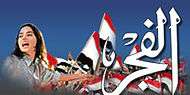 | |
| Type | Weekly newspaper |
|---|---|
| Format | Broadsheet |
| Owner(s) | Al-Fagr for Printing and Publishing Inc. |
| Editor | Manal Lashin |
| Founded | 3 June 2005 |
| Language | Arabic |
| Headquarters | Cairo, Egypt |
| Website | Official website |
El Fagr (IPA: [elˈfæɡɾ]; also Al Fagr, Arabic: الفجر "The dawn") is an Egyptian independent weekly newspaper,[1] based in Cairo.
History and profile
El Fagr was first published on 3 June 2005.[2] The paper is part of Al-Fagr for Printing and Publishing Inc.[2] The weekly, published on Thursdays,[3] is a sensationalist publication.[4]
Hassan Amr is one of the former editors of the paper.[5] As of 2013 Manal Lashin was the editor-in-chief of the weekly.[6]
In its 21st edition, dated 17 October 2005, El Fagr was the first newspaper worldwide to republish on its front page (one cartoon) and page 17, a total of six cartoons portraying the Islamic prophet Muhammad of twelve cartoons originally published in the Danish newspaper Jyllands-Posten.[7] These twelve cartoons gave rise to the Jyllands-Posten Muhammad cartoons controversy. However, these caricatures received little attention in Egypt and the paper was not banned due to its reprints of the caricatures.[7]
In March 2006 Amira Malsh, a journalist working for El Fagr, was sentenced to a year in prison with hard labor because of libeling a judge in an article published in the paper.[8]
In 2013 the weekly started an award in the memory of Al Husseiny Abu Deif, a journalist who died in December 2012 during clashes among the demonstrators.[6]
References
- ↑ Adel Iskandar (May 2007). "Lines in the Sand: Problematizing Arab Media in the Post-Taxonomic Era" (PDF). Arab Media & Society. Retrieved 2 October 2014.
- 1 2 Mohamed Ezz Elvarab. "Greasing the presses". Arab Memo to the Next American President (PDF). Retrieved 26 September 2015.
- ↑ Ekram Ibrahim (21 June 2012). "Egyptian media warns of "massacre of the century"". Ahram Online. Retrieved 5 October 2014.
- ↑ Richard Butsch; Sonia Livingstone (15 August 2013). The Meanings of Audiences: Comparative Discourses. Routledge. p. 125. ISBN 978-1-135-04305-6.
- ↑ Lawrence Pintak; Jeremy Ginges (July 2008). "The Mission of Arab Journalism: Creating Change in a Time of Turmoil" (PDF). The International Journal of Press/Politics. 13 (3). doi:10.1177/1940161208317142. Retrieved 13 February 2014.
- 1 2 "Media and Press Situation in Egypt: Ninth Report" (Report). Al Sawt Al Hurr. 2013. Retrieved 6 October 2014.
- 1 2 Daved Barry; Hans Hansen (30 April 2008). The SAGE Handbook of New Approaches in Management and Organization. SAGE Publications. p. 245. ISBN 978-1-4462-0407-8. Retrieved 5 October 2014.
- ↑ Hussein Amin. "Strengthening the Rule of Law and Integrity in the Arab World" (PDF). Arab Center for the Development of the Rule of Law and Integrity. Retrieved 5 October 2014.
External links
- – Reproductions of 17 October 2005 edition
- Assyrian International News Agency commentary on the El Fagr republication


