Indian egg-eating snake
| Indian egg-eater snake | |
|---|---|
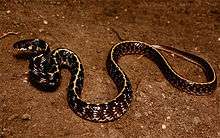 | |
| Indian egg-eater at Amravati | |
| Scientific classification | |
| Kingdom: | Animalia |
| Phylum: | Chordata |
| Class: | Reptilia |
| Order: | Squamata |
| Suborder: | Serpentes |
| Family: | Colubridae |
| Subfamily: | Colubrinae |
| Genus: | Elachistodon Reinhardt, 1863 |
| Species: | E. westermanni |
| Binomial name | |
| Elachistodon westermanni Reinhardt, 1863 | |
 | |
The Indian egg-eating snake or Indian egg-eater (Elachistodon westermanni) is a rare species of egg-eating snake found in the Indian subcontinent. It is also called Westermann's snake, reflecting its scientific name. The snake belongs to the monotypic genus Elachistodon.
Geographic range
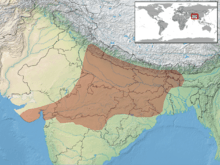
The Indian egg-eating snake is found in Bangladesh, India, and Nepal. Recent discoveries of the species come from Maharashtra, Gujarat, Punjab, Madhya Pradesh and Telangana.[2][3][4][5]
Description
This species is glossy brown to black, with bluish white flecks posteriorly and a middorsal creamy stripe from neck to tail tip. The head is brown with a black arrow mark. The ventrals are white with brown dots. Adults may attain a total length of 78 cm (31 inches), with a tail 11 cm (4¼ inches) long.[6]
Behaviour
A nocturnal, terrestrial species that shows remarkable dexterity in scaling vegetation. When provoked, it raises the anterior portion of the body, forming ‘S’ shaped coils as a defensive strategy.
Diet
Elachistodon westermanni exclusively feeds on bird eggs that lack embryonic growth. It has special adaptations such as a vertebral hypapophysis, a projection of the backbone, that juts into the oesophagus and helps in cracking eggs.[7] The only other snakes that share these egg-eating adaptations are in the genus Dasypeltis found in Africa.
References
- ↑ Srinivasulu, C., Srinivasulu, B., Vyas, R., Thakur, S., Mohapatra, P. & Giri, V. (2013). "Elachistodon westermanni". IUCN Red List of Threatened Species. IUCN. 2013: e.T7091A3136878. Retrieved 8 March 2016.
- ↑ Captain, A. & F. Tillack & A. Gumprecht & P. Dandge (2005). "First record of Elachistodon westermanni Reinhardt 1863 (Serpentes, Colubridae, Colubrinae) from Maharashtra State, India". Russian Journal of Herpetology. 12 (2): 156–158.
- ↑ Nande R and Sawan Deshmukh (2007). "Snakes of Amravati district including Melghat, Maharashtra, with important records of the Indian egg-eater, montane trinket snake and Indian Smooth Snake" (PDF). Zoos' Print Journal. 22 (12): 2920–2924. doi:10.11609/jott.zpj.1653.2920-4.
- ↑ Sharma, V. (2014). "On the distribution of Elachistodon westermanni Reinhardt, 1863 (Serpentes, Colubridae)". Russian Journal of Herpetology. 21 (3): 161–165.
- ↑ Visvanathan, A. (2015). "Natural history notes on Elachistodon westermanni Reinhardt, 1863". Hamadryad. 37 (1&2): 132–136.
- ↑ Boulenger, G.A. 1896. Catalogue of the Snakes in the British Museum (Natural History), Volume III. London.
- ↑ Gans, Carl, Oshima, Masamitsu, 1952. Adaptations for egg eating in the snake Elaphe climacophora (Boie). American Museum novitates ; no. 1571
External links
- Genus information
- Elachistodon westermanni at the Reptarium.cz Reptile Database. Accessed 5 November 2010.
- Animal Diversity Web