Elephantopus
For other uses, see Elephantopus (disambiguation).
| Elephant’s foot | |
|---|---|
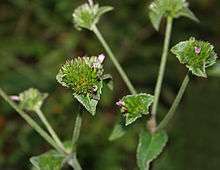 | |
| Elephantopus scaber in India | |
| Scientific classification | |
| Kingdom: | Plantae |
| (unranked): | Angiosperms |
| (unranked): | Eudicots |
| (unranked): | Asterids |
| Order: | Asterales |
| Family: | Asteraceae |
| Tribe: | Vernonieae[1] |
| Genus: | Elephantopus L. |
| Type species | |
| Elephantopus scaber L.[2] | |
| Synonyms[3] | |
| |
Elephantopus is a genus of perennial plants in the daisy family.[4][5][6]
The genus is widespread over much of Africa, southern Asia, Australia, and the Americas.[3] Several species are native to the southeastern United States,[7][8] and at least one is native to India and the Himalayas.[9][10][11]
Uses
Elephantopus scaber is a traditional medicine[12] and other species, including E. mollis[13] and E. carolinianus,[14] have also been investigated for medicinal properties. Elephantopus scaber contains elephantopin which is a germacranolide sesquiterpene lactone containing two lactone rings and an epoxide functional group.[15]
Species
- accepted species[3]
- Elephantopus angolensis O.Hoffm. - Angola
- Elephantopus arenarius Britton & P.Wilson ex Britton - Cuba
- Elephantopus arenosus Krasch. - Brazil
- Elephantopus biflorus (Less.) Sch.Bip. - Brazil
- Elephantopus carolinianus Raeusch.- southeastern + south-central United States; Cuba, Puerto Rico
- Elephantopus dilatatus Gleason - Costa Rica, Panama
- Elephantopus elatus Bertol. - southeastern United States
- Elephantopus elongatus Gardner - Brazil
- Elephantopus hirtiflorus DC. - Brazil, Venezuela
- Elephantopus mendoncae Philipson - Angola
- Elephantopus micropappus Less. - Brazil
- Elephantopus mollis Kunth native to Latin America + West Indies; widely naturalized in tropics of Africa, Asia, Australia, various islands
- Elephantopus multisetus O.Hoffm. ex T.Durand & De Wild. - Angola, Zaire, Tanzania
- Elephantopus nudatus A.Gray - southeastern + south-central United States, east Texas to Maryland
- Elephantopus nudicaulis Poir. - Mexico
- Elephantopus palustris Gardner - Brazil, Bolivia, Paraguay
- Elephantopus piauiensis R.Barros & Semir - Brazil
- Elephantopus pratensis C.Wright - Cuba
- Elephantopus racemosus Gardner - Brazil
- Elephantopus riparius Gardner - Brazil
- Elephantopus scaber L. - China, India, southeast Asia, northern Australia; naturalized in Africa, Madagascar, Latin America
- Elephantopus senegalensis (Klatt) Oliv. & Hiern- tropical Africa
- Elephantopus tomentosus L. - southern United States
- Elephantopus vernonioides S. Moore - Africa
- Elephantopus virgatus Desv. ex Ham. - Guyana
- Elephantopus welwitschii Hiern - Africa
References
- ↑ "187d. Asteraceae Martinov tribe Vernonieae Cassini". Flora of North America.
- ↑ Baker, C. F. 1902. A revision of the Elephantopeae--1. Transactions of the Academy of Science of St. Louis 12: 43-56 in English
- 1 2 3 Flann, C (ed) 2009+ Global Compositae Checklist
- ↑ Linnaeus, Carl von. 1753. Species Plantarum 2: 814 in Latin
- ↑ Baker, C. F. 1902. A revision of the Elephantopeae--1. Transactions of the Academy of Science of St. Louis 12: plate IX line drawings of fruits of several species of Elephantopus and Pseudelephantopus (captions on page 56)
- ↑ Clonts, J. A. 1972. A Revision of the Genus Elephantopus Including Orthopappus and Pseudelephantopus (Compositae). Ph.D. thesis. Mississippi State University.
- ↑ "Elephantopus L.". United States Department of Agriculture plants profile.
- ↑ Flora of North America, Elephant’s foot, Elephantopus Linnaeus
- ↑ Press, J.R., Shrestha, K.K. & Sutton, D.A. "Elephantopus L.". Annotated Checklist of the Flowering Plants of Nepal. Retrieved 2009-06-15.
- ↑ Flora of China Vol. 20-21 Page 368 地胆草属 di dan cao shu Elephantopus Linnaeus, Sp. Pl. 2: 814. 1753.
- ↑ Forzza, R. C. 2010. Lista de espécies Flora do Brasil http://floradobrasil.jbrj.gov.br/2010. Jardim Botânico do Rio de Janeiro, Rio de Janeiro
- ↑ Poli, A; Nicolau, M; Simoes, Cm; Nicolau, Rm; Zanin, M (August 1992). "Preliminary pharmacologic evaluation of crude whole plant extracts of Elephantopus scaber. Part I: in vivo studies". Journal of Ethnopharmacology. 37 (1): 71–6. doi:10.1016/0378-8741(92)90005-C. ISSN 0378-8741. PMID 1453704.
- ↑ Tabopda, Tk; Liu, J; Ngadjui, Bt; Luu, B (Apr 2007). "Cytotoxic triterpene and sesquiterpene lactones from Elephantopus mollis and induction of apoptosis in neuroblastoma cells". Planta Medica. 73 (4): 376–80. doi:10.1055/s-2007-967132. ISSN 0032-0943. PMID 17366372.
- ↑ Lee, Kh; Cowherd, Cm; Wolo, Mt (September 1975). "Antitumor agents. XV: Deoxyelephantopin, an antitumor principle from Elephantopus carolinianus Willd". Journal of pharmaceutical sciences. 64 (9): 1572–3. doi:10.1002/jps.2600640938. ISSN 0022-3549. PMID 1185584.
- ↑ Rajkapoor B, Jayakar B, Anandan R (Jan–Feb 2002). "Antitumor activity of Elephantopus scaber linn against Dalton's ascitis lymphoma". Indian Journal of Pharmaceutical Sciences. 64 (1): 71–3.
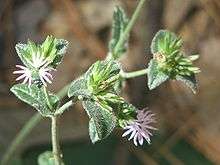
Elephantopus tomentosus in the United States
 |
Wikimedia Commons has media related to Elephantopus. |
This article is issued from Wikipedia - version of the 5/29/2016. The text is available under the Creative Commons Attribution/Share Alike but additional terms may apply for the media files.