Ernst Lecher
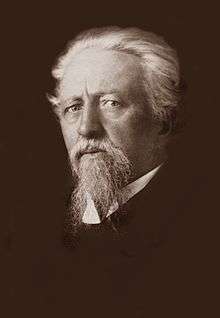
Ernst Lecher (1 June 1856 – 19 July 1926) was an Austrian physicist who, from 1909, was head of the First Institute of Physics [1] in Vienna. He is remembered for developing an apparatus— "Lecher lines"—to measure the wavelength and frequency of electromagnetic waves.[2] He gave his name to the Ernst-Lecher-Institut, a radar research establishment set up in the 1940s in Reichenau, south of Vienna,[3] which is now a part of the German research institute Max Planck Institute.
Lecher's father, Zacharias K Lecher,[4] was editor of Vienna's leading daily newspaper, Die Presse, and helped to publicise the discovery of X-rays of his German colleague Wilhelm Röntgen in 1896. Lecher's nephew, Konrad Zacharias Lorenz, won the Nobel Prize in Physiology or Medicine in 1973.[5]
Publications
- Studie über elektr. Resonanzerscheinungen, 1890
- Lehrbuch der Physik für Mediziner und Biologen, 1912
References
- ↑ Jagdish Mehra, Helmut Rechenberg, The Historical Development of Quantum Theory: V.1 Pt.2, p.73 et. seq., Springer, 2001, ISBN 0-387-95179-2, ISBN 978-0-387-95179-9 - some notes on the history of the First and Second Physical Institutes in Vienna
- ↑ "Ernst Lecher", Encyclopedia of Austria (online extract)
- ↑ "Henri Zemanek Interview", December 12, 1972, Archives Center, National Museum of American History, Computer Oral History Collection, 1969-1973, 1977
- ↑ "Röntgen: Invisible Rays that Save Lives", CMC - Vellore - History of Medicine Picture Collection
- ↑ John R. Krebs, Sverre Sjölander, Konrad Z. Lorenz For. Mem. R.S.(1903-1989), Konrad Lorenz Institute for Research on Evolution and Cognition