F minor
 | |
| Relative key | A♭ major |
|---|---|
| Parallel key | F major |
| Dominant key | C minor |
| Subdominant | B♭ minor |
| Component pitches | |
| F, G, A♭, B♭, C, D♭, E♭, F | |

 Play
Play  Play
Play  Play
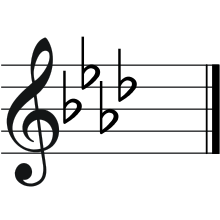
Play F minor is a minor scale based on F, consisting of the pitches F, G, A♭, B♭, C, D♭, and E♭. The harmonic minor raises the E♭ to E♮. Its key signature has four flats.
Its relative major is A-flat major, and its parallel major is F major.
Two famous pieces in the key of F minor are Beethoven's Appassionata Sonata, and Haydn's Symphony No. 49 in F minor, La Passione.
Glenn Gould once said if he could be any key, he would be F minor, because "it's rather dour, halfway between complex and stable, between upright and lascivious, between gray and highly tinted...There is a certain obliqueness."[1]
Helmholtz once described F minor as harrowing and melancholy. Schubart described this key as "Deep depression, funereal lament, groans of misery and longing for the grave."
Notable compositions
- Violin Concerto L'inverno, RV 297, Op. 8, No. 4 – Antonio Vivaldi
- Piano Sonata No. 1 Op. 2/1 - Ludwig van Beethoven
- Piano Sonata No. 23, Op. 57 (Appassionata) – Ludwig van Beethoven
- String Quartet No. 11, Op. 95 "Serioso" – Ludwig van Beethoven
- String Quartet No. 6 (Mendelssohn)
- Ballade No. 4, Op. 52 – Frédéric Chopin
- Fantaisie in F minor, Op. 49 – Frédéric Chopin
- Fantasia in F minor – Franz Schubert
- Harpsichord Concerto No. 5, BWV 1056 – Johann Sebastian Bach
- "Ich ruf zu dir, Herr Jesu Christ", BWV 639 – J. S. Bach
- Transcendental Étude No. 10 (Liszt)-Franz Liszt
- Piano Concerto No. 2, Op. 21 – Chopin
- Piano Quintet, Op. 34 – Johannes Brahms
- Piano Sonata No. 3, Op. 5 – Johannes Brahms
- Symphony No. 4 - Tchaikovsky
- Mass No. 3 - Anton Bruckner
- String Quintet - Alexander Borodin
- L'apprenti sorcier – Paul Dukas
- Symphony No. 1 - Dmitri Shostakovich
- String Quartet No. 11, Op. 122 (1966), Dmitri Shostakovich
E-sharp minor
 | |
| Relative key |
G♯ major enharmonic: A♭ major |
|---|---|
| Parallel key |
E♯ major enharmonic: F major |
| Dominant key |
B♯ minor enharmonic: C minor |
| Subdominant |
A♯ minor enharmonic: B♭ minor |
| Enharmonic | F minor |
| Component pitches | |
E♯, F , G♯, A♯, B♯, C♯, D♯, E♯ , G♯, A♯, B♯, C♯, D♯, E♯ | |
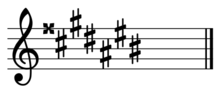
E-sharp minor is a theoretical key based on the musical note E-sharp (E♯) and consisting of the pitches E♯, F, G♯, A♯, B♯, C♯ and D♯. In the harmonic minor, the D♯ is raised to D. Its key signature has six sharps and one double sharp.
Its relative major is G♯ major, usually replaced by A♭ major, while its parallel major is E♯ major, usually replaced by F major, due to the presence of 4 double-sharps in the E♯ major scale causing it to be one of the more impractical key signatures in music to use. Although E♯ minor is usually notated as F minor, it could be used on a local level, such as a brief passage in Johann Sebastian Bach's The Well-Tempered Clavier, Book 1, Prelude and Fugue No. 3 in C-sharp major. (E♯ minor is the mediant minor key of C♯ major.)
See also
Notes
- ↑ Cathering Meng, Tonight's the Night (Apostrophe Books, 2007): 21
External links
 Media related to F minor at Wikimedia Commons
| Diatonic scales and keys | |||||||||||||||||||||||||||||||||||||||||||||||||||||||
|---|---|---|---|---|---|---|---|---|---|---|---|---|---|---|---|---|---|---|---|---|---|---|---|---|---|---|---|---|---|---|---|---|---|---|---|---|---|---|---|---|---|---|---|---|---|---|---|---|---|---|---|---|---|---|---|
 |
| ||||||||||||||||||||||||||||||||||||||||||||||||||||||
| The table indicates the number of sharps or flats in each scale. Minor scales are written in lower case. | |||||||||||||||||||||||||||||||||||||||||||||||||||||||