GEOMAR Helmholtz Centre for Ocean Research Kiel
| Abbreviation | GEOMAR |
|---|---|
| Formation | 2012 |
| Type | Nonprofit research organization |
| Purpose | Marine research |
| Headquarters | Kiel, Germany |
Region served | Worldwide |
Membership |
Helmholtz Association Deutsches Forschungsbohrkonsortium[1] FishBase Consortium[2] |
| Affiliations | University of Kiel[3] |
Budget | € 72 million[4] |
Staff | about 950 (scientists plus supporting staff) |
| Website | http://www.geomar.de/en/ |
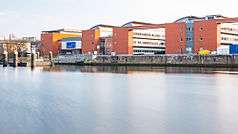
The GEOMAR - Helmholtz Centre for Ocean Research Kiel (GEOMAR), former Leibniz Institute of Marine Sciences (German: Leibniz-Institut für Meereswissenschaften, IFM-GEOMAR), is a research institute in Kiel, Germany. It was formed in 2004 by merging the Institute for Marine Science (IFM) with the Research Center for Marine Geosciences (GEOMAR) and is co-funded by both federal and provincial governments.[4] It was a member of the Leibniz Association till 2012 and is coordinator of the FishBase Consortium.[2] Since 2012 it is member of the Helmholtz Association and named GEOMAR - Helmholtz Centre for Ocean Research Kiel. The institute operates world-wide in all ocean basins,[4] specialising in climate dynamics, marine ecology and biogeochemistry, and ocean floor dynamics and circulation.[5] GEOMAR offers degree courses in affiliation with the University of Kiel,[3] and operates the Kiel Aquarium[6] and the Lithothek, a repository for split sediment core samples.[7]
Research divisions
GEOMAR is structured into four research divisions:[8]
- Ocean circulation and climate dynamics: This division, led by Mojib Latif, investigates climate from different time perspectives, with computer simulations and ocean current models that include meteorological, geological and oceanographic considerations. Current ocean measurements are made from research vessels at sea, and include the use of remote sensing.[9]
- Marine biogeochemistry: Work in this division looks at the way the components of the marine biogeochemical processes interact with each other. These components include the material in the atmosphere, the sediment and oceanic reservoirs, and the biological organisms including humans. Particular attention is paid to the atmosphere/ocean interface and the sediment/ocean interface, as well as to elements and compounds which can cycle and cause radiative forcing. Research ranges from the atmosphere over the ocean, through the ocean surface layer into the water column, and then down to the marine sediments and the oceanic crust. Field work is also undertakes, as well as laboratory and mesocosm studies. The division also develops biological, chemical and isotope diagnostic tools for measuring proxy variables.[10]
- Marine ecology: This division, led by Ulrich Sommer, aims to "understand the sensitivity of marine ecosystems to anthropogenic and natural changes, with a mid-term focus on climate change and overexploitation of marine bio-resources." It is important to understand how much stress a given ecosystem can absorb before structural shifts occur. When a shift does occur, it is necessary to understand how this will impact the ecosystem populations and the degree to which the shift can be reversed. Structural shifts can result in invasions by harmful organisms, species collapse and a radical reconfiguring of the biogeochemical cycles. Traditional approaches group species broadly into size classes and trophic levels measured by productivity or biomass. But to understand how ecosystems react to natural and anthropogenic stressors, specific differences in the way individual species react must also be understood, particularly where keystone species are involved. Research within this division range from genes to ecosystems, including the "ecophysiology of key species and its genetic basis, dynamics and genetics of individual populations and of communities, interactions within and among species, structure and response of entire food webs."[11]
- Dynamics of the ocean floor: Research is focused on "processes that shape the oceanic lithosphere, and the impact of these processes on the environment, e.g. climate and natural hazards. These research themes are pursued in the three main geotectonic settings: divergent and convergent margins and in intraplate regions. These three settings represent critical stages in the life-cycle of the ocean floor. The ocean basins are created by the rifting apart of continents. Oceanic lithosphere then forms at mid-ocean ridges. It is subsequently modified by low and high temperature interactions with the overlying oceans, the addition of intraplate magmas, the deposition of marine sediments, and tectonic processes occurring at or near transform and convergent plate margins. When it subducts at convergent margins, the dehydration of the plate induces arc volcanism that creates and modifies the continental crust and transfers climate-relevant volatiles into the atmosphere. Such continental margins are sites of sediment accumulation, fluid exchange, important resources and major geo-hazards."[12]
Research fleet
GEOMAR operates two open ocean research vessels: the 36-year-old RV Poseidon (1050 GRT)[13] and the 20-year-old RV Alkor (1000 GRT).[14] In 2009, both vessels were refurbished and modernised.[15] It also operates the research cutter, RC Littorina (168 GRT)[16] and the research boat, RB Polarfuchs (16 GRT).[17] In addition it operates JAGO, a three-ton research submersible, the only manned research submersible in Germany,[4][18][19] capable of diving to 400 metres,[20] as well as a remotely operated underwater vehicle, ROV KIEL 6000 capable of diving to 6,000 metres,[21] an autonomous underwater vehicle, AUV ABYSS,[22] and a video-controlled hydraulic grab, TV-Grab.[23] At the end of 2010, the institute took possession of ROV PHOCA, a new 1.5 ton ROV with an operational working depth of 3000 metres.[24]
-
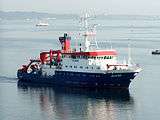
Research vessel, RV Alkor
(1000 GRT) -

Research cutter, RC Littorina
(168 GRT) -
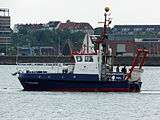
Research boat, RB Polarfuchs
(16 GRT) -
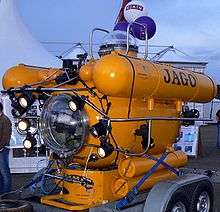
JAGO, a 3-ton manned research submersible
Notes
- ↑ Consortium members Deutsches Forschungsbohrkonsortium. Retrieved 29 July 2011.
- 1 2 Palomares MLD and Bailly N (2011) "Organising and disseminating marine biodiversity information: the FishBase and SeaLifeBase story" In: Villy Christensen and Jay Maclean (eds) Ecosystem Approaches to Fisheries: A Global Perspective, Cambridge University Press, page 30. ISBN 978-0-521-13022-6.
- 1 2 Leibniz Institute of Marine Sciences – IFM-GEOMAR (University affiliated) University of Kiel. Retrieved 29 July 2011.
- 1 2 3 4 Leibniz Institute of Marine Sciences (IFM-GEOMAR) German Marine Research Consortium. Retrieved 28 July 2011.
- ↑ Leibniz Institute of Marine Sciences (IFM-GEOMAR) Fisa, 21 July 2011.
- ↑ Kiel Aquarium in the Institute of Marine Science Ostee-Radweg. Retrieved 29 July 2011.
- ↑ Core Repositories Deutsches Forschungsbohrkonsortium. Retrieved 29 July 2011.
- ↑ Organizational Structure of the Institute IFM-GEOMAR web site.Retrieved 20 July 2011.
- ↑ Research Division 1: Ocean Circulation and Climate Dynamics IFM-GEOMAR. Updated 5 August 2010. Retrieved 24 July 2011.
- ↑ Research Division 2: Marine biogeochemistry IFM-GEOMAR. Updated 2 November 2010. Retrieved 24 July 2011.
- ↑ Research Division 3: Marine Ecology IFM-GEOMAR. Updated 27 November 2009. Retrieved 24 July 2011.
- ↑ Research Division 4: Dynamics of the ocean floor IFM-GEOMAR. Updated 16 September 2010. Retrieved 24 July 2011.
- ↑ RV Poseidon Ocean Facilities Exchange Group. Retrieved 29 July 2011.
- ↑ RV Alkor Ocean Facilities Exchange Group. Retrieved 29 July 2011.
- ↑ Modernisation of the IFM-GEOMAR-research fleet Research in Germany. Retrieved 29 July 2011.
- ↑ RC Littirina IFM-GEOMAR web site.Retrieved 20 July 2011.
- ↑ RB Polarfuchs IFM-GEOMAR web site.Retrieved 20 July 2011.
- ↑ Europe’s Big 3 Labs Sign New Oceanography Cooperation Pact Marine Science Today, 3 January 2009.
- ↑ List of research submersibles by country Marine Technology Society. Retrieved 30 July 2011.
- ↑ Kohnen, William (2005) Manned Research Submersibles: State of Technology 2004/2005 Marine Technology Society Journal, 39(3): 124.
- ↑ Schilling Robotics’ Kiel 6000 ROV approved by GL Offshore Shipping Online, 9 January 2008.
- ↑ AUV Abyss IFM-GEOMAR web site.Retrieved 20 July 2011.
- ↑ V-Grab IFM-GEOMAR web site.Retrieved 20 July 2011.
- ↑ New Remotely Operated Vehicle for IFM-GEOMAR Research in Germany, 17 January 2011.
External links
- GEOMAR Helmholtz Centre for Ocean Research Kiel home page
- Organizational Structure GEOMAR Helmholtz Centre for Ocean Research Kiel
- OceanRep - open access digital repository of GEOMAR Helmholtz Centre for Ocean Research Kiel research
Coordinates: 54°19′38″N 10°10′51″E / 54.32722°N 10.18083°E