Quasi-arithmetic mean
In mathematics and statistics, the quasi-arithmetic mean or generalised f-mean is one generalisation of the more familiar means such as the arithmetic mean and the geometric mean, using a function . It is also called Kolmogorov mean after Russian mathematician Andrey Kolmogorov.

Definition
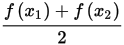
If f is a function which maps an interval of the real line to the real numbers, and is both continuous and injective then we can define the f-mean of two numbers


as

For numbers

- ,

the f-mean is

We require f to be injective in order for the inverse function to exist. Since is defined over an interval, lies within the domain of .

Since f is injective and continuous, it follows that f is a strictly monotonic function, and therefore that the f-mean is neither larger than the largest number of the tuple nor smaller than the smallest number in .

Examples
- If = ℝ, the real line, and , (or indeed any linear function , not equal to 0) then the f-mean corresponds to the arithmetic mean.
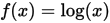
- If = ℝ+, the positive real numbers and , then the f-mean corresponds to the geometric mean. According to the f-mean properties, the result does not depend on the base of the logarithm as long as it is positive and not 1.
- If = ℝ+ and , then the f-mean corresponds to the harmonic mean.
- If = ℝ+ and , then the f-mean corresponds to the power mean with exponent .
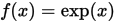
- If = ℝ and , then the f-mean is a constant shifted version of the LogSumExp (LSE) function, . The LogSumExp function is used as a smooth approximation to the maximum function.






Properties
- Partitioning: The computation of the mean can be split into computations of equal sized sub-blocks.

- Subsets of elements can be averaged a priori, without altering the mean, given that the multiplicity of elements is maintained.
- With it holds


- The quasi-arithmetic mean is invariant with respect to offsets and scaling of :
- .

- If is monotonic, then is monotonic.
- Any quasi-arithmetic mean of two variables has the mediality property and the self-distributivity property . Moreover, any of those properties is essentially sufficient to characterize quasi-arithmetic means; see Aczél–Dhombres, Chapter 17.
- Any quasi-arithmetic mean of two variables has the balancing property . An interesting problem is whether this condition (together with fixed-point, symmetry, monotonicity and continuity properties) implies that the mean is quasi-arithmetic. Georg Aumann showed in the 1930s that the answer is no in general,[1] but that if one additionally assumes to be an analytic function then the answer is positive.[2]





Homogeneity
Means are usually homogeneous, but for most functions , the f-mean is not. Indeed, the only homogeneous quasi-arithmetic means are the power means and the geometric mean; see Hardy–Littlewood–Pólya, page 68.
The homogeneity property can be achieved by normalizing the input values by some (homogeneous) mean .

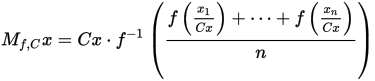
However this modification may violate monotonicity and the partitioning property of the mean.
References
- ↑ Aumann, Georg (1937). "Vollkommene Funktionalmittel und gewisse Kegelschnitteigenschaften". Journal für die reine und angewandte Mathematik. 176: 49–55. doi:10.1515/crll.1937.176.49.
- ↑ Aumann, Georg (1934). "Grundlegung der Theorie der analytischen Analytische Mittelwerte". Sitzungsberichte der Bayerischen Akademie der Wissenschaften: 45–81.
- Aczél, J.; Dhombres, J. G. (1989) Functional equations in several variables. With applications to mathematics, information theory and to the natural and social sciences. Encyclopedia of Mathematics and its Applications, 31. Cambridge Univ. Press, Cambridge, 1989.
- Andrey Kolmogorov (1930) “On the Notion of Mean”, in “Mathematics and Mechanics” (Kluwer 1991) — pp. 144–146.
- Andrey Kolmogorov (1930) Sur la notion de la moyenne. Atti Accad. Naz. Lincei 12, pp. 388–391.
- John Bibby (1974) “Axiomatisations of the average and a further generalisation of monotonic sequences,” Glasgow Mathematical Journal, vol. 15, pp. 63–65.
- Hardy, G. H.; Littlewood, J. E.; Pólya, G. (1952) Inequalities. 2nd ed. Cambridge Univ. Press, Cambridge, 1952.