Hipster PDA
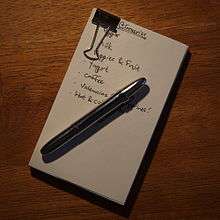
The Hipster PDA is a paper-based personal organizer, popularized by Merlin Mann.[1] Originally a tongue-in-cheek reaction to the increasing expense and complexity of personal digital assistants, the Hipster PDA (said to stand for "Parietal Disgorgement Aid" and often abbreviated to "hPDA") simply comprises a sheaf of index cards held together with a binder clip. Following widespread coverage in the media[2][3] and blogs, the hPDA has become a popular personal management tool particularly with followers of David Allen's Getting Things Done methodology.
Although it began as a joke, or perhaps a statement about technology fetishism, the Hipster PDA has rapidly gained popularity with serious users,[4] with hundreds posting pictures of their customized hPDAs on photo sharing sites and exchanging tips on Internet mailing lists. Advocates of the hPDA claim that it is a cheap, lightweight, freeform organizer[5] that doesn't need batteries and is unlikely to be stolen. Enthusiasts also design and share index-card-size printable templates for storing contacts, to-do lists, calendars, notes, project plans, and so on.
A Hipster Nano PDA utilizes business cards with blank backs and one that has a calendar on the back.
References
- ↑ Mann, Merlin (September 3, 2004). "Introducing the Hipster PDA". 43 Folders.
- ↑ Musgrove, Mike (July 17, 2005). "This Retro PDA Doesn't Need Batteries". The Washington Post.
- ↑ Ho, Leon (September 29, 2005). "Who needs a PDA when I've got paper?". The Guardian.
- ↑ "Hipster PDA Tips for People Obsessed With Productivity Pr0n But Bad At Actual Productivity". Slow Burn Productions. July 15, 2006.
- ↑ "Card Sharp". The Guardian. June 23, 2005.