Honanotherium
| Honanotherium Temporal range: Late Miocene | |
|---|---|
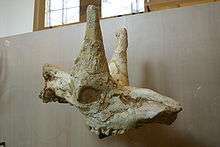 | |
| skull | |
Scientific classification  | |
| Kingdom: | Animalia |
| Phylum: | Chordata |
| Clade: | Synapsida |
| Class: | Mammalia |
| Order: | Artiodactyla |
| Family: | Giraffidae |
| Genus: | †Honanotherium Bohlin, 1927 |
| Species | |
| |
Honanotherium is a genus of extinct giraffid from the late Miocene of Hunan Province, China, and northwestern Iran.[1][2] It was closely related to Bohlinia and was once thought to be ancestral to the modern giraffe (genus Giraffa). The living animal would have resembled a modern giraffe, but, somewhat shorter, and with more massive ossicones.
The first part of the generic name, honano refers to the Henan (Chinese: 河南; pinyin: Húnán) province of China, where the first specimens were recovered. the second part, therium, comes from the Greek, θηρίον which means "beast."
Paleobiology
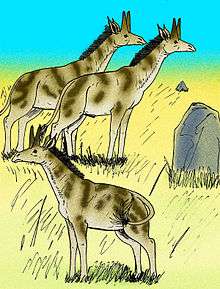
Like the modern-day giraffe, Honanotherium may have grazed on low-lying trees in the savannah environment, although its shorter neck shows that it probably fed on different plants than the extant giraffe.
References
- ↑ Bohlin, B. 1927. Die Familie Giraffidae. Pal. Sinica, Ser. C, IV, Fasc. 1, various pages.
- ↑ Nikos Solounias and Melinda Danowitz (2016). "The Giraffidae of Maragheh and the identification of a new species of Honanotherium". Palaeobiodiversity and Palaeoenvironments. in press. doi:10.1007/s12549-016-0230-7.