Hyalella azteca
| Hyalella azteca | |
|---|---|
 | |
| Scientific classification | |
| Kingdom: | Animalia |
| Phylum: | Arthropoda |
| Subphylum: | Crustacea |
| Class: | Malacostraca |
| Order: | Amphipoda |
| Family: | Hyalellidae |
| Genus: | Hyalella |
| Species: | H. azteca |
| Binomial name | |
| Hyalella azteca (Saussure, 1858) | |
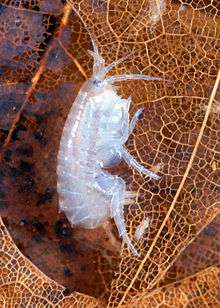
Hyalella azteca is a widespread and abundant species of amphipod crustacean in North America. It reaches 3–8 mm (0.12–0.31 in) long, and is found in a range of fresh and brackish waters. It feeds on algae and diatoms and is a major food of waterfowl.
Description
Hyalella azteca grows to a length of 3–8 millimetres (0.12–0.31 in), with males being larger than females.[1] Their colour is variable, but the most frequent hues are white, green and brown.[1]
Distribution
Hyalella azteca is found across Central America, the Caribbean and North America,[2] as far north as the Arctic tree line.[1] It lives among vegetation in permanent bodies of freshwater, including lakes and rivers,[1] extending into tidal fresh water, and freshwater barrier lagoons.[2] It is "the most abundant amphipod of lakes [in North America]".[3]
Ecology
In contrast to other species of Hyalella, H. azteca is extremely common and has wide ecological tolerances.[4] It can tolerate alkaline waters and brackish waters, but cannot tolerate a pH lower (more acidic) than 6.0.[4]
The main foodstuffs of H. azteca are filamentous algae and diatoms, although they may also consume organic detritus.[1] It cannot assimilate either cellulose or lignin, even though these biomolecules are a major component of the leaf litter.[5] It can, however, assimilate 60%–90% of the bacterial biomass that it ingests.[5]
Hyalella azteca is an important food for many waterfowl. In Saskatchewan, 97% of the diet of female white-winged scoters was observed to be H. azteca, and it also makes up a significant part of the diet of lesser scaup.[6]
Life cycle
Hyalella azteca passes through a minimum of nine instars during its development.[4] Sexes can first be distinguished at the 6th instar, with the first mating occurring in the 8th instar. Subsequent instars, of which there may be 15–20, are considered adulthood.[4]
Uses
Hyalella azteca is used in various aquatic bioassays.[7]
Taxonomic history
| External identifiers for Hyalella azteca | |
|---|---|
| Encyclopedia of Life | 342551 |
| ITIS | 94026 |
| NCBI | 294128 |
| WoRMS | 158105 |
| Also found in: Wikispecies | |
Hyalella azteca was first described by Henri Louis Frédéric de Saussure in 1858, under the name Amphitoe aztecus, based on material collected by Aztecs[8] from a "cistern" near Veracruz, Mexico.[9] It has also been described under several junior synonyms, including:[10]
- Hyalella dentata S. I. Smith, 1874
- Hyalella fluvialis Lockington, 1877
- Hyalella inermis S. I. Smith, 1875
- Hyalella knickerbockeri Bate, 1862
- Hyalella ornata Pearse, 1911
When Sidney Irving Smith erected the genus Hyalella in 1874, H. azteca was the only included species, and therefore the type species.[11] The genus now includes dozens of species, mostly in South America.[11]
H. azteca is now thought to represent a species complex, since there is little gene flow between populations, and different morphotypes are known to coexist in some areas.[8] Two local populations have been described as separate species – Hyalella texana from the Edwards Plateau of Texas, and Hyalella montezuma from Montezuma Well, Arizona.[8]
References
- 1 2 3 4 5 "Aquatic Invertebrates: Amphipods". The Nature of the Rideau River. Canadian Museum of Nature. May 18, 2007. Retrieved October 5, 2010.
- 1 2 Mark D. Sytsma; Jeffery R. Cordell; John W. Chapman; Robyn C. Draheim (October 2004). "Final Technical Report: Appendices" (PDF). Lower Columbia River Aquatic Nonindigenous Species Survey 2001–2004. United States Fish and Wildlife Service. Retrieved October 6, 2010.
- ↑ C. F. Mason (2002). "Acidification". Biology of Freshwater Pollution (4th ed.). Pearson Education. pp. 175–204. ISBN 978-0-13-090639-7.
- 1 2 3 4 Douglas Grant Smith (2001). "Amphipoda". Pennak's freshwater invertebrates of the United States: Porifera to Crustacea (4th ed.). John Wiley and Sons. pp. 569–584. ISBN 978-0-471-35837-4.
- 1 2 N. Kaushik (1975). "Decomposition of allochthonous organic matter and secondary production in stream ecosystems". Productivity of World Ecosystems: Proceedings of a Symposium Presented August 31–September 1, 1972, at the V General Assembly of the Special Committee for the International Biological Program, Seattle, Washington. United States National Academy of Sciences. pp. 90–95. ISBN 0-309-02317-3.
- ↑ Gary L. Krapu; Kenneth J. Reinecke (1992). "Foraging ecology and nutrition". In Bruce D. J. Batt. Ecology and Management of Breeding Waterfowl. University of Minnesota Press. pp. 1–29. ISBN 978-0-8166-2001-2.
- ↑ Robert Jay Goldstein; Rodney W. Harper; Richard Edwards (2000). "Foods and feeding". American Aquarium Fishes. Volume 28 of W. L. Moody, Jr., natural history series. Texas A&M University Press. pp. 43–51. ISBN 978-0-89096-880-2.
- 1 2 3 Yihao Duan; Sheldon I. Guttman; James T. Oris; A. John Bailer (2000). "Genetic structure and relationships among populations of Hyalella azteca and H. montezuma (Crustacea:Amphipoda)". Journal of the North American Benthological Society. 19 (2): 308–320. JSTOR 1468073.
- ↑ Exequiel R. Gonzalez & Les Watling; Watling (2002). "Redescription of Hyalella azteca from its type locality, Vera Cruz, Mexico (Amphipoda: Hyalellidae)". Journal of Crustacean Biology. 22 (1): 173–183. doi:10.1651/0278-0372(2002)022[0173:ROHAFI]2.0.CO;2. JSTOR 1549618.
- ↑ J. Lowry (2010). J. Lowry, ed. "Hyalella azteca (Saussure, 1858)". World Amphipoda database. World Register of Marine Species. Retrieved October 5, 2010.
- 1 2 J. Laurens Barnard (1969). "The Families and Genera of Marine Gammaridean Amphipoda". United States National Museum Bulletin. 271: 1–535.
Further reading
- John Janovy (2001). "Hyalella azteca". Dunwoody Pond: Reflections on the High Plains Wetlands and the Cultivation of Naturalists. University of Nebraska Press. pp. 150–167. ISBN 978-0-8032-7616-1.
Once upon a time we went to a roadside ditch. There was Hyalella azteca. Then we went to a river. There, too, was Hyalella azteca.