Ministry of Defence (Iraq)
|
Ministry of Defence insignia | |
| Department overview | |
|---|---|
| Formed | February 22, 2004 (As modern department) |
| Jurisdiction | Iraq |
| Headquarters | Baghdad |
| Minister responsible |
|
The Ministry of Defence (Arabic: وزارة الدفاع العراقية) is the Iraq government agency responsible for Defence of Iraq. It is also involved with internal security.
Authority
The Ministry directs all the Iraqi Armed Forces, comprising a Joint Headquarters, the Iraqi Ground Forces Command (which controls the Army), the Iraqi Special Operations Forces, the Iraqi Army, the Iraqi Navy (including Marines), and the Iraqi Air Force.[1]
History
The Ministry was dissolved by Coalition Provisional Authority Order Number 2 of mid-2003. It was formally re-established by CPA Order 61 of February 22, 2004. In the interim period, the CPA Office of Security Affairs served as the de facto Ministry of Defence.[2]
The Iraqi Counter Terrorism Bureau directs the Iraqi Counter Terrorism Command, which is a further military force answerable to the Prime Minister of Iraq directly. As of 30 June 2009, there had been legislation in progress for a year to make the Iraqi CTB a separate ministry.[3]
Minister of Defence
The position of Minister of Defence became vacant in the previous Iraqi cabinet, approved on 21 December 2010. While it was vacant, Prime Minister Nouri al-Maliki served as the acting defence minister. Saadoun al-Dulaimi later served as Minister of Defence from 2011 to 2014. Khaled al-Obaidi currently serves as defence minister in the Iraqi cabinet of Prime Minister Haider al-Abadi.
The previous Minister of Defence, Lieutenant General Abd al-Qadr Muhammed Jassim al-Obaidi, is a Sunni career military officer and political independent. He had limited experience and faced a number of hurdles impeding his effective governance. Some of the major problems included inheriting a staff that is notorious for favorism, corruption, and deeply divided along sectarian and ethnic lines. He was a rival of the former Minister of the Interior Jawad al-Bolani, National Security Advisor Muwafaq al-Rubai, and Minister of Staff for National Security Affairs Shirwan al-Waili. He has been criticized for not being able to stand up to the Badr Organization and Mehdi Army members which dominate his own party. In addition, as a Sunni he faced inherent challenges working within a Shiite-dominated government.
On September 19, 2005, The Independent reported that approximately one billion US dollars have been stolen by top ranking officials from the Ministry of Defence including Hazim al-Shaalan and Ziyad Cattan.[4]
Previous defence ministers under Saddam Hussein's regime included Ali Hassan al-Majid ('Chemical Ali'). Iraq's very first minister of defence was Jafar al-Askari (1920-1922).
List of Ministers of Defence
Ministers of Defence 1921 - 1958
| Name | Portrait | Term of office | Political party | Prime Minister | |||
|---|---|---|---|---|---|---|---|
| Jafar al-Askari | 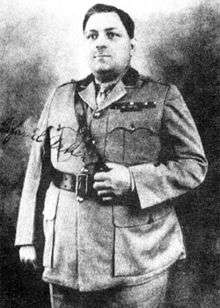 |
23 October 1920 | 16 November 1922 | Abd Al-Rahman Al-Gillani | |||
| Nuri as-Said | 20 November 1922 | 2 August 1924 | |||||
| Yasin al-Hashimi | 2 August 1924 | 2 June 1925 | |||||
| Nuri as-Said | 26 June 1925 | 8 January 1928 | |||||
| Abd al-Muhsin as-Sa'dun | 14 January 1928 | 20 January 1929 | |||||
| Muhammad Amin Zaki | 28 April 1929 | 25 August 1929 | |||||
| Nuri al-Sa’id | 19 September 1929 | 19 March 1930 | |||||
| Ja’far al-‘Askari | 23 March 1930 | 27 October 1932 | |||||
| Rashid al-Khawja | 3 November 1932 | 18 March 1933 | |||||
| Jalal Baban | 20 March 1933 | 28 October 1933 | |||||
Ministers of Defence 1958 - 1968
| Name | Portrait | Term of office | Political party | President | |||
|---|---|---|---|---|---|---|---|
| Abd al-Karim Qasim |  |
14 July 1958 | 8 February 1963 | Independent | Muhammad Najib ar-Ruba'i | ||
| Salah Mahdi Ammash | 8 February 1963 | 10 November 1963 | Ba'ath Party (Iraq Region) |
Abdul Salam Arif | |||
| Hardan al-Tikriti |  |
10 November 1963 | 2 March 1964 | ||||
| Tahir Yahya | 2 March 1964 | 3 September 1965 | Arab Socialist Union | ||||
| Arif Abd ar-Razzaq | 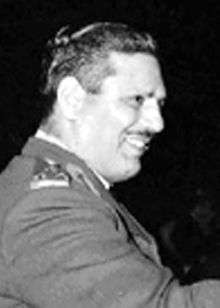 |
6 September 1965 | 16 September 1965 | Arab Socialist Union | |||
| Abd al-'Aziz al-'Uqaili | 21 September 1965 | 18 April 1966 | |||||
| Shakir Mahmud Shukri | 18 April 1966 | 17 July 1968 | Abdul Rahman Arif | ||||
Ministers of Defence 1968 - 2003
| Name | Portrait | Term of office | Political party | President | |||
|---|---|---|---|---|---|---|---|
| Ibrahim Abdel Rahman Dawoud | 17 July 1968 | 30 July 1968 | Independent | Ahmed Hassan al-Bakr | |||
| Hardan al-Tikriti | |
30 July 1968 | April 1970 | Iraqi Ba'ath Party (Iraq Region) | |||
| Hammad Shihab | April 1970 | 30 June 1973 | Iraqi Ba'ath Party (Iraq Region) | ||||
| Abdullah al-Khadduri (acting) | 30 June 1973 | 11 November 1974 | Iraqi Ba'ath Party (Iraq Region) | ||||
| Ahmed Hassan al-Bakr |  |
11 November 1974 | 15 October 1977 | Iraqi Ba'ath Party (Iraq Region) | |||
| Adnan Khairallah | 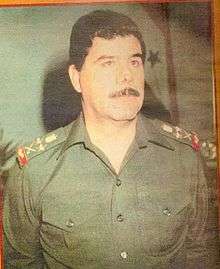 |
15 October 1977 | 4 May 1989 | Iraqi Ba'ath Party (Iraq Region) |
Saddam Hussein | ||
| Abdel Jabbar Khalil Shanshal | 4 May 1989 | 1990 | Iraqi Ba'ath Party (Iraq Region) | ||||
| Saadi Tuma Abbas | 1990 | 1991 | Iraqi Ba'ath Party (Iraq Region) | ||||
| Ali Hassan al-Majid |  |
1991 | 1995 | Iraqi Ba'ath Party (Iraq Region) | |||
| Sultan Hashim Ahmad al-Tai |  |
1995 | 2003 | Iraqi Ba'ath Party (Iraq Region) | |||
Ministers of Defence 2003 - present
| Name | Portrait | Term of office | Political party | Prime Minister | |||
|---|---|---|---|---|---|---|---|
| Ali Allawi | 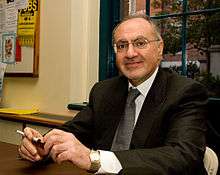 |
April 2004 | June 2004 | Independent | Ayad Allawi | ||
| Hazim al-Shaalan | June 2004 | 1 June 2005 | Iraqi National Congress | ||||
| Saadoun al-Dulaimi |  |
1 June 2005 | 6 March 2006 | Independent | Ibrahim al-Jaafari | ||
| Qadir Obeidi |  |
6 March 2006 | 21 December 2010 | Independent | Nouri al-Maliki | ||
| Nouri al-Maliki | .jpg) |
21 December 2010 | 17 August 2011 | State of Law Coalition | |||
| Saadoun al-Dulaimi | |
17 August 2011 | October 2014 | Unity Alliance of Iraq | |||
| Khaled al-Obaidi | 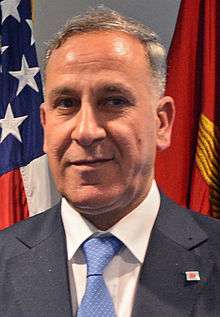 |
18 October 2014 | 19 August 2016 | Unity Alliance of Iraq | Haider al-Abadi | ||
| Othman Ghanm (interim) | 19 August 2016 | Incumbent | |||||
Notes
- ↑ United States Department of Defense, Measuring Stability and Security in Iraq, Report to Congress, June 2007, p.37
- ↑ Rathmell, Andrew. Developing Iraq's security sector: the coalition provisional authority's experience. Rand Corporation. p. 27. ISBN 0-8330-3823-0.
- ↑ Montrose Toast, Iraqi Counter Terrorism Bureau, 30 June 2009
- ↑ Cockburn, Patrick (19 September 2005). "What has happened to Iraq's missing $1bn?". The Independent. Retrieved 2009-07-01.
Further reading
- RAND, 'Developing Iraq's Security Sector: The Coalition Provisional Authority's Experience,' 2005, p. 27-32
External links
- Ministry of Defence
- Ministry of Defence (Arabic)