Iris prismatica
| Slender blue flag | |
|---|---|
 | |
| Scientific classification | |
| Kingdom: | Plantae |
| (unranked): | Angiosperms |
| (unranked): | Monocots |
| Order: | Asparagales |
| Family: | Iridaceae |
| Subfamily: | Iridoideae |
| Tribe: | Irideae |
| Genus: | Iris |
| Subgenus: | Limniris |
| Section: | Limniris |
| Species: | I. prismatica |
| Binomial name | |
| Iris prismatica Pursh | |
| Synonyms[1] | |
| |
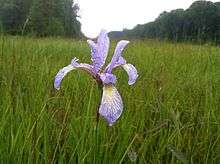
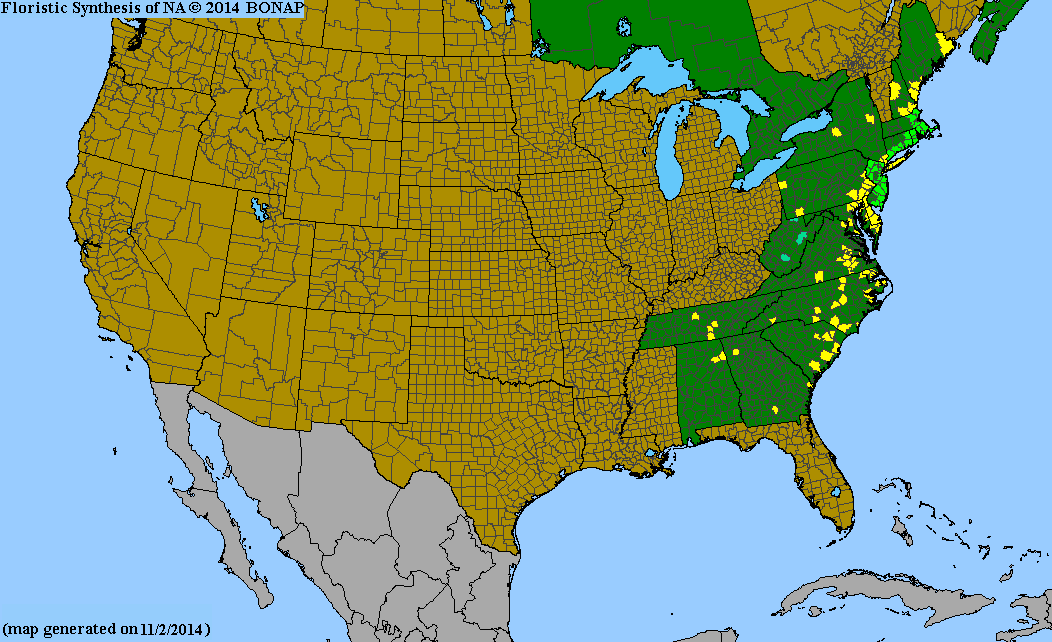
Iris prismatica, the Slender blue flag, is a plant species native to parts of the southern and eastern United States from Maine south to Alabama, as well as to the Canadian provinces of Ontario and Nova Scotia.[2][3][4]
Iris prismatica is a perennial herb spreading by means of rhizomes that are close to the surface of the soil. Flowering stalks can reach a height of 80 cm. Leaves are long and narrow, up to 60 cm long but rarely more than 5 mm across. Flowers are pale blue to blue-violet.[2][5][6][7][8][9] It tends to grow in wet conditions,[2] and in the United States is currently state listed as threatened in Maine, New Hampshire, New York, and Tennessee, and state listed as endangered in Maryland and Pennsylvania.[10]
References
- ↑ The Plant List, Iris prismatica
- 1 2 3 Flora of North America v 26 p 395, Iris prismatica
- ↑ BONAP (Biota of North America Project) floistic synthesis, Iris prismatica
- ↑ Rodionenko, Georgi Ivanovich. 2007. Botaničnyj Žurnal 92: 552. 2007.
- ↑ Pursh, Frederick Traugott. 1813. Flora Americae Septentrionalis 1: 30.
- ↑ Godfrey, R. K. & J. W. Wooten. 1979. Aquatic and Wetland Plants of Southeastern United States Monocotyledons 1–712. The University of Georgia Press, Athens.
- ↑ Chester, E. W. 1993. Atlas of Tennessee Vascular Plants Volume 1. Pteridophytes, Gymnosperms & Moncots. 118 pp.
- ↑ Radford, A. E., H. E. Ahles & C. R. Bell. 1968. Manual of the Vascular Flora of the Carolinas i–lxi, 1–1183. University of North Carolina Press, Chapel Hill.
- ↑ Gleason, H. A. & A.J. Cronquist. 1968. The Pteridophytoa, Gymnospermae and Monocotyledoneae. 1: 1–482. In H. A. Gleason New Britton and Brown Illustrated Flora of the Northeastern United States and Adjacent Canada. New York Botanical Garden, New York.
- ↑ "Natural Resources Conservation Service". United States Department of Agriculture. Retrieved 22 May 2014.
This article is issued from Wikipedia - version of the 6/17/2016. The text is available under the Creative Commons Attribution/Share Alike but additional terms may apply for the media files.