Kuortane
| Kuortane | ||
|---|---|---|
| Municipality | ||
| Kuortaneen kunta | ||
| ||
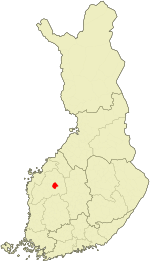 Location of Kuortane in Finland | ||
| Coordinates: 62°48.5′N 023°30.5′E / 62.8083°N 23.5083°ECoordinates: 62°48.5′N 023°30.5′E / 62.8083°N 23.5083°E | ||
| Country | Finland | |
| Region | Southern Ostrobothnia | |
| Sub-region | Kuusiokunnat sub-region | |
| Government | ||
| • Municipal manager | Pentti Turunen | |
| Area (2011-01-01)[1] | ||
| • Total | 484.89 km2 (187.22 sq mi) | |
| • Land | 462.17 km2 (178.44 sq mi) | |
| • Water | 22.72 km2 (8.77 sq mi) | |
| Area rank | 238th largest in Finland | |
| Population (2016-03-31)[2] | ||
| • Total | 3,717 | |
| • Rank | 217th largest in Finland | |
| • Density | 8.04/km2 (20.8/sq mi) | |
| Population by native language[3] | ||
| • Finnish | 99.4% (official) | |
| • Swedish | 0.1% | |
| • Others | 0.5% | |
| Population by age[4] | ||
| • 0 to 14 | 15.3% | |
| • 15 to 64 | 59.5% | |
| • 65 or older | 25.2% | |
| Time zone | EET (UTC+2) | |
| • Summer (DST) | EEST (UTC+3) | |
| Municipal tax rate[5] | 19.5% | |
| Website | www.kuortane.fi | |
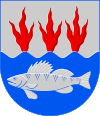
Kuortane is a municipality of Finland.
It is located in the province of Western Finland and is part of the Southern Ostrobothnia region. The municipality has a population of 3,717 (31 March 2016)[2] and covers an area of 484.89 square kilometres (187.22 sq mi) of which 22.72 km2 (8.77 sq mi) is water.[1] The population density is 8.04 inhabitants per square kilometre (20.8/sq mi).
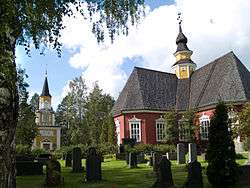
Old church in Kuortane
The municipality is unilingually Finnish.
Kuortane is the birthplace of world-famous architect Alvar Aalto.
Kuortane is mostly known for the Kuortane Sports Institute and the history of pine tar production.
See also
References
- 1 2 "Area by municipality as of 1 January 2011" (PDF) (in Finnish and Swedish). Land Survey of Finland. Retrieved 9 March 2011.
- 1 2 "Ennakkoväkiluku sukupuolen mukaan alueittain, maaliskuu.2016" (in Finnish). Statistics Finland. Retrieved 31 March 2016.
- ↑ "Population according to language and the number of foreigners and land area km2 by area as of 31 December 2008". Statistics Finland's PX-Web databases. Statistics Finland. Retrieved 29 March 2009.
- ↑ "Population according to age and gender by area as of 31 December 2008". Statistics Finland's PX-Web databases. Statistics Finland. Retrieved 28 April 2009.
- ↑ "List of municipal and parish tax rates in 2011". Tax Administration of Finland. 29 November 2010. Retrieved 13 March 2011.
External links
 Media related to Kuortane at Wikimedia Commons
- Municipality of Kuortane – Official website (Finnish)
| Municipalities |  | |
|---|---|---|
| Former municipalities | ||
This article is issued from Wikipedia - version of the 1/16/2015. The text is available under the Creative Commons Attribution/Share Alike but additional terms may apply for the media files.