Lapemis curtus
| Shaw's Sea Snake | |
|---|---|
| Scientific classification | |
| Kingdom: | Animalia |
| Phylum: | Chordata |
| Class: | Reptilia |
| Order: | Squamata |
| Suborder: | Serpentes |
| Family: | Hydrophiidae |
| Genus: | Lapemis |
| Species: | L. curtus |
| Binomial name | |
| Lapemis curtus (Shaw, 1802) | |
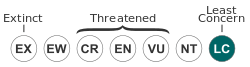
The Shaw's Sea Snake (Lapemis curtus, but often includes Lapemis hardwickii[1]) is a species of sea snake. Like all Hydrophiinae sea snakes, it is a viviparous, fully marine, and front fanged elapid that is highly venomous.[2] It is collected for a variety of purposes including human and animal food, for medicinal purposes and for their skin.[3]
Description
This species is characterized by a wide variation in number of ventral scales and degree of parietal scale fragmentation.[1] Both sexes possess spiny scales along their bodies but males have more highly developed spines. This sexual dimorphism in spines may play a role in courtship or in locomotion by reducing drag.[1]
Distribution
It is a widely distributed species and like most sea snakes is restricted to warmer, tropical waters. Its range includes:
- Persian Gulf (Oman, Bahrain, United Arab Emirates, Iran)
- Indian Ocean (Bangladesh, Pakistan, Sri Lanka, India)
- South China Sea north to the coasts of Fujian and Shandong
- Strait of Taiwan
- Indoaustralian Archipelago
- North coast of Australia (North Territory, Queensland, West Australia)
- Philippines (Panay, etc.)
- Pacific Ocean (Myanmar (= Burma), Thailand, Indonesia, China, Japan, New Guinea)
Taxonomy
Originally considered to be two species of the genus Lapemis: Lapemis curtus and Lapemis hardwickii. Gritis and Voris (1990) examined the morphological variation of over 1,400 specimens across its geographic range and concluded it is most likely a single species.[1][3] As is convention, the species name reverts to the first description by Shaw in 1802. Recent DNA and morphological analysis has confirmed its phylogenic status as a single species.[4]
Hydrodynamic sense
L. curtus have corpuscles (scale sensillae) concentrated on the front of their head which may be a hydrodynamic receptor.[5] A study measuring brain response to water vibration found that L. curtus is sensitive to low amplitude (100–150 Hz) water motions.[6] Sensing water motion is useful in locating prey, predators, or potential mates and has been demonstrated in other aquatic animals (e.g. lateral line in fish, whiskers in harbour seals).[7]
References
- 1 2 3 4 Gritis, P. & H. K. Voris 1990 Variability and significance of parietal and ventral scales in the marine snakes of the genus Lapemis (Serpentes: Hydrophiidae), with comments on the occurrence of spiny scales in the genus. Fieldiana Zool. n.s. (56): i-iii + 1-13.
- ↑ Heatwole H. 1999. Sea Snakes. University of New South Wales Press, Sydney.
- 1 2 Lukoschek, V., Guinea, M., Cogger, H., Rasmussen, A., Murphy, J., Lane, A., Sanders, K. Lobo, A., Gatus, J., Limpus, C., Milton, D., Courtney, T., Read, M., Fletcher, E., Marsh, D., White, M.-D., Heatwole, H., Alcala, A., Voris, H. & Karns, D. 2010. Lapemis curtus. In: IUCN 2014. IUCN Red List of Threatened Species. Version 2014.1. <www.iucnredlist.org>. Downloaded on 26 June 2014
- ↑ Sanders, K. L., Mumpuni, Lee M. S. Y. 2010 Uncoupling ecological innovation and speciation in sea snakes (Elapidae, Hydrophiinae, Hydrophiini. J. Evol. Biol. 23 (12):2685-93
- ↑ Povel, D. , Kooij, J.v.d. 1997. Scale sensillae of the file snake (Serpentes: Acrochordidae) and some other aquatic and burrowing snakes. Neth. J. Zool., 47, 443–456
- ↑ Westhoff G, Fry BG, Bleckmann H. 2005. Sea snakes (Lapemis curtus) are sensitive to low-amplitude water motions. Zoology 108, 195-200.
- ↑ Dehnhardt G, Mauck B, Bleckmann H (1998) Seal whiskers detect water movements. Nature 394, 235-236.
- Anderson, J. 1871 A list of the reptilian accession to the Indian Museum, Calcutta, from 1865 to 1870, with a description of some new species. J. Asiat. Soc. Bengal, Calcutta, 40, part 11(1): 12-39.
- Rasmussen, A. R. & I. Ineich 2000 Sea snakes of New Caledonia and surrounding waters (Serpentes: Elapidae): first report on the occurrence of Lapemis curtus and description of new species from the genus Hydrophis. Hamadryad, 25(2): 91-99.
- The IUCN Red List of Threatened Species (http://www.iucnredlist.org/details/176746/0).