Libyan desert glass
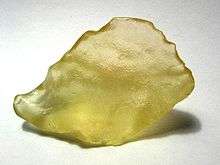
Libyan desert glass (LDG), or great sand sea glass is a substance found in areas in the Libyan Desert. Fragments of desert glass can be found over areas of tens of square kilometers.
Geologic origin

The origin of Libyan glass is uncertain. Meteoritic origins have long been considered possible, and recent research links the glass to impact features, such as zircon-breakdown, vaporized quartz and meteoritic metals, and to an impact crater.[2][3][4][5][6][7][8] Some geologists associate the glass with radiative melting from meteoric large aerial bursts, making it analogous to trinitite created from sand exposed to the thermal radiation of a nuclear explosion. Libyan glass has been dated as having formed about 26 million years ago. It was knapped and used to make tools during the Pleistocene.
See also
- Desert glass
- Darwin glass
- Edeowie glass
- Lechatelierite
- Impactite
- Kebira Crater
- Tektite
- Tunguska event
References
- ↑ Tut's gem hints at space impact, BBC News, July 19, 2006.
- ↑ Jan Kramers; David Block; Marco Andreoli (2013). "First ever evidence of a comet striking Earth". Wits University. Archived from the original on 2013-10-10.
- ↑ Kramers, J.D et al (2013): Unique chemistry of a diamond-bearing pebble from the Libyan Desert Glass strewnfield, SW Egypt: Evidence for a shocked comet fragment. Earth and Planetary Science Letters 382, 21-31
- ↑ B. Kleinmann (1968): The breakdown of zircon observed in the Libyan desert glass as evidence of its impact origin. Earth and Planetary Science Letters 5, 497-501.
- ↑ Weeks, R. (1984): Libyan Desert glass: A review. Journal of Non-Crystalline Solids, 67, 593-619.
- ↑ Seebaugh, W. R. & Strauss, A. M. (1984): Libyan Desert Glass: Remnants of an Impact Melt Sheet. LUNAR AND PLANETARY SCIENCE XV, 744-745. [Abstract.]
- ↑ Barbara Kleinmann, Peter Horn and Falko Langenhorst (2001): Evidence for shock metamorphism in sandstones from the Libyan Desert Glass strewn field. Meteoritics & Planetary Science 36, 1277-1282
- ↑ Giovanni Pratesi, Cecilia Viti, Curzio Cipriani and Marcello Mellini (2002): Silicate-silicate liquid immiscibility and graphite ribbons in Libyan desert glass. Geochimica et Cosmochimica Acta 66, 903-911.
Literature
- V. de Michele (ed.): Proceedings of the Silica '96 Meeting on Libyan Desert Glass and related desert events, Bologna, 1997 Contents
- P.A. Clayton / L.J. Spencer: Silica Glass from the Libyan Desert, Vortrag vom 09.11.1933 online
External links
 |
Wikimedia Commons has media related to Desert glass. |
- Google Scholar: "Desert Glass"
- Saudi Aramco World : Desert Glass: An Enigma
- Sahara Desert Glass/Tutankhamun's gem stone
- Glass in Nature from The Corning Museum of Glass