Methyl orange
 | |
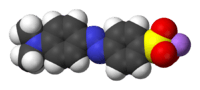 | |
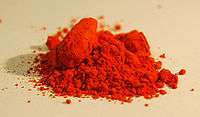 | |
| Names | |
|---|---|
| Preferred IUPAC name
Sodium 4-{[4-(dimethylamino)phenyl]diazenyl}benzene-1-sulfonate | |
| Other names
Sodium 4-[(4-dimethylamino)phenylazo]benzenesulfonate | |
| Identifiers | |
547-58-0  | |
| 3D model (Jmol) | Interactive image |
| ChemSpider | 16736152 |
| ECHA InfoCard | 100.008.115 |
| |
| |
| Properties | |
| C14H14N3NaO3S | |
| Molar mass | 327.33 g·mol−1 |
| Density | 1.28 g/cm3, solid |
| Melting point | >300 °C (572 °F; 573 K) not precisely defined |
| Boiling point | decomposes |
| 0.5 g/100 mL (20 °C) | |
| Solubility | insoluble in diethyl ether[1] |
| Hazards | |
| Main hazards | Toxic (T) |
| GHS pictograms |  |
| GHS signal word | Danger |
| H301 | |
| P308, P310 | |
| EU classification (DSD) |
 T T |
| R-phrases | R25 |
| S-phrases | S37, S45 |
| NFPA 704 | |
| Lethal dose or concentration (LD, LC): | |
| LD50 (median dose) |
60 mg/kg (rat, oral) |
| Except where otherwise noted, data are given for materials in their standard state (at 25 °C [77 °F], 100 kPa). | |
verify (what is  ?) ?) | |
| Infobox references | |

Methyl orange is a pH indicator frequently used in titrations because of its clear and distinct colour change. Because it changes colour at the pH of a midstrength acid, it is usually used in titrations for acids. Unlike a universal indicator, methyl orange does not have a full spectrum of colour change, but has a sharper end point. Methyl orange shows red colour in acidic medium and yellow colour in basic medium.
Indicator colours
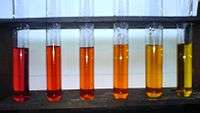
In a solution becoming less acidic, methyl orange moves from red to orange and finally to yellow with the reverse occurring for a solution increasing in acidity. The entire colour change occurs in acidic conditions.
| Methyl orange (pH indicator) | ||
| below pH 3.1 | above pH 4.4 | |
| 3.1 | ⇌ | 4.4 |
In an acid, it is reddish and in alkali, it is yellow. Methyl orange has a pKa of 3.47 in water at 25 °C (77 °F).[2]
Other indicators
| Methyl orange in xylene cyanol solution (pH indicator) | ||
| below pH 3.2 | above pH 4.2 | |
| 3.2 | ⇌ | 4.2 |
Modified (or screened) methyl orange, an indicator consisting of a solution of methyl orange and xylene cyanol, changes from grey-violet to green as the solution becomes more basic.
Safety
Methyl orange has mutagenic properties.[1] Direct contact should be avoided.
See also
References
- 1 2 3 MSDS from ScienceLab.com, Inc. Retrieved 2011-09-24
- ↑ Sandberg, Richard G.; Henderson, Gary H.; White, Robert D.; Eyring, Edward M. (1972). "Kinetics of acid dissociation-ion recombination of aqueous methyl orange". The Journal of Physical Chemistry. 76 (26): 4023–4025. doi:10.1021/j100670a024.
External links
 |
Wikimedia Commons has media related to Methyl orange. |