Mirza Muhammad Rafi Sauda
Mirza Muhammad Rafi 'Sauda' (1713–1781) (Urdu: مرزا محمد رفیع سودا ) was an Urdu poet in Delhi, India. He is known for his Ghazals and Urdu Qasidas.[1]
Biography
He was born in 1713 [2] in Shahjahanabad (i.e. Old Delhi), where he was also brought up.[3][4] At the age of 60 or 66, he moved to Farrukhabad (with Nawab Bangash),[2] and lived there from 1757 to about 1770.[3][5] In A.H. 1185 [1771–72] he moved to court of Nawab of Awadh (then in Faizabad) and remained there till his death.[3] When Lucknow became state capital, he came there with Nawab Shujauddaula.[4]
He died in A.H. 1195 [1780–81] in Lucknow.[3][2][6]
Ustads and shagirds
Sulaimān Qulī Ḳhān 'Vidād' and Shāh Ḥātim were his Ustads (teachers of Urdu poetry).[2][7] King Shah Alam was Shagird (student of Urdu poetry) of Sauda.[2] He was also Ustad of Shujauddaulla. Nawab Āṣif ud-Daulah gave him title of Malkushshu'ara and annual pension of Rs 6,000.[2]
Works
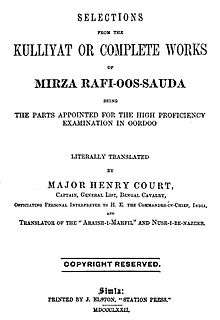
Initially he composed in Persian, but switched to Urdu on the advice of his ustad, Ḳhān-e Ārzū.[2] His work was translated in 1872 by Major Henry Court, Captain, Bengal Cavalry.[8] Kulliyat of Sauda was compiled by Ḥakīm Sayyid Aṣlaḥ. ud-Dīn Ḳhān wrote the introduction.[2] List of Sauda's work from his Kulliyat are:[9]
- Masnavi dar hajv-e hakim ghaus
- Masnavi dar hajv-e amir-a daulatmand bakhil
- Masnavi dar ta'rif-e shikar
- Masnavi dar hajv-e pil rajah nripat singh
- Masnavi dar hajv-e sidi faulad khan kotval-e shahjahanabad
- Masnavi dar hajv-e fidvi mutavatan-e panjab kih darasal baqal bachchah bud
- Masnavi dar hajv-e chipak mirza faizu
- Qissah-e darvesh kih iradah-e ziyarat-e ka'bah kardah bud
- Mukhammas-e shahr ashob
- Qasidah dar madh-e navab vazir imad ul-mulk
Some ashaar of Sauda
1.
| “ | kisii ka dard-e-dil pyaare tumhaara naaz kya samjhe jo guzre said ke dil par use shahbaaz kya samajhe |
” |
| — Sauda | ||
2.
| “ | badla tere sitam ka koii tujhse kya kare apana hii tu farefta howe, kh.uda kare |
” |
| — Sauda | ||
3.
| “ | shama-roo kahna use Sauda hai taareeki-e-aql shama ka aks uske aariz par kalaf hai maah kaa |
” |
| — Sauda | ||
4.
| “ | ishq zarra bhii agar ho to use kam mat jaan hoke shola hii bujhe hai ye sharaar aakh.irkaar |
” |
| — Sauda | ||
5.
| “ | mulaayam ho gayiin birah kii saa'itein karDiyaan pahar kaTne lage unbin jinhon bin kaaTtii gharDiyaan |
” |
| — Sauda | ||
6.
| “ | ye rutbaa jaah-e-duniya ka nahiin kam kisii maalzaadii se ki is par roz-o-shab mein saikarDo charDhte-utarate hain |
” |
| — Sauda | ||
7.
| “ | nai bulbul-e-chaman na gul-e-naudmeeda hoon main mausam-e-bahaar mein shaakh.-e-bareeda hoon giriyaan na shakl-e-sheesha wa kh.anda na tarz-e-jaam |
” |
| — Sauda | ||
8.
| “ | cheez kya hoon jo karein qatl wo aMkhiyaan mujhko phir gaye dekh ke muMh kh.anzar-e-mizgaan mujhko |
” |
| — Sauda | ||
9.
| “ | gada dast-e-ahl-e-karam dekhte hain ham apna hii dam aur qadam dekhte hain |
” |
| — Sauda | ||
10.
| “ | shaikh. ne us but ko jis kooche mein dekha shaam ko le charag ab DhooMrDhe hai waan ta-sehar islaam ko |
” |
| — Sauda | ||
11.
| “ | tabee'at se faromaya kee sher-e-tar nahiin hota jo aab-e-chaah ka qatra hai wo gauhar nahiin hota talaash-e-khijr bahr-e-manzil-e-maqsad na kar Sauda |
” |
| — Sauda | ||
12.
| “ | saawan ke baadalon kii tarah se bhare hu'e ye wo nayan hain jinse ki jangal hare hu'e |
” |
| — Sauda | ||
13.
| “ | kuwwat-e-namiya leti hai nabaataat ka arz daal se paat tak phool se lekar ta phal |
” |
| — Sauda | ||
References
- ↑ "A Shahr-ashob of Sauda, translated by Mark Pegors" (PDF). Retrieved 11 May 2013.
- 1 2 3 4 5 6 7 8 "Aab-e hayaat (1880) on Sauda". Dsal.uchicago.edu. Retrieved 11 May 2013.
- 1 2 3 4 "Chapter 2 of Three Mughal Poets: Mir Sauda, Mir Hasan*, by Ralph Russell and Khurshidul Islam (Cambridge: Harvard University Press, 1968)" (PDF). Retrieved 11 May 2013.
- 1 2 Frances Pritchett. "Introduction of Selections from the Kulliyat of Sauda, by Major Henry Court, 1872". Columbia.edu. Retrieved 11 May 2013.
- ↑ To be more precise, some time between A.H. 1183 (A.D. 1769–1770) and A.H. 1185 (A.D. 1771–1772). Cf. Shaikh Cand, pp. 55–56
- ↑ An Urdu chronogram by Faḳhr ud-Dīn; Persian chronograms by Muṣḥafī and Mīr Qamar ud-Dīn 'Minnat'.
- ↑ "Azad, Muhammad Husain Ab-i hayat: yani mashahir shura-yi Urdu ke savanih umri aur zaban-i mazkur ki ahd ba ahd ki taraqqiyon aur islahon ka bayan. Lahor: Naval Kishor 1907". Dsal.uchicago.edu. 8 April 2010. Retrieved 11 May 2013.
- ↑ Frances Pritchett. "Selections from the Kulliyat of Sauda, by Major Henry Court, 1872". Columbia.edu. Retrieved 11 May 2013.
- ↑ Frances Pritchett. "Introduction by FWP, Selections from the Kulliyat of Sauda, by Major Henry Court, 1872". Columbia.edu. Retrieved 11 May 2013.
External links
- Professor Nasim Ahmad's Books (a). Diwane-e-Ghazaliyat-e-Sauda and (b). Mutallaqate Sauda
- Vinay Prajapati 'Nazar' Wordpress Blog तख़लीक़-ए-नज़र – Expanding day by day.
Coordinates: 59°41′15″N 6°26′14″E / 59.68750°N 6.43722°E