Nesoptilotis
| Nesoptilotis | |
|---|---|
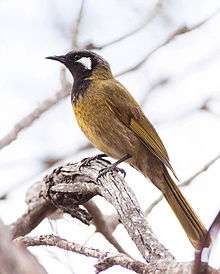 | |
| Nesoptilotis leucotis (white-eared honeyeater) | |
| Scientific classification | |
| Kingdom: | Animalia |
| Phylum: | Chordata |
| Class: | Aves |
| Order: | Passeriformes |
| Family: | Meliphagidae |
| Genus: | Nesoptilotis Mathews, 1913 |
Nesoptilotis is a genus of honeyeaters endemic to Australia and Tasmania. The genus consists of two former members of Lichenostomus, and was created after a molecular phylogenetic analysis published in 2011 showed that the original genus was polyphyletic.[1]
The genus contains two species:[2]
- Yellow-throated honeyeater (N. flavicollis) - Tasmania
- White-eared honeyeater (N. leucotis) - southwest, south and east Australia
The name Nesoptilotis was first proposed by the Australian ornithologist Gregory Mathews in 1913.[3][4] The word is derived from the Greek nēsos island (i.e. Tasmania), ptilon feather and -ōtis eared.[5]
References
- ↑ Nyári, Á.S.; Joseph, L. (2011). "Systematic dismantlement of Lichenostomus improves the basis for understanding relationships within the honeyeaters (Meliphagidae) and historical development of Australo–Papuan bird communities". Emu. 111: 202–211. doi:10.1071/mu10047.
- ↑ Gill, Frank; Donsker, David (eds.). "Honeyeaters". World Bird List Version 6.1. International Ornithologists' Union. Retrieved 28 January 2016.
- ↑ Mathews, Gregory M. (1913). "New generic names with some notes on others". Austral Avian Record. 2: 55-62 [60].
- ↑ Salomonsen, F. (1967). "Family Maliphagidae, Honeyeaters". In Paynter, R.A. Jnr. Check-list of birds of the world (Volume 12). Cambridge, Mass.: Museum of Comparative Zoology. p. 365.
- ↑ Jobling, James A. (2010). The Helm Dictionary of Scientific Bird Names. London: Christopher Helm. pp. 269, 321. ISBN 978-1-4081-2501-4.
This article is issued from Wikipedia - version of the 1/29/2016. The text is available under the Creative Commons Attribution/Share Alike but additional terms may apply for the media files.