Newton metre
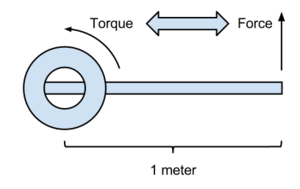
The newton metre (also newton-metre, symbol N m or N·m)[1] is a unit of torque (also called "moment") in the SI system. One newton metre is equal to the torque resulting from a force of one newton applied perpendicularly to a moment arm which is one metre long.
It is also used less commonly as a unit of work, or energy, in which case it is equivalent to the more common and standard SI unit of energy, the joule.[2] In this very different usage the metre term represents the distance travelled or displacement in the direction of the force, and not the perpendicular distance from a fulcrum as it does when used to express torque. This usage is generally discouraged,[3] since it can lead to confusion as to whether a given quantity expressed in newton metres is a torque or a quantity of energy.[4] However, since torque represents energy transferred or expended per angle of revolution, one newton metre of torque is equivalent to one joule per radian.[4]
Newton metres and joules are dimensionally equivalent in the sense that they have the same expression in SI base units:

Again, N⋅m and J are distinguished in order to avoid misunderstandings where a torque is mistaken for an energy or vice versa. Similar examples of dimensionally equivalent units include Pa versus J/m³, Bq versus Hz, and ohm versus ohm per square.
Conversion factors
- 1 kilogram-force metre = 9.80665 N·m[5][6]
- 1 pound-force = 0.45359237 kilogram-force
- 1 newton metre ≈ 0.73756215 pound-force-feet (often "foot-pounds")
- 1 pound-foot (often "foot-pound") ≡ 1 pound-force-foot ≈ 1.35581795 N·m
- 1 ounce-inch (often "inch-ounce") ≡ 1 ounce-force-inch ≈ 7.06155181 mN·m(milliNewtons-metre)
- 1 dyne-centimetre = 10−7 N·m
- 1 joule = 1 N·m
See also
References
- ↑ BIPM - unit symbols
- ↑ For example: Eshbach's handbook of engineering fundamentals - 10.4 Engineering Thermodynamics and Heat Transfer "In SI units the basic unit of energy is Newton-metre".
- ↑ Fundamentals of Physics, 9th edition by Halliday Resnick Ralker, p309. "The SI unit of torque is the newton-meter. In our discussion of energy we called this combination the joule. But torque is not work and torque should be expressed in newton-meters, not joules. google books link
- 1 2 BIPM - special names
- ↑ Mechanical Engineering Formulas Pocket Guide, p6
- ↑ Concise encyclopedia of plastics, by Donald V. Rosato, Marlene G. Rosato, Dominick V. Rosato, p621
| Base units |  | |
|---|---|---|
| Derived units with special names | ||
| Other accepted units | ||
| See also | ||
| ||

