Orbison illusion
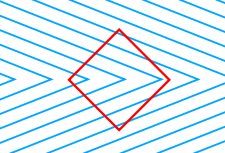
Orbison illusion consisting of a square placed over radial lines.
The Orbison illusion (or Orbison's illusion) is an optical illusion first described by American psychologist William Orbison (1912–1952)[1] in 1939.
Description
The Orbison illusion consists of a two dimensional figure, such as a circle or square, superimposed over a background of radial lines or concentric circles. The result is an optical illusion in which both the figure and the rectangle which contains it appear to distorted; in particular, squares appear slightly bulged, circles appear elliptical, and the containing rectangle appears tilted.[2][3]
References
Footnotes
- ↑ Roeckelein, Jon E. (2006). Elsevier's Dictionary of Psychological Theories. Amsterdam: Elsevier. p. 651. ISBN 9780444517500.
- ↑ "Orbison illusion". newworldencyclopedia.org. New World Encyclopedia. Retrieved June 30, 2016.
- ↑ "Orbison illusion". opticalillusions.info. Retrieved June 30, 2016.
General References
- Fineman, Mark (1996). The Nature of Visual Illusion. Dover Publications. pp. 152–153. ISBN 0486291057.
- Robinson, J.O. (1998). The Psychology of Visual Illusion. Dover Publications. pp. 72–73. ISBN 978-0486404493.
| Illusions |
|  |
|---|---|---|
| Popular culture
|
| |
| Related | ||
 |
Wikimedia Commons has media related to Optical illusion. |
This article is issued from Wikipedia - version of the 7/2/2016. The text is available under the Creative Commons Attribution/Share Alike but additional terms may apply for the media files.