Parodia scopa
| Parodia scopa | |
|---|---|
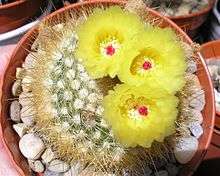 | |
| P. scopa (Les Chatfield) | |
| Scientific classification | |
| Kingdom: | Plantae |
| (unranked): | Angiosperms |
| (unranked): | Eudicots |
| (unranked): | Core eudicots |
| Order: | Caryophyllales |
| Family: | Cactaceae |
| Subfamily: | Cactoideae |
| Tribe: | Notocacteae |
| Genus: | Parodia |
| Species: | P. scopa |
| Binomial name | |
| Parodia scopa | |
Parodia scopa syn. Notocactus scopa (silver ball cactus) is a species of flowering plant in the cactus family Cactaceae, native to upland southern Brazil and Uruguay. It is a ball- or cylinder-shaped cactus growing to 5–50 cm (2–20 in) tall by 10 cm (4 in) broad, with a spiny, woolly crown and pale yellow flowers in summer.[1]
The specific epithet scopa means "broom" and refers to the long spines. The species was transferred from Notocactus to Parodia in 1997 by David Hunt.[2]
In cultivation it requires a minimum temperature of 10 °C (50 °F), therefore in temperate regions it must be grown under glass or as a houseplant.
The subspecies P. scopa subsp. scopa has gained the Royal Horticultural Society's Award of Garden Merit.[3]
References
- ↑ RHS A-Z encyclopedia of garden plants. United Kingdom: Dorling Kindersley. 2008. p. 1136. ISBN 1405332964.
- ↑ "Notocactus scopa". Old Cactuspedia. Retrieved 23 July 2013.
- ↑ "Parodia scopa subsp. scopa". Royal Horticultural Society. Retrieved 23 July 2013.
This article is issued from Wikipedia - version of the 10/4/2016. The text is available under the Creative Commons Attribution/Share Alike but additional terms may apply for the media files.