Pattala
 | |
| Percussion instrument | |
|---|---|
| Other names | Burmese xylophone |
| Classification | Percussion instrument |
| Related instruments | |
| Ranat ek, Roneat ek | |
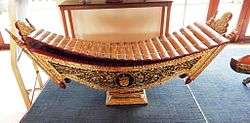
The pattala (Burmese: ပတ္တလား patta.la:, Burmese pronunciation: [pattəlá]; Karen: paw ku[1] ) is a Burmese xylophone, consisting of 24 bamboo slats (called ywet / ရွက် or asan အဆံ) suspended over a boat-shaped resonating chamber.[2][3] It is played with two padded mallets.[2][3] The pattala is tuned similar to the diatonic scale.[2]
In pre-colonial Burma, the pattala was used in royal court music.[4] In fact, when the piano was first introduced to the Burmese court in the late 1800s, it was tuned to the scale of the pattala.[4]
In modern days, classical Burmese chamber music is accompanied by either the pattala or the saung (the Burmese harp), both of which are capable of performing a harmonic countermelody.[5] The pattala is also a key instrument in the Burmese ensemble orchestra, the hsaing waing.[6] The pattala is also prominently featured in Burmese drama, anyeint.[7]
Origins
The earliest historical mention of the pattala is in the Kalyani Inscriptions and dates to the CE 147.[7] The pattala is similar to other mainland Southeast Asian instruments, including the ranat ek and the Cambodian roneat ek.
Construction
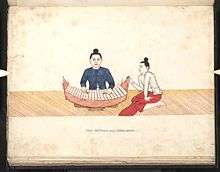
The bamboo slats are typically made from the wood of giant bamboo (Dendrocalamus giganteus), which is durable and produces a stable sound.[2] Slats are occasionally made from brass or iron.[2] The mallets are made from hardwoods such as teak, padauk, black cutch, yindaik, or pyinkado.[2] The resonance box is made from teak and decorated with inlaid glass or gold leaf.[2]
See also
References
- ↑ Cooler, Richard M. (1995). The Karen Bronze Drums of Burma. BRILL. p. 29. ISBN 9789004099333.
- 1 2 3 4 5 6 7 簡約雍容狂野. 國立傳統藝術中心. 2006. pp. 112–113. ISBN 9789860059182.
- 1 2 A Description of the Burmese Empire. Oriental Translation Fund of Great Britain and Ireland. 1833. p. 128.
- 1 2 Parakilas, James; E. Douglas Bomberger (2002). Piano Roles: A New History of the Piano. Yale University Press. ISBN 9780300093063.
- ↑ Rice, Timothy (2011). Ethnomusicological Encounters with Music and Musicians. Ashgate Publishing. p. 185. ISBN 9781409434023.
- ↑ Brandon, James R. (2009). Theatre in Southeast Asia. Harvard University Press. p. 127. ISBN 9780674028746.
- 1 2 "Musical Instruments - Xylophone (Pattala)". Union of Myanmar Ministry of Hotels and Tourism. 2006. Retrieved 31 August 2013.