Poa secunda
| Poa secunda | |
|---|---|
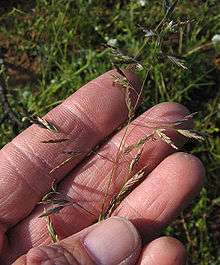 | |
| Scientific classification | |
| Kingdom: | Plantae |
| (unranked): | Angiosperms |
| (unranked): | Monocots |
| (unranked): | Commelinids |
| Order: | Poales |
| Family: | Poaceae |
| Genus: | Poa |
| Species: | P. secunda |
| Binomial name | |
| Poa secunda J.Presl[1] | |
| Synonyms[2][3][4] | |
|
N O T E : This list has been aggregated from three sources, each having considerably differing lists of taxa
| |

Poa secunda (variously known by the common names of Sandberg bluegrass,[1][2][3] alkali bluegrass,[3] big bluegrass,[3] Canby's bluegrass,[1] Nevada bluegrass,[3] one-sided bluegrass,[2] Pacific bluegrass,[1] pine blugrass,[1] slender bluegrass,[1] wild bluegrass,[3] and curly bluegrass.[5]) is a widespread species of grass native to North and South America.[3] It is highly resistant to drought conditions, and provides excellent fodder;[2] and has also been used in controlling soil erosion,[3] and as revegetator,[3] often after forest fires.[6] Cultivars include 'Canbar', 'Service', 'Sherman', and 'Supernova'.[7] Historically, indigenous Americans, such as the Gosiute of Utah, have used P. secunda for food.[8] It was originally described botanically in 1830 by Jan Svatopluk Presl, from a holotype collected from Chile by Thaddäus Haenke in 1790.[1]
Native distribution
- In North America, Poa secunda is native to Canada (in Alberta; British Columbia; eastern Quebec; southern Saskatchewan; southern Yukon Territory; and, rarely, in Ontario), the U.S. (in southeastern Alaska; Arizona; California; Colorado; the Dakotas; Idaho; Isle Royale in Michigan; Montana; northwestern Nebraska; Nevada; New Mexico; Oregon; Utah; Washington; and Wyoming), and northwestern Mexico.[3]
- In South America, it is native to Argentina (found in Chubut; Neuquén; and Santa Cruz), and central Chile.[3]
References
- 1 2 3 4 5 6 7 Poa secunda was originally described and published in Reliquiae Haenkeanae 1(4–5): 271. 1830. "Name - Poa secunda J.Presl". Tropicos. Saint Louis, Missouri: Missouri Botanical Garden. Retrieved 15 December 2012.
- 1 2 3 4 "Profile for Poa secunda (Sandberg bluegrass)". PLANTS Database. USDA, NRCS. Retrieved 15 December 2012.
- 1 2 3 4 5 6 7 8 9 10 11 GRIN (November 20, 2007). "Poa secunda information from NPGS/GRIN". Taxonomy for Plants. National Germplasm Resources Laboratory, Beltsville, Maryland: USDA, ARS, National Genetic Resources Program. Retrieved 15 December 2012.
- ↑ "TPL, treatment of Poa secunda J.Presl". The Plant List; Version 1. (published on the internet). Royal Botanic Gardens, Kew and Missouri Botanical Garden. 2010. Retrieved 15 December 2012.
- ↑ Poa secunda. NatureServe. 2012.
- ↑ Fact Sheet available in PDF and DOC form from USDA PLANTS Profile
- ↑ "Conservation Plant Characteristics for Poa secunda (Sandberg bluegrass)". PLANTS Database. USDA, NRCS. Retrieved 15 December 2012.
- ↑ Chamberlin, R. V. (1911). "The Ethno-Botany of the Gosiute Indians of Utah.". Memoirs of the American Anthropological Association. 2 (5): 331–405 (p. 377).
.jpg)
.jpg)
External links
- Taxon report from Calflora
- Photo gallery from CalPhotos database
- Jepson Manual Treatment from the University of California
- Fire Effects Information Service information from the U.S. Forest Service
- Original description published in 1830, in Latin from the Biodiversity Heritage Library
 |
Wikimedia Commons has media related to Poa secunda. |