Primary ideal
In mathematics, specifically commutative algebra, a proper ideal Q of a commutative ring A is said to be primary if whenever xy is an element of Q then x or yn is also an element of Q, for some n>0. For example, in the ring of integers Z, (pn) is a primary ideal if p is a prime number.
The notion of primary ideals is important in commutative ring theory because every ideal of a Noetherian ring has a primary decomposition, that is, can be written as an intersection of finitely many primary ideals. This result is known as the Lasker–Noether theorem. Consequently,[1] an irreducible ideal of a Noetherian ring is primary.
Various methods of generalizing primary ideals to noncommutative rings exist[2] but the topic is most often studied for commutative rings. Therefore, the rings in this article are assumed to be commutative rings with identity.
Examples and properties
- The definition can be rephrased in a more symmetric manner: an ideal is primary if, whenever , we have either or or . (Here denotes the radical of .)
- An ideal Q of R is primary if and only if every zerodivisor in R/Q is nilpotent. (Compare this to the case of prime ideals, where P is prime if every zerodivisor in R/P is actually zero.)
- Any prime ideal is primary, and moreover an ideal is prime if and only if it is primary and semiprime.
- Every primary ideal is primal.[3]
- If Q is a primary ideal, then the radical of Q is necessarily a prime ideal P, and this ideal is called the associated prime ideal of Q. In this situation, Q is said to be P-primary.
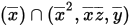
- On the other hand, an ideal whose radical is prime is not necessarily primary: for example, if , , and , then is prime and , but we have , , and for all n > 0, so is not primary. The primary decomposition of is ; here is -primary and is -primary.
- An ideal whose radical is maximal, however, is primary.
- If P is a maximal prime ideal, then any ideal containing a power of P is P-primary. Not all P-primary ideals need be powers of P; for example the ideal (x, y2) is P-primary for the ideal P = (x, y) in the ring k[x, y], but is not a power of P.
- In general powers of a prime ideal P need not be P-primary. (An example is given by taking R to be the ring k[x, y, z]/(xy − z2), with P the prime ideal (x, z). If Q = P2, then xy ∈ Q, but x is not in Q and y is not in the radical P of Q, so Q is not P-primary.) However every ideal Q with radical P is contained in a smallest P-primary ideal, consisting of all elements a such that ax is in Q for some x not in P. In particular there is a smallest P-primary ideal containing Pn, called the nth symbolic power of P.
- If A is a Noetherian ring and P a prime ideal, then the kernel of , the map from A to the localization of A at P, is the intersection of all P-primary ideals.[4]


![R=k[x,y,z]/(xy-z^{2})](../I/m/1f5181f2c009e048042a644155f7581289c104ab.svg)







Footnotes
- ↑ To be precise, one usually uses this fact to prove the theorem.
- ↑ See the references to Chatters-Hajarnavis, Goldman, Gorton-Heatherly, and Lesieur-Croisot.
- ↑ For the proof of the second part see the article of Fuchs
- ↑ Atiyah-Macdonald, Corollary 10.21
References
- Atiyah, Michael Francis; Macdonald, I.G. (1969), Introduction to Commutative Algebra, Westview Press, p. 50, ISBN 978-0-201-40751-8
- Chatters, A. W.; Hajarnavis, C. R. (1971), "Non-commutative rings with primary decomposition", Quart. J. Math. Oxford Ser. (2), 22: 73–83, doi:10.1093/qmath/22.1.73, ISSN 0033-5606, MR 0286822
- Goldman, Oscar (1969), "Rings and modules of quotients", J. Algebra, 13: 10–47, doi:10.1016/0021-8693(69)90004-0, ISSN 0021-8693, MR 0245608
- Gorton, Christine; Heatherly, Henry (2006), "Generalized primary rings and ideals", Math. Pannon., 17 (1): 17–28, ISSN 0865-2090, MR 2215638
- On primal ideals, Ladislas Fuchs
- Lesieur, L.; Croisot, R. (1963), Algèbre noethérienne non commutative (in French), Mémor. Sci. Math., Fasc. CLIV. Gauthier-Villars & Cie, Editeur -Imprimeur-Libraire, Paris, p. 119, MR 0155861