Puteal
_01.jpg)
A puteal (Latin: from puteus (well) — plural: putealia[1][2]) is a classical water well wellhead built around a well's access opening.
Description
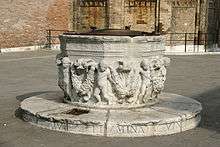
The enclosure keeps people from falling down a well otherwise open at grade level.[3] When fit with a cast iron lid, as traditionally in the public squares, or campos, of Venice, Italy, both the citizens and water supply were protected.[2]
They were used as an accessible point of water distribution, and as an aesthetic architectural element. Locations included public town squares and private courtyards.[2]
Classical putealia
The classical puteal wellheads are made of carved stone, often marble in Europe. They are frequently decorated with bas-reliefs of classical Greek and Roman themes around their outer faces. An Ancient Roman one was in the Puteal Scribonianum structure in the Roman Forum, nothing remains.[1]
The term is also used for circular classical remains—spolia recycled after antiquity into well-heads, such as the Guildford Puteal at the British Museum.
See also
- Wellhead — for all types (e.g., water, gas, oil)
- Fontus (Fons) — the ancient Roman god of fountains and wellheads
- Roman aqueduct
- Wishing well
References
- 1 2 Wiktionary — Puteal
- 1 2 3 Venetian Wellheads @ Venipedia. Accessed May 25, 2012.
- ↑ John Weale, Rudimentary Dictionary of Terms Used in Architecture, Civil, Architecture, Naval, Building and Construction, Early and Ecclesiastical Art, Engineering, Civil, Engineering, Mechanical, Fine Art, Mining, Sur-veying, Etc., to Which Are Added Explanatory Observations on Numerous Subjects Connected with Practical Art and Science. (London: J. Weale, 1849), pg. 364.
External links
 |
Wikimedia Commons has media related to Water well heads—Puteal. |
- Venipedia — Wellheads — The free encyclopedia of Venice, Italy.
- Venipedia — Wellhead Maintenance