Pygmy short-horned lizard
| Pygmy short-horned lizard | |
|---|---|
 | |
| Scientific classification | |
| Kingdom: | Animalia |
| Phylum: | Chordata |
| Subphylum: | Vertebrata |
| Class: | Reptilia |
| Order: | Squamata |
| Suborder: | Iguania |
| Family: | Phrynosomatidae |
| Genus: | Phrynosoma |
| Species: | P. douglasii |
| Binomial name | |
| Phrynosoma douglasii (Bell, 1828)[2] | |
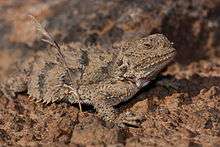
The pygmy short-horned lizard (Phrynosoma douglasii) is a species of small horned lizard that occurs in the northwestern United States. In the past it also occurred in adjacent Canada. Like other horned lizards, it is often called a "horned toad" or "horny toad," but it is not a toad at all. It is a reptile, not an amphibian.[3]
Etymology
The specific name, douglasii, is in honor of Scottish botanist David Douglas.[4]
Identification
The pygmy short-horned lizard is often mistaken for its close relative the greater short-horned lizard (P. hernandesi ) which has the same basic body type consisting of small pointed scales around the head and back.[3] Until recent mitochondrial DNA evidence, the greater short-horned was considered to be the same species as the pygmy short-horned. They are now considered distinct species with the pygmy short-horned lizard occupying the northwest portion of the United States and extreme southern British Columbia (now extirpated from Canada).[3] When placed together the two are easily distinguished at full size, the pygmy short-horned lizard being much smaller. The greater short-horned lizard is a highly variable species with different geographic populations exhibiting differences in color, pattern, and size, with some authorities describing five subspecies. The pygmy short-horned lizard ranges in size from 1.25–2.5 in (3.2–6.4 cm) in snout-to-vent length (SVL) and is a flat-bodied, squat lizard with short spines crowning the head.[5] They have a snub-nosed profile and short legs. The trunk is fringed by one row of pointed scales, while the belly scales are smooth. The color is gray, yellowish, or reddish-brown, and there are two rows of large dark spots on the back. When threatened or aggressive, their colors become more intense.
References
- ↑ Hammerson, G.A. (2007). Phrynosoma douglasii. The IUCN Red List of Threatened Species doi:10.2305/IUCN.UK.2007.RLTS.T64075A12741891.en
- ↑ The Reptile Database. .
- 1 2 3 Sherbrooke, Wade C. 2003. Introduction to Horned Lizards of North America. California Natural History Guides. Oakland, California: University of California Press. 191 pp. ISBN 978-0520228276.
- ↑ Beolens, Bo; Watkins, Michael; Grayson, Michael. (2011). "Phrynosoma douglasi", p. 75 The Eponym Dictionary of Reptiles. Baltimore: Johns Hopkins University Press. ISBN 978-1-4214-0135-5.
- ↑ Stebbins, Robert C. (2003). "Phrynosoma douglasii", pp. 303–304 + Plate 34 + Map 101 in A Field Guide to Western Reptiles and Amphibians: Third Edition. The Peterson Field Guide Series. Boston and New York: Houghton Mifflin Company. ISBN 978-0-395-98272-3.
Further reading
- Bell, Thomas. 1828. "Description of a new Species of Agama, brought from the Columbia River by Mr. Douglass [sic]". Trans. Linnean Soc. London 16: 105–107 + Plate X. ("Agama Douglassii [sic]", new species). (in English and Latin).
External links
 |
Wikimedia Commons has media related to Phrynosoma douglasii. |
 Data related to Pygmy short-horned lizard at Wikispecies