QKI
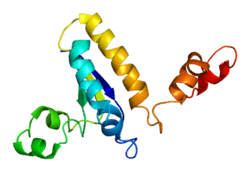
| View/Edit Human | View/Edit Mouse |
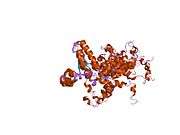
Quaking homolog, KH domain RNA binding (mouse), also known as QKI, is a protein which in humans is encoded by the QKI gene.[3][4]
QKI belongs to a family of RNA-binding proteins called STAR proteins for Signal Transduction and Activation of RNA.[5] They have an HNRNPK homology (KH) domain embedded in a 200-amino acid region called the GSG domain. Other members of this family include SAM68 (KHDRBS1) and SF1 .[6] Two more new members are KHDRBS3[7] and KHDRBS2.[8]
The QKI gene is implicated as being important in schizophrenia,[9][10] and QKI controls translation of many oligodendrocyte-related genes.
References
- ↑ "Human PubMed Reference:".
- ↑ "Mouse PubMed Reference:".
- ↑ "Entrez Gene: QKI quaking homolog, KH domain RNA binding (mouse)".
- ↑ Saccomanno L, Loushin C, Jan E, Punkay E, Artzt K, Goodwin EB (October 1999). "The STAR protein QKI-6 is a translational repressor". Proc. Natl. Acad. Sci. U.S.A. 96 (22): 12605–10. Bibcode:1999PNAS...9612605S. doi:10.1073/pnas.96.22.12605. PMC 23011
 . PMID 10535969.
 - ↑ Vernet C, Artzt K (December 1997). "STAR, a gene family involved in signal transduction and activation of RNA". Trends Genet. 13 (12): 479–84. doi:10.1016/S0168-9525(97)01269-9. PMID 9433137.
- ↑ Chen T, Richard S (August 1998). "Structure-function analysis of Qk1: a lethal point mutation in mouse quaking prevents homodimerization". Mol. Cell. Biol. 18 (8): 4863–71. PMC 109071. PMID 9671495.
- ↑ Venables JP, Vernet C, Chew SL, Elliott DJ, Cowmeadow RB, Wu J, Cooke HJ, Artzt K, Eperon IC (June 1999). "T-STAR/ETOILE: a novel relative of SAM68 that interacts with an RNA-binding protein implicated in spermatogenesis". Hum. Mol. Genet. 8 (6): 959–69. doi:10.1093/hmg/8.6.959. PMID 10332027.
- ↑ Wang L, Xu J, Zeng L, Ye X, Wu Q, Dai J, Ji C, Gu S, Zhao C, Xie Y, Mao Y (December 2002). "Cloning and characterization of a novel human STAR domain containing cDNA KHDRBS2". Mol. Biol. Rep. 29 (4): 369–75. doi:10.1023/A:1021246109101. PMID 12549823.
- ↑ Aberg K, Saetre P, Jareborg N, Jazin E (May 2006). "Human QKI, a potential regulator of mRNA expression of human oligodendrocyte-related genes involved in schizophrenia". Proc. Natl. Acad. Sci. U.S.A. 103 (19): 7482–7. Bibcode:2006PNAS..103.7482A. doi:10.1073/pnas.0601213103. PMC 1464365. PMID 16641098.
- ↑ Haroutunian V, Katsel P, Dracheva S, Davis KL (October 2006). "The human homolog of the QKI gene affected in the severe dysmyelination "quaking" mouse phenotype: downregulated in multiple brain regions in schizophrenia". Am J Psychiatry. 163 (10): 1834–7. doi:10.1176/ajp.2006.163.10.1834. PMID 17012699.
Further reading
- Robertson NG, Khetarpal U, Gutiérrez-Espeleta GA, et al. (1995). "Isolation of novel and known genes from a human fetal cochlear cDNA library using subtractive hybridization and differential screening.". Genomics. 23 (1): 42–50. doi:10.1006/geno.1994.1457. PMID 7829101.
- Saccomanno L, Loushin C, Jan E, et al. (1999). "The STAR protein QKI-6 is a translational repressor". Proc. Natl. Acad. Sci. U.S.A. 96 (22): 12605–10. Bibcode:1999PNAS...9612605S. doi:10.1073/pnas.96.22.12605. PMC 23011. PMID 10535969.
- Li ZZ, Kondo T, Murata T, et al. (2002). "Expression of Hqk encoding a KH RNA binding protein is altered in human glioma.". Jpn. J. Cancer Res. 93 (2): 167–77. doi:10.1111/j.1349-7006.2002.tb01255.x. PMID 11856480.
- Wu JI, Reed RB, Grabowski PJ, Artzt K (2002). "Function of quaking in myelination: regulation of alternative splicing". Proc. Natl. Acad. Sci. U.S.A. 99 (7): 4233–8. Bibcode:2002PNAS...99.4233W. doi:10.1073/pnas.072090399. PMC 123631. PMID 11917126.
- Strausberg RL, Feingold EA, Grouse LH, et al. (2003). "Generation and initial analysis of more than 15,000 full-length human and mouse cDNA sequences". Proc. Natl. Acad. Sci. U.S.A. 99 (26): 16899–903. Bibcode:2002PNAS...9916899M. doi:10.1073/pnas.242603899. PMC 139241. PMID 12477932.
- Moore FL, Jaruzelska J, Fox MS, et al. (2003). "Human Pumilio-2 is expressed in embryonic stem cells and germ cells and interacts with DAZ (Deleted in AZoospermia) and DAZ-like proteins". Proc. Natl. Acad. Sci. U.S.A. 100 (2): 538–43. Bibcode:2003PNAS..100..538M. doi:10.1073/pnas.0234478100. PMC 141031. PMID 12511597.
- Côté J, Boisvert FM, Boulanger MC, et al. (2003). "Sam68 RNA binding protein is an in vivo substrate for protein arginine N-methyltransferase 1.". Mol. Biol. Cell. 14 (1): 274–87. doi:10.1091/mbc.E02-08-0484. PMC 140244. PMID 12529443.
- Mungall AJ, Palmer SA, Sims SK, et al. (2003). "The DNA sequence and analysis of human chromosome 6.". Nature. 425 (6960): 805–11. doi:10.1038/nature02055. PMID 14574404.
- Ota T, Suzuki Y, Nishikawa T, et al. (2004). "Complete sequencing and characterization of 21,243 full-length human cDNAs.". Nat. Genet. 36 (1): 40–5. doi:10.1038/ng1285. PMID 14702039.
- Gerhard DS, Wagner L, Feingold EA, et al. (2004). "The status, quality, and expansion of the NIH full-length cDNA project: the Mammalian Gene Collection (MGC).". Genome Res. 14 (10B): 2121–7. doi:10.1101/gr.2596504. PMC 528928. PMID 15489334.
- Rual JF, Venkatesan K, Hao T, et al. (2005). "Towards a proteome-scale map of the human protein-protein interaction network". Nature. 437 (7062): 1173–8. Bibcode:2005Natur.437.1173R. doi:10.1038/nature04209. PMID 16189514.
- Ichimura K, Mungall AJ, Fiegler H, et al. (2006). "Small regions of overlapping deletions on 6q26 in human astrocytic tumours identified using chromosome 6 tile path array-CGH.". Oncogene. 25 (8): 1261–71. doi:10.1038/sj.onc.1209156. PMC 2760128. PMID 16205629.
- Aberg K, Saetre P, Lindholm E, et al. (2006). "Human QKI, a new candidate gene for schizophrenia involved in myelination.". Am. J. Med. Genet. B Neuropsychiatr. Genet. 141 (1): 84–90. doi:10.1002/ajmg.b.30243. PMID 16342280.
- Aberg K, Saetre P, Jareborg N, Jazin E (2006). "Human QKI, a potential regulator of mRNA expression of human oligodendrocyte-related genes involved in schizophrenia". Proc. Natl. Acad. Sci. U.S.A. 103 (19): 7482–7. Bibcode:2006PNAS..103.7482A. doi:10.1073/pnas.0601213103. PMC 1464365. PMID 16641098.
- Lim J, Hao T, Shaw C, et al. (2006). "A protein-protein interaction network for human inherited ataxias and disorders of Purkinje cell degeneration.". Cell. 125 (4): 801–14. doi:10.1016/j.cell.2006.03.032. PMID 16713569.
- Haroutunian V, Katsel P, Dracheva S, Davis KL (2006). "The human homolog of the QKI gene affected in the severe dysmyelination "quaking" mouse phenotype: downregulated in multiple brain regions in schizophrenia.". The American Journal of Psychiatry. 163 (10): 1834–7. doi:10.1176/ajp.2006.163.10.1834. PMID 17012699.
- Zhao L, Tian D, Xia M, et al. (2006). "Rescuing qkV dysmyelination by a single isoform of the selective RNA-binding protein QKI.". J. Neurosci. 26 (44): 11278–86. doi:10.1523/JNEUROSCI.2677-06.2006. PMID 17079655.
PDB gallery | ||||
|---|---|---|---|---|
| ||||
This article is issued from Wikipedia - version of the 12/4/2016. The text is available under the Creative Commons Attribution/Share Alike but additional terms may apply for the media files.