Red-capped plover
| Red-capped plover | |
|---|---|
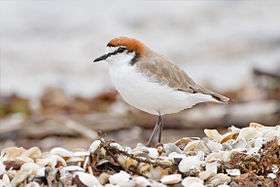 | |
| Male in breeding plumage | |
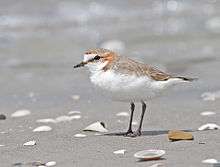 | |
| Female in breeding plumage | |
| Scientific classification | |
| Kingdom: | Animalia |
| Phylum: | Chordata |
| Class: | Aves |
| Order: | Charadriiformes |
| Family: | Charadriidae |
| Genus: | Charadrius |
| Species: | C. ruficapillus |
| Binomial name | |
| Charadrius ruficapillus Temminck, 1822 | |
The red-capped plover (Charadrius ruficapillus), also known as the red-capped dotterel, is a small plover.
It breeds in Australia. The species is closely related to (and sometimes considered conspecific with) the Kentish plover, Javan plover and white-fronted plover.
Description
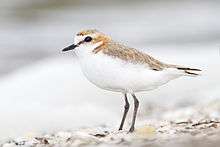
Red-capped plovers have white underparts and forehead. Their upperparts are mainly grey-brown. Adult males have a rufous or reddish-brown crown and hindneck. Adult females have a paler rufous and grey-brown crown and hindneck, with a pale loreal stripe. The upperwing of Charadrius ruficapillus shows dark brown remiges (flight feathers) and primary covert feathers with a white wingbar in flight. Its length is 14–16 cm and its wingspan is 27–34 cm; and weighs 35–40 g.
Breeding plumage shows a red-brown crown and nape with black margins. Non-breeding plumage is duller and lacks the black margins.[2]
Distribution and habitat
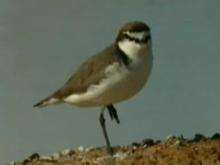
The red-capped plover is widespread in Australia; it is a vagrant to New Zealand, although it bred there for some time in small numbers from 1950–1980.[3] The species occupies a range of coastal and inland habitats, including estuaries, bays, beaches, sandflats and mudflats; inland saline wetlands. It is also found in inland wetland areas with bare ground.
Food
Mainly small invertebrates, especially molluscs, crustaceans and worms.
Breeding
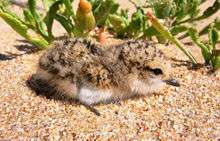
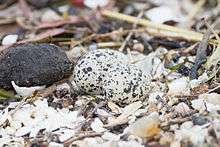
The red-capped plover is a seasonal breeder on the coasts of Australia, but breeds in response to unpredictable rains inland.[3] The plover nests on the ground close to wetlands; the nest is a small depression in the ground, with minimal or no lining. The clutch of two pale yellowish-brown eggs are speckled with black spots. Incubation period 30 days; incubating is mainly done by the female. Upon hatching, the young are open-eyed, mobile and relatively mature (precocial); and flee the nest (nidifugous).
Conservation
With a large range and no evidence of significant population decline, this species' conservation status is of Least Concern.
References
- ↑ BirdLife International (2012). "Charadrius ruficapillus". IUCN Red List of Threatened Species. Version 2013.2. International Union for Conservation of Nature. Retrieved 26 November 2013.
- ↑ Grosset, Arthur. "Red-capped Plover Charadrius ruficapillus". Retrieved 9 January 2011.
- 1 2 Piersma, Theunis; Weirsma, Popko (1996), "Family Charadriidae (Plovers)", in del Hoyo, Josep; Elliott, Andrew; Sargatal, Jordi, Handbook of the Birds of the World. Volume 3, Hoatzin to Auks, Barcelona: Lynx Edicions, pp. 432–433, ISBN 84-87334-20-2
- BirdLife International. (2006). Species factsheet: Charadrius ruficapillus. Downloaded from http://www.birdlife.org on 12 February 2007
- Marchant, S.; Higgins, P.J.; & Davies, J.N. (eds). (1994). Handbook of Australian, New Zealand and Antarctic Birds. Volume 2: Raptors to Lapwings. Oxford University Press: Melbourne. ISBN 0-19-553069-1
External links
 Media related to Charadrius ruficapillus at Wikimedia Commons
 Data related to Charadrius ruficapillus at Wikispecies