Rice's formula
In probability theory, Rice's formula counts the average number of times an ergodic stationary process X(t) per unit time crosses a fixed level u.[1] Adler and Taylor describe the result as "one of the most important results in the applications of smooth stochastic processes."[2]
History
The formula was published by Stephen O. Rice in 1944,[3] having previously been discussed in his 1936 note entitled "Singing Transmission Lines."[4][5]
Formula
Write Du for the number of times the ergodic stationary stochastic process X(t) takes the value u in a unit of time (i.e. t ∈ [0,1]). Then Rice's formula states that
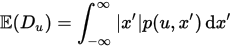
where p(x,x') is the joint probability density of the X(t) and its mean-square derivative X'(t).[6]
If the process X(t) is a Gaussian process and u = 0 then the formula simplifies significantly to give[6][7]
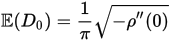
where ρ'' is the second derivative of the normalised autocorrelation of X(t) at 0.
Uses
Rice's formula can be used to approximate an excursion probability[8]
![\mathbb {P} \left\{\sup _{t\in [0,1]}X(t)\geq u\right\}](../I/m/3362cdf144239c76fcba7666aa34d1ccd4efed12.svg)
as for large values of u the probability that there is a level crossing is approximately the probability of reaching that level.
References
- ↑ Rychlik, I. (2000). "On Some Reliability Applications of Rice's Formula for the Intensity of Level Crossings". Extremes. Kluwer Academic Publishers. 3 (4): 331–348. doi:10.1023/A:1017942408501.
- ↑ Adler, Robert J.; Taylor, Jonathan E. (2007). "Random Fields and Geometry". Springer Monographs in Mathematics. doi:10.1007/978-0-387-48116-6. ISBN 978-0-387-48112-8.
- ↑ Rice, S. O. (1944). "Mathematical analysis of random noise" (PDF). Bell System Tech. J. 23: 282–332.
- ↑ Rainal, A. J. (1988). "Origin of Rice's formula". IEEE Transactions on Information Theory. 34 (6): 1383–1387. doi:10.1109/18.21276.
- ↑ Borovkov, K.; Last, G. (2012). "On Rice's formula for stationary multivariate piecewise smooth processes". Journal of Applied Probability. 49 (2): 351. doi:10.1239/jap/1339878791.
- 1 2 Barnett, J. T. (2001). "Zero-Crossings of Random Processes with Application to Estimation Detection". In Marvasti, Farokh A. Nonuniform Sampling: Theory and Practice. Springer. ISBN 0306464454.
- ↑ Ylvisaker, N. D. (1965). "The Expected Number of Zeros of a Stationary Gaussian Process". The Annals of Mathematical Statistics. 36 (3): 1043. doi:10.1214/aoms/1177700077.
- ↑ Adler, Robert J.; Taylor, Jonathan E. (2007). "Excursion Probabilities". Random Fields and Geometry. Springer Monographs in Mathematics. pp. 75–76. doi:10.1007/978-0-387-48116-6_4. ISBN 978-0-387-48112-8.