Rusty-vented canastero
| Rusty-vented canastero | |
|---|---|
 | |
| Scientific classification | |
| Kingdom: | Animalia |
| Phylum: | Chordata |
| Class: | Aves |
| Order: | Passeriformes |
| Family: | Furnariidae |
| Genus: | Asthenes |
| Species: | A. dorbignyi |
| Binomial name | |
| Asthenes dorbignyi (Reichenbach, 1853) | |
| Subspecies | |
|
See text | |
| Synonyms | |
| |
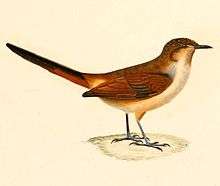
The rusty-vented canastero (Asthenes dorbignyi), also known as the creamy-breasted canastero, is a species of bird in the Furnariidae family. It is found in South America.
Description
The creamy-breasted canastero is brown or rufous brown above, usually with a rufous rump, and with pale gray or whitish underparts (throat, breast, and belly). The tail is blackish, but the outer rectrices are rufous, buffy or whitish in color.
The creamy-breasted canastero is common in most areas within its range,[2] but some subspecies are restricted to small geographic areas and so potentially are vulnerable to habitat loss or degradation.[3]
Taxonomy
The taxonomy of the creamy-breasted canastero is complicated. There are five subspecies: arequipae of southwestern Peru, western Bolivia, and northern Chile; huancavelicae and usheri, both found in south central Peru; consobrina of southwestern Bolivia, and dorbignyi of central Bolivia and northwestern Argentina.[3] Some authors have grouped these into as many as three separate species: Dark-winged canastero Asthenes arequipae; pale-tailed canastero Asthenes huancavelicae (including the subspecies huancavelicae and usheri); and the rusty-vented canastero Asthenes dorbignyi (including the subspecies consobrina and dorbignyi).[4] Currently, however, most authorities include all five into the single species creamy-breasted canastero,[3][5] but there is widespread acknowledgement that the taxonomy of this species requires more research. Also, it is possible that creamy-breasted canastero is not a member of the genus Asthenes at all, but instead belongs to the genus Phacellodomus.[3]
Distribution and habitat
It is found in the Andes Mountains in Peru, Chile, Bolivia, and northwestern Argentina. Its habitat is montane scrub or open Polylepis forest.
References
- ↑ BirdLife International (2012). "Asthenes dorbignyi". IUCN Red List of Threatened Species. Version 2013.2. International Union for Conservation of Nature. Retrieved 26 November 2013.
- ↑ http://www.birdlife.org/datazone/species/index.html?action=SpcHTMDetails.asp&sid=31136&m=0 BirdLife International
- 1 2 3 4 J. V. Remsen, 2003, Family Furnariidae (Ovenbirds), pages 162-357 in Handbook of the Birds of the World. Volume 8 (J. del Hoyo, A. Elliott, and D. A. Christie, editors). Lynx Edicions, Barcelona
- ↑ R. S. Ridgely and G. Tudor, 1994, The birds of South America. Volume II. The suboscine passerines. University of Texas Press, Austin
- ↑ http://www.museum.lsu.edu/~Remsen/SACCBaseline06.html South American Classification Committee