Space Shogi
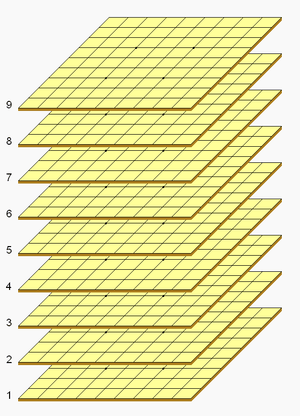
Space Shogi 3D gamespace
Space Shogi is a three-dimensional shogi variant invented by George R. Dekle, Sr. in 1987.[1][2] The gamespace comprises nine 9×9 shogi boards stacked vertically. Each player controls a standard set of shogi pieces.
Space Shogi was included in World Game Review No. 10 edited by Michael Keller.[3]
Game rules
Space Shogi follows standard shogi conventions, including the same types and numbers of pieces, and a similar initial setup. All the normal shogi rules apply, including drops, promotion, check, checkmate, and impasse. But pieces have the freedom of three-dimensional movement.
Starting setup
Black starts the game occupying levels 1 through 3; White starts on levels 9 through 7.

Black's level 1 (and White's level 9, rank a) starting setup. Unlike standard shogi, the silver is placed between the lance and the knight (8i and 2i in the diagram).

Black's level 2 (and White's level 8, rank b) starting setup. The bishop and rook occupy the same positions as in standard shogi.
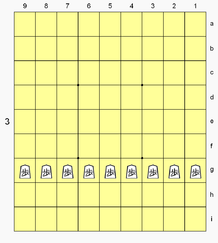
Black's level 3 (and White's level 7, rank c) starting setup. The pawns fill the same rank as in standard shogi.
See also
- Three-dimensional chess
- Also by George Dekle:
- Hexshogi—a variant with hexagonal cells
- Trishogi—a variant with triangular cells
- Masonic Shogi—a variant with standard cells but staggered ranks
References
- ↑ Pritchard (1994), p. 285
- ↑ Pritchard (2007), p. 261
- ↑ Keller, Michael, ed. (June 1991). "A Panorama of Chess Variants". World Game Review. Michael Keller (No. 10). ISSN 1041-0546.
Bibliography
- Pritchard, D. B. (1994). The Encyclopedia of Chess Variants. Games & Puzzles Publications. ISBN 0-9524142-0-1.
- Pritchard, D. B. (2007). Beasley, John, ed. The Classified Encyclopedia of Chess Variants. John Beasley. ISBN 978-0-9555168-0-1.
Standard shogi (9×9, drops) | ||
| Small variants |
|  |
| Standard-size variants |
| |
| Large variants |
| |
| Multiplayer variants |
| |
| 3D variants |
| |
This article is issued from Wikipedia - version of the 12/27/2015. The text is available under the Creative Commons Attribution/Share Alike but additional terms may apply for the media files.