Stellar atmosphere
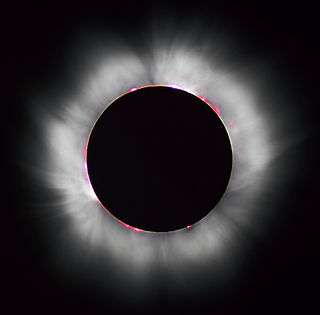
Photo taken in France during the 1999 eclipse
The stellar atmosphere is the outer region of the volume of a star, lying above the stellar core, radiation zone and convection zone. It is divided into several regions of distinct character:
- The photosphere, which is the atmosphere's lowest and coolest layer, is normally its only visible part.[1] Light escaping from the surface of the star stems from this region and passes through the higher layers. The Sun's photosphere has a temperature in the 5,770 K to 5,780 K range.[2][3] Starspots, cool regions of disrupted magnetic field lie on the photosphere.[3]
- Above the photosphere lies the chromosphere. This part of the atmosphere first cools down and then starts to heat up to about 10 times the temperature of the photosphere.
- Above the chromosphere lies the transition region, where the temperature increases rapidly on a distance of only around 100 km.[4]
- The outermost part of the stellar atmosphere is the corona, a tenuous plasma which has a temperature above one million Kelvin.[5] While all stars on the main sequence feature transition regions and coronae, not all evolved stars do so. It seems that only some giants, and very few supergiants, possess coronae. An unresolved problem in stellar astrophysics is how the corona can be heated to such high temperatures. The answer lies in magnetic fields, but the exact mechanism remains unclear.[6]
During a total solar eclipse, the photosphere of the Sun is obscured, revealing its atmosphere's other layers.[1] Observed during eclipse, the sun's chromosphere appears (briefly) as a thin pinkish arc,[7] and its corona is seen as a tufted halo. The same phenomenon in eclipsing binaries can make the chromosphere of giant stars visible.[8]
See also
- Cecilia Payne-Gaposchkin, who first proposed the presently-accepted composition of stellar atmospheres
Notes
- 1 2 ""Beyond the Blue Horizon" – A Total Solar Eclipse Chase". 1999-08-05. Retrieved 2010-05-21.
On ordinary days, the corona is hidden by the blue sky, since it is about a million times fainter than the layer of the sun we see shining every day, the photosphere.
- ↑ Mariska, J.T. The solar transition region. Cambridge Astrophysics Series. Cambridge University Press. ISBN 978-0-521-38261-8.
- 1 2 Lang, K.R. (September 2006). "5.1 MAGNETIC FIELDS IN THE VISIBLE PHOTOSPHERE". Sun, earth, and sky (2nd ed.). Springer. p. 81. ISBN 978-0-387-30456-4.
this opaque layer is the photosphere, the level of the Sun from which we get our light and heat
- ↑ Mariska, J.T. The solar transition region. p. 60. ISBN 978-0-521-38261-8.
100 km suggested by average models
- ↑ R.C. Altrock (2004). "The Temperature of the Low Corona During Solar Cycles 21–23". Solar Physics. 224: 255. Bibcode:2004SoPh..224..255A. doi:10.1007/s11207-005-6502-4.
- ↑ "The Sun's Corona – Introduction". NASA. Retrieved 2010-05-21.
Now most scientists believe that the heating of the corona is linked to the interaction of the magnetic field lines.
- ↑ Lewis, J.S. (2004-02-23). Physics and chemistry of the solar system (Second ed.). Elsevier Academic Press. p. 87. ISBN 978-0-12-446744-6.
The dominant color is influenced by the Balmer radiation of atomic hydrogen
- ↑ Griffin, R.E. (2007-08-27). Hartkopft, W.I.; Guinan, E.F., eds. Only Binary Stars Can Help Us Actually SEE a Stellar Chromosphere (1 ed.). Cambridge University Press. p. 460. doi:10.1017/S1743921307006163. ISBN 978-0-521-86348-3. Retrieved 2010-05-21.
| Internal structure |  | ||||||||||
|---|---|---|---|---|---|---|---|---|---|---|---|
| Atmosphere | |||||||||||
| Variation | |||||||||||
| Heliosphere | |||||||||||
| Related topics | |||||||||||
| Star |  | |
|---|---|---|
| Exoplanet | ||
| Planet | ||
| Dwarf planet | ||
| Satellite | ||
| See also | ||
This article is issued from Wikipedia - version of the 6/4/2016. The text is available under the Creative Commons Attribution/Share Alike but additional terms may apply for the media files.