Suasoria
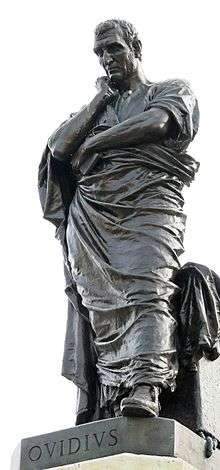
Suasoria is an exercise in rhetoric; a form of declamation in which the student makes a speech which is the soliloquy of an historical figure debating how to proceed at a critical junction in their life.[1]
Origin
The exercise was used in ancient Rome, where it was, with the controversia, the final stage of a course in rhetoric at an academy. One famous instance was recalled by Juvenal in the first of his Satires:[2]
| “ |
Et nos ergo manum ferulæ subduximus: et nos |
” |
Here Juvenal recalls his speech advising the dictator Sulla to retire. Another Roman poet who recalled enjoying his suasoria was Ovid.[3]
References
- ↑ Bloomer, W. Martin (2010), "Roman Declamation: The Elder Seneca and Quintilian", A Companion to Roman Rhetoric, John Wiley & Sons, pp. 301–302, ISBN 9781444334159
- ↑ Susanna Morton Braund (1997), "Declamation and contestation in satire", Roman Eloquence: Rhetoric in Society and Literature, Routledge, p. 147, ISBN 9780415125444
- ↑ "Education (Roman)", Encyclopaedia of Religion and Ethics, 9, Charles Scribner's Sons, 1912, p. 212