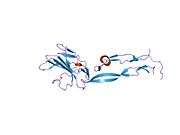
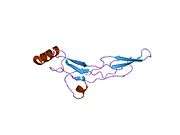
Transforming growth factor, beta 3
| View/Edit Human | View/Edit Mouse |
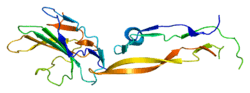
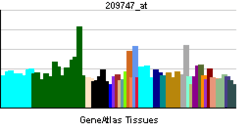
Transforming growth factor beta-3 is a protein that in humans is encoded by the TGFB3 gene.[3][4]
It is a type of protein, known as a cytokine, which is involved in cell differentiation, embryogenesis and development. It belongs to a large family of cytokines called the Transforming growth factor beta superfamily, which includes the TGF-β family, Bone morphogenetic proteins (BMPs), growth and differentiation factors (GDFs), inhibins and activins.[5]
TGF-β3 is believed to regulate molecules involved in cellular adhesion and extracellular matrix (ECM) formation during the process of palate development. Without TGF-β3, mammals develop a deformity known as a cleft palate.[6][7] This is caused by failure of epithelial cells in both sides of the developing palate to fuse. TGF-β3 also plays an essential role in controlling the development of lungs in mammals, by also regulating cell adhesion and ECM formation in this tissue,[8] and controls wound healing by regulating the movements of epidermal and dermal cells in injured skin.[3]
Interactions
Transforming growth factor, beta 3 has been shown to interact with TGF beta receptor 2.[9][10][11][12]
Clinical research
After successful phase I/II trials,[13] human recombinant TGF-β3 (Avotermin, planned trade name Juvista) failed in Phase III trials.[14]
References
- ↑ "Human PubMed Reference:".
- ↑ "Mouse PubMed Reference:".
- 1 2 Bandyopadhyay B, Fan J, Guan S, Li Y, Chen M, Woodley DT, Li W (Mar 2006). "A "traffic control" role for TGFbeta3: orchestrating dermal and epidermal cell motility during wound healing". The Journal of Cell Biology. 172 (7): 1093–105. doi:10.1083/jcb.200507111. PMC 2063766
 . PMID 16549496.
 - ↑ "Entrez Gene: TGFB3 transforming growth factor, beta 3".
- ↑ Herpin A, Lelong C, Favrel P (May 2004). "Transforming growth factor-beta-related proteins: an ancestral and widespread superfamily of cytokines in metazoans". Developmental and Comparative Immunology. 28 (5): 461–85. doi:10.1016/j.dci.2003.09.007. PMID 15062644.
- ↑ Taya Y, O'Kane S, Ferguson MW (Sep 1999). "Pathogenesis of cleft palate in TGF-beta3 knockout mice". Development. 126 (17): 3869–79. PMID 10433915.
- ↑ Dudas M, Nagy A, Laping NJ, Moustakas A, Kaartinen V (Feb 2004). "Tgf-beta3-induced palatal fusion is mediated by Alk-5/Smad pathway". Developmental Biology. 266 (1): 96–108. doi:10.1016/j.ydbio.2003.10.007. PMID 14729481.
- ↑ Kaartinen V, Voncken JW, Shuler C, Warburton D, Bu D, Heisterkamp N, Groffen J (Dec 1995). "Abnormal lung development and cleft palate in mice lacking TGF-beta 3 indicates defects of epithelial-mesenchymal interaction". Nature Genetics. 11 (4): 415–21. doi:10.1038/ng1295-415. PMID 7493022.
- ↑ De Crescenzo G, Pham PL, Durocher Y, O'Connor-McCourt MD (May 2003). "Transforming growth factor-beta (TGF-beta) binding to the extracellular domain of the type II TGF-beta receptor: receptor capture on a biosensor surface using a new coiled-coil capture system demonstrates that avidity contributes significantly to high affinity binding". Journal of Molecular Biology. 328 (5): 1173–83. doi:10.1016/S0022-2836(03)00360-7. PMID 12729750.
- ↑ Hart PJ, Deep S, Taylor AB, Shu Z, Hinck CS, Hinck AP (Mar 2002). "Crystal structure of the human TbetaR2 ectodomain--TGF-beta3 complex". Nature Structural Biology. 9 (3): 203–8. doi:10.1038/nsb766. PMID 11850637.
- ↑ Barbara NP, Wrana JL, Letarte M (Jan 1999). "Endoglin is an accessory protein that interacts with the signaling receptor complex of multiple members of the transforming growth factor-beta superfamily". The Journal of Biological Chemistry. 274 (2): 584–94. doi:10.1074/jbc.274.2.584. PMID 9872992.
- ↑ Rotzer D, Roth M, Lutz M, Lindemann D, Sebald W, Knaus P (Feb 2001). "Type III TGF-beta receptor-independent signalling of TGF-beta2 via TbetaRII-B, an alternatively spliced TGF-beta type II receptor". The EMBO Journal. 20 (3): 480–90. doi:10.1093/emboj/20.3.480. PMC 133482. PMID 11157754.
- ↑ Ferguson MW, Duncan J, Bond J, Bush J, Durani P, So K, Taylor L, Chantrey J, Mason T, James G, Laverty H, Occleston NL, Sattar A, Ludlow A, O'Kane S (Apr 2009). "Prophylactic administration of avotermin for improvement of skin scarring: three double-blind, placebo-controlled, phase I/II studies". Lancet. 373 (9671): 1264–74. doi:10.1016/S0140-6736(09)60322-6. PMID 19362676.
- ↑ Renovo shares plummet 75% as scar revision product Juvista fails to meet study endpoints, 14 February 2011
Further reading
- Kalluri R, Neilson EG (Dec 2003). "Epithelial-mesenchymal transition and its implications for fibrosis". The Journal of Clinical Investigation. 112 (12): 1776–84. doi:10.1172/JCI20530. PMC 297008. PMID 14679171.
- Arrick BA, Lee AL, Grendell RL, Derynck R (Sep 1991). "Inhibition of translation of transforming growth factor-beta 3 mRNA by its 5' untranslated region". Molecular and Cellular Biology. 11 (9): 4306–13. doi:10.1128/mcb.11.9.4306. PMC 361291. PMID 1875922.
- ten Dijke P, Hansen P, Iwata KK, Pieler C, Foulkes JG (Jul 1988). "Identification of another member of the transforming growth factor type beta gene family". Proceedings of the National Academy of Sciences of the United States of America. 85 (13): 4715–9. doi:10.1073/pnas.85.13.4715. PMC 280506. PMID 3164476.
- Derynck R, Lindquist PB, Lee A, Wen D, Tamm J, Graycar JL, Rhee L, Mason AJ, Miller DA, Coffey RJ (Dec 1988). "A new type of transforming growth factor-beta, TGF-beta 3". The EMBO Journal. 7 (12): 3737–43. PMC 454948. PMID 3208746.
- Barton DE, Foellmer BE, Du J, Tamm J, Derynck R, Francke U (1989). "Chromosomal mapping of genes for transforming growth factors beta 2 and beta 3 in man and mouse: dispersion of TGF-beta gene family". Oncogene Research. 3 (4): 323–31. PMID 3226728.
- Kaartinen V, Voncken JW, Shuler C, Warburton D, Bu D, Heisterkamp N, Groffen J (Dec 1995). "Abnormal lung development and cleft palate in mice lacking TGF-beta 3 indicates defects of epithelial-mesenchymal interaction". Nature Genetics. 11 (4): 415–21. doi:10.1038/ng1295-415. PMID 7493022.
- Nishida K, Sotozono C, Adachi W, Yamamoto S, Yokoi N, Kinoshita S (Mar 1995). "Transforming growth factor-beta 1, -beta 2 and -beta 3 mRNA expression in human cornea". Current Eye Research. 14 (3): 235–41. doi:10.3109/02713689509033520. PMID 7796607.
- Lin HY, Moustakas A, Knaus P, Wells RG, Henis YI, Lodish HF (Feb 1995). "The soluble exoplasmic domain of the type II transforming growth factor (TGF)-beta receptor. A heterogeneously glycosylated protein with high affinity and selectivity for TGF-beta ligands". The Journal of Biological Chemistry. 270 (6): 2747–54. doi:10.1074/jbc.270.6.2747. PMID 7852346.
- Rampazzo A, Nava A, Danieli GA, Buja G, Daliento L, Fasoli G, Scognamiglio R, Corrado D, Thiene G (Jun 1994). "The gene for arrhythmogenic right ventricular cardiomyopathy maps to chromosome 14q23-q24". Human Molecular Genetics. 3 (6): 959–62. doi:10.1093/hmg/3.6.959. PMID 7951245.
- Zhao Y, Chegini N, Flanders KC (Oct 1994). "Human fallopian tube expresses transforming growth factor (TGF beta) isoforms, TGF beta type I-III receptor messenger ribonucleic acid and protein, and contains [125I]TGF beta-binding sites". The Journal of Clinical Endocrinology and Metabolism. 79 (4): 1177–84. doi:10.1210/jc.79.4.1177. PMID 7962292.
- Hildebrand A, Romarís M, Rasmussen LM, Heinegård D, Twardzik DR, Border WA, Ruoslahti E (Sep 1994). "Interaction of the small interstitial proteoglycans biglycan, decorin and fibromodulin with transforming growth factor beta". The Biochemical Journal. 302 (2): 527–34. doi:10.1042/bj3020527. PMC 1137259. PMID 8093006.
- López-Casillas F, Payne HM, Andres JL, Massagué J (Feb 1994). "Betaglycan can act as a dual modulator of TGF-beta access to signaling receptors: mapping of ligand binding and GAG attachment sites". The Journal of Cell Biology. 124 (4): 557–68. doi:10.1083/jcb.124.4.557. PMC 2119924. PMID 8106553.
- Mittl PR, Priestle JP, Cox DA, McMaster G, Cerletti N, Grütter MG (Jul 1996). "The crystal structure of TGF-beta 3 and comparison to TGF-beta 2: implications for receptor binding". Protein Science. 5 (7): 1261–71. doi:10.1002/pro.5560050705. PMC 2143453. PMID 8819159.
- Ambros RA, Kallakury BV, Malfetano JH, Mihm MC (Oct 1996). "Cytokine, cell adhesion receptor, and tumor suppressor gene expression in vulvar squamous carcinoma: correlation with prominent fibromyxoid stromal response". International Journal of Gynecological Pathology. 15 (4): 320–5. doi:10.1097/00004347-199610000-00004. PMID 8886879.
- Djonov V, Ball RK, Graf S, Mottaz AE, Arnold AM, Flanders K, Studer UE, Merz VW (May 1997). "Transforming growth factor-beta 3 is expressed in nondividing basal epithelial cells in normal human prostate and benign prostatic hyperplasia, and is no longer detectable in prostate carcinoma". The Prostate. 31 (2): 103–9. doi:10.1002/(SICI)1097-0045(19970501)31:2<103::AID-PROS5>3.0.CO;2-O. PMID 9140123.
- Jin L, Qian X, Kulig E, Sanno N, Scheithauer BW, Kovacs K, Young WF, Lloyd RV (Aug 1997). "Transforming growth factor-beta, transforming growth factor-beta receptor II, and p27Kip1 expression in nontumorous and neoplastic human pituitaries". The American Journal of Pathology. 151 (2): 509–19. PMC 1858020. PMID 9250163.
- Lidral AC, Romitti PA, Basart AM, Doetschman T, Leysens NJ, Daack-Hirsch S, Semina EV, Johnson LR, Machida J, Burds A, Parnell TJ, Rubenstein JL, Murray JC (Aug 1998). "Association of MSX1 and TGFB3 with nonsyndromic clefting in humans". American Journal of Human Genetics. 63 (2): 557–68. doi:10.1086/301956. PMC 1377298. PMID 9683588.
- Barbara NP, Wrana JL, Letarte M (Jan 1999). "Endoglin is an accessory protein that interacts with the signaling receptor complex of multiple members of the transforming growth factor-beta superfamily". The Journal of Biological Chemistry. 274 (2): 584–94. doi:10.1074/jbc.274.2.584. PMID 9872992.
- Lux A, Attisano L, Marchuk DA (Apr 1999). "Assignment of transforming growth factor beta1 and beta3 and a third new ligand to the type I receptor ALK-1". The Journal of Biological Chemistry. 274 (15): 9984–92. doi:10.1074/jbc.274.15.9984. PMID 10187774.
- Mori T, Kawara S, Shinozaki M, Hayashi N, Kakinuma T, Igarashi A, Takigawa M, Nakanishi T, Takehara K (Oct 1999). "Role and interaction of connective tissue growth factor with transforming growth factor-beta in persistent fibrosis: A mouse fibrosis model". Journal of Cellular Physiology. 181 (1): 153–9. doi:10.1002/(SICI)1097-4652(199910)181:1<153::AID-JCP16>3.0.CO;2-K. PMID 10457363.
External links
- GeneReviews/NCBI/NIH/UW entry on Arrhythmogenic Right Ventricular Dysplasia/Cardiomyopathy, Autosomal Dominant
- OMIM entries on Arrhythmogenic Right Ventricular Dysplasia/Cardiomyopathy, Autosomal Dominant
PDB gallery | ||||||||
|---|---|---|---|---|---|---|---|---|
| ||||||||