TR-1 Temp
| TR-1 Temp SS-12 Scaleboard | |
|---|---|
|
9P120 launcher with 9M76 rocket of missile complex Temp-S | |
| Type | Theatre ballistic missile |
| Place of origin |
 Soviet Union Soviet Union |
| Service history | |
| In service | 1969 - 1989 |
| Used by | Soviet Armed Forces |
| Production history | |
| Designer | Nadiradze OKB |
| Manufacturer | Votkinsk Machine Building Plant |
| Specifications | |
| Weight | 9,700 kg (21,400 lb) |
| Length | 12.4 m (41 ft) |
| Diameter | 1.01 m (3 ft 4 in) |
| Warhead | Single 500 kt warhead |
|
| |
| Engine | Single-stage liquid propellant |
Operational range | 900 km (560 mi) |
Guidance system | Inertial |
| Accuracy | 370 m (1,210 ft) CEP |
Launch platform | Road-mobile TEL |
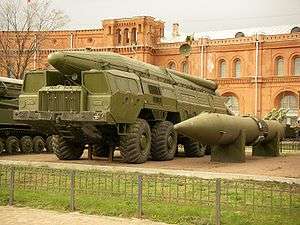
The TR-1 Temp is a mobile theatre ballistic missile developed and deployed by the Soviet Union during the Cold War. It was assigned the NATO reporting name SS-12 Scaleboard and carried the industrial designation 9M76. A modified version was initially identified by NATO as a new design and given the SS-22 reporting name, but later recognized it as merely a variant of the original and maintained the name Scaleboard. The Temp entered service in the mid-1960s.
The TR-1 was designed as a mobile weapon to give theatre (front) commanders nuclear strike capability. The weapon used the same mobile launcher (MAZ-543) as the R-11 Scud missile but had an environmental protective cover that split down the middle and was only opened when the missile was ready to fire. All were decommissioned in 1988-1989.
Operators
- Soviet Union
- The Soviet Armed Forces were the only operator of the TR-1 Temp. It was also placed in countries of Warsaw Pact for example Hranice (39) in Czechoslovakia, and Königsbrück (19), Bischofswerda (8), Waren (22) and Wokuhl (5) in East Germany.[1] Its active reach from there covered whole West Germany, parts of Scandinavia, France and Netherlands.
See also
- MGM-31 Pershing and Pershing II – comparable U. S. theatre nuclear missiles
- List of missiles
External links
References
- ↑ "Treaty between the United States of America and the Union of Soviet Socialist Republics on the Elimination of their Intermediate-Range and Shorter-Range Missiles - Memorandum of Understanding". State Department web site. Retrieved November 7, 2013.
- Hogg, Ian (2000). Twentieth-Century Artillery. Friedman/Fairfax Publishers. ISBN 1-58663-299-X