Timeline of cosmological theories
For a timeline of the cosmos (or universe), see Timeline of the Big Bang.
| Part of a series on | |||
| Physical cosmology | |||
|---|---|---|---|
 | |||
|
Early universe
|
|||
|
Components · Structure |
|||
| |||

This timeline of cosmological theories and discoveries is a chronological record of the development of humanity's understanding of the cosmos over the last two-plus millennia. Modern cosmological ideas follow the development of the scientific discipline of physical cosmology.
Pre-1900
- ca. 16th century BCE — Mesopotamian cosmology has a flat, circular Earth enclosed in a cosmic ocean.[1]
- ca. 12th century BCE — The Rigveda has some cosmological hymns, particularly in the late book 10, notably the Nasadiya Sukta which describes the origin of the universe, originating from the monistic Hiranyagarbha or "Golden Egg".
- 6th century BCE — The Babylonian world map shows the Earth surrounded by the cosmic ocean, with seven islands arranged around it so as to form a seven-pointed star. Contemporary Biblical cosmology reflects the same view of a flat, circular Earth swimming on water and overarched by the solid vault of the firmament to which are fastened the stars.
- 4th century BCE — Aristotle proposes an Earth-centered universe in which the Earth is stationary and the cosmos (or universe) is finite in extent but infinite in time
- 4th century BCE — De Mundo - Five elements, situated in spheres in five regions, the less being in each case surrounded by the greater — namely, earth surrounded by water, water by air, air by fire, and fire by ether — make up the whole Universe.[2]
- 3rd century BCE — Aristarchus of Samos proposes a Sun-centered universe
- 3rd century BCE — Archimedes in his essay The Sand Reckoner, estimates the diameter of the cosmos to be the equivalent in stadia of what we call two light years
- 2nd century BCE — Seleucus of Seleucia elaborates on Aristarchus' heliocentric universe, using the phenomenon of tides to explain heliocentrism
- 2nd century CE — Ptolemy proposes an Earth-centered universe, with the Sun, moon, and visible planets revolving around the Earth
- 5th-11th centuries — Several astronomers propose a Sun-centered universe, including Aryabhata, Albumasar[3] and Al-Sijzi
- 6th century — John Philoponus proposes a universe that is finite in time and argues against the ancient Greek notion of an infinite universe
- ca. 8th century — Puranic Hindu cosmology, in which the Universe goes through repeated cycles of creation, destruction and rebirth, with each cycle lasting 4.32 billion years.
- 9th-12th centuries — Al-Kindi (Alkindus), Saadia Gaon (Saadia ben Joseph) and Al-Ghazali (Algazel) support a universe that has a finite past and develop two logical arguments against the notion of an infinite past, one of which is later adopted by Immanuel Kant
- 964 — Abd al-Rahman al-Sufi (Azophi), a Persian astronomer, makes the first recorded observations of the Andromeda Galaxy and the Large Magellanic Cloud, the first galaxies other than the Milky Way to be observed from Earth, in his Book of Fixed Stars
- 12th century — Fakhr al-Din al-Razi discusses Islamic cosmology, rejects Aristotle's idea of an Earth-centered universe, and, in the context of his commentary on the Qur'anic verse, "All praise belongs to God, Lord of the Worlds," proposes that the universe has more than "a thousand thousand worlds beyond this world such that each one of those worlds be bigger and more massive than this world as well as having the like of what this world has."[4] He argued that there exists an infinite outer space beyond the known world,[5] and that there could be an infinite number of universes.[6]
- 13th century — Nasīr al-Dīn al-Tūsī provides the first empirical evidence for the Earth's rotation on its axis
- 15th century — Ali Qushji provides empirical evidence for the Earth's rotation on its axis and rejects the stationary Earth theories of Aristotle and Ptolemy
- 15th-16th centuries — Nilakantha Somayaji and Tycho Brahe propose a universe in which the planets orbit the Sun and the Sun orbits the Earth, known as the Tychonic system
- 1543 — Nicolaus Copernicus publishes his heliocentric universe in his De revolutionibus orbium coelestium
- 1576 — Thomas Digges modifies the Copernican system by removing its outer edge and replacing the edge with a star-filled unbounded space
- 1584 — Giordano Bruno proposes a non-hierarchical cosmology, wherein the Copernican solar system is not the center of the universe, but rather, a relatively insignificant star system, amongst an infinite multitude of others
- 1610 — Johannes Kepler uses the dark night sky to argue for a finite universe
- 1687 — Sir Isaac Newton's laws describe large-scale motion throughout the universe
- 1720 — Edmund Halley puts forth an early form of Olbers' paradox
- 1729 - James Bradley discovers the aberration of light, due to the Earth's motion around the Sun.
- 1744 — Jean-Philippe de Cheseaux puts forth an early form of Olbers' paradox
- 1755 — Immanuel Kant asserts that the nebulae are really galaxies separate from, independent of, and outside the Milky Way Galaxy; he calls them island universes.
- 1785 — William Herschel proposes the theory that our Sun is at or near the center of the galaxy.
- 1791 — Erasmus Darwin pens the first description of a cyclical expanding and contracting universe in his poem The Economy of Vegetation
- 1826 — Heinrich Wilhelm Olbers puts forth Olbers' paradox
- 1837 - Following over 100 years of unsuccessful attempts, Friedrich Bessel, Thomas Henderson and Otto Struve measure the parallax of a few nearby stars; this is the first measurement of any distances outside the solar system.
- 1848 — Edgar Allan Poe offers first correct solution to Olbers' paradox in Eureka: A Prose Poem, an essay that also suggests the expansion and collapse of the universe
- 1860s - William Huggins develops astronomical spectroscopy; he shows that the Orion nebula is mostly made of gas, while the Andromeda nebula (later called Andromeda galaxy) is probably dominated by stars.
1900–1949
- 1905 — Albert Einstein publishes the Special Theory of Relativity, positing that space and time are not separate continua
- 1912 - Henrietta Leavitt discovers the period-luminosity law for Cepheid variable stars, which becomes a crucial step in measuring distances to other galaxies.
- 1915 — Albert Einstein publishes the General Theory of Relativity, showing that an energy density warps spacetime
- 1917 — Willem de Sitter derives an isotropic static cosmology with a cosmological constant, as well as an empty expanding cosmology with a cosmological constant, termed a de Sitter universe
- 1920 — The Shapley-Curtis Debate, on the distances to spiral nebulae, takes place at the Smithsonian
- 1921 — The National Research Council (NRC) published the official transcript of the Shapley-Curtis Debate
- 1922 — Vesto Slipher summarizes his findings on the spiral nebulae's systematic redshifts
- 1922 — Alexander Friedmann finds a solution to the Einstein field equations which suggests a general expansion of space
- 1923 — Edwin Hubble measures distances to a few nearby spiral nebulae (galaxies), the Andromeda Galaxy (M31), Triangulum Galaxy (M33), and NGC 6822. The distances place them far outside our Milky Way, and implies that fainter galaxies are much more distant, and the universe is composed of many thousands of galaxies.
- 1927 — Georges Lemaître discusses the creation event of an expanding universe governed by the Einstein field equations. From its solutions to the Einstein equations, he predicts the distance-redshift relation.
- 1928 — Howard P. Robertson briefly mentions that Vesto Slipher's redshift measurements combined with brightness measurements of the same galaxies indicate a redshift-distance relation
- 1929 — Edwin Hubble demonstrates the linear redshift-distance relation and thus shows the expansion of the universe
- 1933 — Edward Milne names and formalizes the cosmological principle
- 1933 — Fritz Zwicky shows that the Coma cluster of galaxies contains large amounts of dark matter. This result agrees with modern measurements, but is generally ignored until the 1970s.
- 1934 — Georges Lemaître interprets the cosmological constant as due to a vacuum energy with an unusual perfect fluid equation of state
- 1938 — Paul Dirac suggests the large numbers hypothesis, that the gravitational constant may be small because it is decreasing slowly with time
- 1948 — Ralph Alpher, Hans Bethe ("in absentia"), and George Gamow examine element synthesis in a rapidly expanding and cooling universe, and suggest that the elements were produced by rapid neutron capture
- 1948 — Hermann Bondi, Thomas Gold, and Fred Hoyle propose steady state cosmologies based on the perfect cosmological principle
- 1948 — George Gamow predicts the existence of the cosmic microwave background radiation by considering the behavior of primordial radiation in an expanding universe
1950–1999
- 1950 — Fred Hoyle coins the term "Big Bang", saying that it was not derisive; it was just a striking image meant to highlight the difference between that and the Steady-State model.
- 1961 — Robert Dicke argues that carbon-based life can only arise when the gravitational force is small, because this is when burning stars exist; first use of the weak anthropic principle
- 1963 - Maarten Schmidt discovers the first quasar; these soon provide a probe of the universe back to substantial redshifts.
- 1965 — Hannes Alfvén proposes the now-discounted concept of ambiplasma to explain baryon asymmetry and supports the idea of an infinite universe.
- 1965 — Martin Rees and Dennis Sciama analyze quasar source count data and discover that the quasar density increases with redshift.
- 1965 — Arno Penzias and Robert Wilson, astronomers at Bell Labs discover the 2.7 K microwave background radiation, which earns them the 1978 Nobel Prize in Physics. Robert Dicke, James Peebles, Peter Roll and David Todd Wilkinson interpret it as a relic from the big bang.
- 1966 — Stephen Hawking and George Ellis show that any plausible general relativistic cosmology is singular
- 1966 — James Peebles shows that the hot Big Bang predicts the correct helium abundance
- 1967 — Andrei Sakharov presents the requirements for baryogenesis, a baryon-antibaryon asymmetry in the universe
- 1967 — John Bahcall, Wal Sargent, and Maarten Schmidt measure the fine-structure splitting of spectral lines in 3C191 and thereby show that the fine-structure constant does not vary significantly with time
- 1967 — Robert Wagoner, William Fowler, and Fred Hoyle show that the hot Big Bang predicts the correct deuterium and lithium abundances
- 1968 — Brandon Carter speculates that perhaps the fundamental constants of nature must lie within a restricted range to allow the emergence of life; first use of the strong anthropic principle
- 1969 — Charles Misner formally presents the Big Bang horizon problem
- 1969 — Robert Dicke formally presents the Big Bang flatness problem
- 1970 — Vera Rubin and Kent Ford measure spiral galaxy rotation curves at large radii, showing evidence for substantial amounts of dark matter.
- 1973 — Edward Tryon proposes that the universe may be a large scale quantum mechanical vacuum fluctuation where positive mass-energy is balanced by negative gravitational potential energy
- 1976 — Alex Shlyakhter uses samarium ratios from the Oklo prehistoric natural nuclear fission reactor in Gabon to show that some laws of physics have remained unchanged for over two billion years
- 1977 — Gary Steigman, David Schramm, and James Gunn examine the relation between the primordial helium abundance and number of neutrinos and claim that at most five lepton families can exist.
- 1980 — Alan Guth and Alexei Starobinsky independently propose the inflationary Big Bang universe as a possible solution to the horizon and flatness problems.
- 1981 — Viacheslav Mukhanov and G. Chibisov propose that quantum fluctuations could lead to large scale structure in an inflationary universe.
- 1982 — The first CfA galaxy redshift survey is completed.
- 1982 — Several groups including James Peebles, J. Richard Bond and George Blumenthal propose that the universe is dominated by cold dark matter.
- 1983 - 1987 — The first large computer simulations of cosmic structure formation are run by Davis, Efstathiou, Frenk and White. The results show that cold dark matter produces a reasonable match to observations, but hot dark matter does not.
- 1988 — The CfA2 Great Wall is discovered in the CfA2 redshift survey.
- 1988 — Measurements of galaxy large-scale flows provide evidence for the Great Attractor.
- 1990 — Preliminary results from NASA's COBE mission confirm the cosmic microwave background radiation has a blackbody spectrum to an astonishing one part in 105 precision, thus eliminating the possibility of an integrated starlight model proposed for the background by steady state enthusiasts.
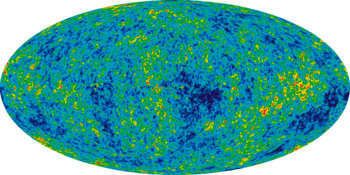
- 1992 — Further COBE measurements discover the very small anisotropy of the cosmic microwave background, providing a "baby picture" of the seeds of large-scale structure when the universe was around 1/1100th of its present size and 380,000 years old.
- 1996 - The first Hubble Deep Field is released, providing a clear view of very distant galaxies when the universe was around one-third of its present age.
- 1998 — Controversial evidence for the fine structure constant varying over the lifetime of the universe is first published.
- 1998 — The Supernova Cosmology Project and High-Z Supernova Search Team discover cosmic acceleration based on distances to Type Ia supernovae, providing the first direct evidence for a non-zero cosmological constant.
- 1999 — Measurements of the cosmic microwave background radiation with finer resolution than COBE, (most notably by the BOOMERanG experiment see Mauskopf et al., 1999, Melchiorri et al., 1999, de Bernardis et al. 2000) provide evidence for oscillations (the first acoustic peak) in the anisotropy angular spectrum, as expected in the standard model of cosmological structure formation. The angular position of this peak indicates that the geometry of the universe is close to flat.
Since 2000
- 2001 — The 2dF Galaxy Redshift Survey (2dF) by an Australian/British team gave strong evidence that the matter density is near 25% of critical density. Together with the CMB results for a flat universe, this provides independent evidence for a cosmological constant or similar dark energy.
- 2002 — The Cosmic Background Imager (CBI) in Chile obtained images of the cosmic microwave background radiation with the highest angular resolution of 4 arc minutes. It also obtained the anisotropy spectrum at high-resolution not covered before up to l ~ 3000. It found a slight excess in power at high-resolution (l > 2500) not yet completely explained, the so-called "CBI-excess".
- 2003 — NASA's Wilkinson Microwave Anisotropy Probe (WMAP) obtained full-sky detailed pictures of the cosmic microwave background radiation. The image can be interpreted to indicate that the universe is 13.7 billion years old (within one percent error), and are very consistent with the Lambda-CDM model and the density fluctuations predicted by inflation.
- 2003 — The Sloan Great Wall is discovered.
- 2004 — The Degree Angular Scale Interferometer (DASI) first obtained the E-mode polarization spectrum of the cosmic microwave background radiation.
- 2005 — The Sloan Digital Sky Survey (SDSS) and 2dF redshift surveys both detected the baryon acoustic oscillation feature in the galaxy distribution, a key prediction of cold dark matter models.
- 2006 — The long-awaited three-year WMAP results are released, confirming previous analysis, correcting several points, and including polarization data.
- 2006-2011 — Improved measurements from WMAP, new supernova surveys ESSENCE and SNLS, and baryon acoustic oscillations from SDSS and WiggleZ, continue to be consistent with the standard Lambda-CDM model.
- 2014 — On March 17, 2014, astrophysicists of the BICEP2 collaboration announced the detection of inflationary gravitational waves in the B-mode power spectrum, which if confirmed, would provide clear experimental evidence for the theory of inflation.[7][8][9][10][11][12] However, on June 19, 2014, lowered confidence in confirming the cosmic inflation findings was reported.[11][13][14]
- 2016 —On February 11, 2016, LIGO Scientific Collaboration and Virgo Collaboration announced that gravitational waves were directly detected by two LIGO's detectors. The waveform matched the prediction of General relativity for a gravitational wave emanating from the inward spiral and merger of a pair of black holes of around 36 and 29 solar masses and the subsequent "ringdown" of the single resulting black hole.[15][16][17] The second detection verified that GW150914 is not a fluke, thus opens entire new branch in astrophysics, gravitational-wave astronomy.[18][19]
See also
Physical cosmology
Belief systems
Others
References
- ↑ Horowitz (1998), p.xii
- ↑ Aristotle; Forster, E. S. (Edward Seymour), 1879-1950; Dobson, J. F. (John Frederic), 1875-1947 (1914). De Mundo. p. 2.
- ↑ "Introduction to Astronomy, Containing the Eight Divided Books of Abu Ma'shar Abalachus". World Digital Library. 1506. Retrieved 2013-07-16.
- ↑ Adi Setia (2004), "Fakhr Al-Din Al-Razi on Physics and the Nature of the Physical World: A Preliminary Survey", Islam & Science, 2, retrieved 2010-03-02
- ↑ Muammer İskenderoğlu (2002), Fakhr al-Dīn al-Rāzī and Thomas Aquinas on the question of the eternity of the world, Brill Publishers, p. 79, ISBN 90-04-12480-2
- ↑ John Cooper (1998), "al-Razi, Fakhr al-Din (1149-1209)", Routledge Encyclopedia of Philosophy, Routledge, retrieved 2010-03-07
- ↑ Staff (March 17, 2014). "BICEP2 2014 Results Release". National Science Foundation. Retrieved March 18, 2014.
- ↑ Clavin, Whitney (March 17, 2014). "NASA Technology Views Birth of the Universe". NASA. Retrieved March 17, 2014.
- ↑ Overbye, Dennis (March 17, 2014). "Space Ripples Reveal Big Bang's Smoking Gun". The New York Times. Retrieved March 17, 2014.
- ↑ Overbye, Dennis (March 24, 2014). "Ripples From the Big Bang". New York Times. Retrieved March 24, 2014.
- 1 2 Ade, P.A.R.; BICEP2 Collaboration (June 19, 2014). "Detection of B-Mode Polarization at Degree Angular Scales by BICEP2" (PDF). Physical Review Letters. 112: 241101. arXiv:1403.3985
 . Bibcode:2014PhRvL.112x1101A. doi:10.1103/PhysRevLett.112.241101. PMID 24996078. Retrieved June 20, 2014.
 - ↑ http://www.math.columbia.edu/~woit/wordpress/?p=6865
- ↑ Overbye, Dennis (June 19, 2014). "Astronomers Hedge on Big Bang Detection Claim". New York Times. Retrieved June 20, 2014.
- ↑ Amos, Jonathan (June 19, 2014). "Cosmic inflation: Confidence lowered for Big Bang signal". BBC News. Retrieved June 20, 2014.
- ↑ Abbott, B. P.; Abbott, R.; Abbott, T. D.; Abernathy, M. R.; Acernese, F.; Ackley, K.; Adams, C.; Adams, T.; Addesso, P. (2016-02-11). "Observation of Gravitational Waves from a Binary Black Hole Merger". Physical Review Letters. 116 (6). arXiv:1602.03837. Bibcode:2016PhRvL.116f1102A. doi:10.1103/PhysRevLett.116.061102. ISSN 0031-9007.
- ↑ Castelvecchi, Davide; Witze, Alexandra (11 February 2016). "Einstein's gravitational waves found at last". Nature News. doi:10.1038/nature.2016.19361. Retrieved 11 February 2016.
- ↑ Blum, Alexander; Lalli, Roberto; Renn, Jürgen (12 February 2016). "The long road towards evidence". Max Planck Society. Retrieved 15 February 2016.
- ↑ Abbott, B. P.; et al. (LIGO Scientific Collaboration and Virgo Collaboration) (15 June 2016). "GW151226: Observation of Gravitational Waves from a 22-Solar-Mass Binary Black Hole Coalescence". Physical Review Letters. 116 (24): 241103. doi:10.1103/PhysRevLett.116.241103.
- ↑ Commissariat, Tushna (15 June 2016). "LIGO detects second black-hole merger". Physics World. Institute of Physics. Retrieved 15 June 2016.
- Horowitz, Wayne (1998). Mesopotamian cosmic geography. Eisenbrauns.
- Bunch, Bryan, and Alexander Hellemans, "The History of Science and Technology: A Browser's Guide to the Great Discoveries, Inventions, and the People Who Made Them from the Dawn of Time to Today". ISBN 0-618-22123-9
- P. Mauskopf et al.,astro-ph/9911444, Astrophys. J. 536 (2000) L59-L62.
- A. Melchiorri et al.,astro-ph/9911445, Astrophys. J. 536 (2000) L63-L66.
- P. de Bernardis et al., astro-ph/0004404, Nature 404 (2000) 955-959.
- A. Readhead et al., Polarization observations with the Cosmic Background Imager, Science 306 (2004), 836-844.
This article is issued from Wikipedia - version of the 10/23/2016. The text is available under the Creative Commons Attribution/Share Alike but additional terms may apply for the media files.