Timeline of nuclear fusion
See also: Fusion power § History of research
This timeline of nuclear fusion is an incomplete chronological summary of significant events in the study and use of nuclear fusion.
1920s
- Based on F.W. Aston's measurements of the masses of low-mass elements and Einstein's discovery that E=mc2, Arthur Eddington proposes that large amounts of energy released by fusing small nuclei together provides the energy source that powers the stars.[1]
- 1929
- Atkinson and Houtermans provide the first calculations of the rate of nuclear fusion in stars.[2]
1930s
- 1932
- Mark Oliphant discovered helium-3 and tritium, and that heavy hydrogen nuclei could be made to react with each other.[3]
- 1939
- Peter Thonemann develops a detailed plan for a pinch device, but is told to do other work for his thesis.
- Hans Bethe shows how fusion powers the stars in work.
1940s
- 1941
- Enrico Fermi proposed the idea of using a fission weapon to initiate nuclear fusion (still hypothetical) in a mass of hydrogen to Edward Teller. Teller became enthusiastic about the idea and worked on it (unsuccessfully) throughout the Manhattan Project.
- 1946
- George Paget Thomson and Moses Blackman patent the concept that would become known as the Z-pinch.
- 1947
- Thomson, Blackman, Thonemann, Cousins, Ware, Jim Tuck, and others meet in Harwell to discuss the pinch approach and plan development.
- First kiloampere plasma created by Cousins and Ware at the Imperial College, London, in a doughnut-shaped glass vacuum vessel. Plasmas are unstable and only last fractions of seconds.
1950s
- 1950
- The tokamak, a type of magnetic confinement fusion device, was proposed by soviet scientists Andrei Sakharov and Igor Tamm.
- 1951
- Edward Teller and Stanislaw Ulam at Los Alamos National Laboratory (LANL) develop the Teller-Ulam design for the thermonuclear weapon, allowing for the development of multi-megaton weapons.
- Fusion work in the UK is classified after the Klaus Fuchs affair.
- A press release from Argentina claims that their Huemul Project had produced controlled nuclear fusion. This prompted a wave of responses in other countries, especially the U.S.
- Lyman Spitzer dismisses the Argentinian claims, but while thinking about it comes up with the stellarator concept. Funding is arranged under Project Matterhorn and develops into the Princeton Plasma Physics Laboratory.
- Tuck introduces the British pinch work to LANL. He develops the Perhapsatron under the codename Project Sherwood. (Some people claim that the project was named Sherwood based on Friar Tuck. This claim is corroborated in a brief biographical sketch written by Tuck.[4])

Ivy Mike, the first thermonuclear weapon, in 1952
- 1952
- Ivy Mike shot off Operation Ivy, the first detonation of a thermonuclear weapon, yields 10.4 megatons of TNT out of a fusion fuel of liquid deuterium.
- Cousins and Ware build a larger toroidal pinch device in England, and demonstrated that instabilities in the plasma make pinch devices inherently unstable.
- 1953
- Pinch devices in the US and USSR attempted to take the reactions to fusion levels without worrying about stability. Both reported detections of neutrons, which were later explained as non-fusion in nature.
- 1954
- Construction of the ZETA device started at Harwell. It is the largest fusion device for some time.
- Edward Teller gives a now-famous speech on plasma stability in magnetic bottles at the Princeton Gun Club. His work suggests that most magnetic bottles are inherently unstable.
- 1956
- Experimental research of tokamak systems started at Kurchatov Institute, Moscow by a group of Soviet scientists led by Lev Artsimovich.
- Igor Kurchatov gives a talk at Harwell on pinch devices,[5] revealing for the first time that the USSR is also working on fusion. He details the problems they are seeing, mirroring those in the US and UK.
- In the wake of the Kurchatov's speech, the US and UK begin to consider releasing their own data. Eventually they settle on a release prior to the 2nd Atoms for Peace conference in Geneva.
- 1957
- Initial results in ZETA appear to suggest the machine has successfully reached basic fusion temperatures. UK researchers start pressing for public release, while the US demurs.
- Scientists at the AEI Research laboratory in Harwell reported that the Sceptre III plasma column remained stable for 300 to 400 microseconds, a dramatic improvement on previous efforts. Working backward, the team calculated that the plasma had an electrical resistivity around 100 times that of copper, and was able to carry 200 kA of current for 500 microseconds in total.
- 1958
- The US and UK release large amounts of data in February, with the ZETA team claiming fusion. Other researchers, notably Artsimovich, are skeptical.
- American, British and Soviet scientists began to share previously classified controlled fusion research as part of the Atoms for Peace conference in Geneva in September. It is the largest international scientific meeting to date. It becomes clear that basic pinch concepts are not successful.
1960s
- 1961
- The Soviet Union test the Tsar Bomba (50 megatons), the most powerful thermonuclear weapon ever.
- 1965 (approximate)
- The 12-beam "4 pi laser" using ruby as the lasing medium is developed at Lawrence Livermore National Laboratory (LLNL) includes a gas-filled target chamber of about 20 centimeters in diameter.
- 1967
- Demonstration of Farnsworth-Hirsch Fusor appeared to generate neutrons in a nuclear reaction.
- Hans Bethe wins the 1967 Nobel Prize in physics for his publication on how fusion powers the stars in work of 1939.[6]
- 1968
- Results from the tokamak, a T-3 Soviet magnetic confinement device, which Igor Tamm and Andrei Sakharov had been working on, shows the temperatures in their machine to be over an order of magnitude higher than what was expected by the rest of the fusion community. The Western scientists visited the experiment and verified the high temperatures and confinement, sparking a wave of optimism for the prospects of the tokamak. It remains a dominant magnetic confinement device today, as well as development of new experiments.
1970s
- 1970
- Kapchinskii and Teplyakov conceive the "The ion linear accelerator with space-uniform strong focusing". Demonstrated in 1979 at LANL, and named the radiofrequency quadrupole accelerator (RFQ). The concept increases the ion beam current that can be accelerated at low beta. This will be important for ICF drivers using high-energy heavy ions (HIF).
- 1972
- The first neodymium-doped glass (Nd:glass) laser for ICF research, the "Long Path laser" is completed at LLNL and is capable of delivering ~50 joules to a fusion target.
- 1973
- Design work on JET, the Joint European Torus, begins.
- 1974
- Taylor re-visited ZETA results of 1958 and explained that the quiet-period was in fact very interesting. This led to the development of reversed field pinch, now generalised as "self-organising plasmas", an ongoing line of research.
- KMS Fusion was the only private sector company to pursue controlled thermonuclear fusion research using laser technology. Despite limited resources and numerous business problems KMS successfully demonstrated fusion from the Inertial Confinement Fusion (ICF) process. They achieved compression of a deuterium-tritium pellet from laser-energy in December 1973, and on May 1, 1974 carried out the world’s first successful laser-induced fusion. Neutron-sensitive nuclear emulsion detectors, developed by Nobel Prize winner Robert Hofstadter, were used to provide evidence of this discovery.
- Beams using mature high-energy accelerator technology are hailed as the elusive "brand-X" laser capable of driving fusion implosions for commercial power. The Livingston Curve, from Stanford SLAC Education Group, is modified to show the energy needed for fusion to occur. Experiments commence on the single beam LLNL Cyclops laser, testing new optical designs for future ICF lasers.
- 1976
- Workshop, called by the US-ERDA (now DoE) at the Claremont Hotel in Berkeley, CA for an ad-hoc two-week summer study. Fifty senior scientists from the major US ICF programs and accelerator laboratories participated, with program heads and Nobel laureates also attending. In the closing address, Dr. C. Martin Stickley, then Director of US-ERDA’s Office of Inertial Fusion, announced the conclusion was "no showstoppers" on the road to fusion energy.
- The two beam Argus laser is completed at LLNL and experiments involving more advanced laser-target interactions commence.
- 1977
- The 20 beam Shiva laser at LLNL is completed, capable of delivering 10.2 kilojoules of infrared energy on target. At a price of $25 million and a size approaching that of a football field, the Shiva laser is the first of the "megalasers" at LLNL and brings the field of ICF research fully within the realm of "big science".
- The JET project is given the go-ahead by the EC, choosing an ex-RAF airfield south east of Oxford, UK as its site.
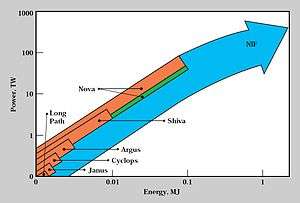 Progress in power and energy levels attainable by inertial confinement lasers has increased dramatically since the early 1970s.
- 1979
- LANL successfully demonstrates the radio frequency quadrupole accelerator (RFQ).
- ANL and Hughes Research Laboratories demonstrate required ion source brightness with xenon beam at 1.5MeV.
- Foster Panel reports to US-DoE’s Energy Research and Advisory Board that High-energy heavy ion fusion (HIF) is the "conservative approach" to fusion power. Listing HIF’s advantages in his report, John Foster remarked: "…now that is kind of exciting." After DoE Office of Inertial Fusion completed review of programs, Director Gregory Canavan decides to accelerate the HIF effort.
1980s
- 1982
- HIBALL study by German and US institutions,[7] Garching uses the high repetition rate of the RF accelerator driver to serve four reactor chambers and first-wall protection using liquid lithium inside the chamber cavity.
- Tore Supra construction starts at Cadarache, France. Its superconducting magnets will permit it to generate a strong permanent toroidal magnetic field.
- high-confinement mode (H-mode) discovered in tokamaks.
- 1983
- JET, the largest operational magnetic confinement plasma physics experiment is completed on time and on budget. First plasmas achieved.
- The NOVETTE laser at LLNL comes on line and is used as a test bed for the next generation of ICF lasers, specifically the NOVA laser.
- 1984
- The huge 10 beam NOVA laser at LLNL is completed and switches on in December. NOVA would ultimately produce a maximum of 120 kilojoules of infrared laser light during a nanosecond pulse in a 1989 experiment.
- 1985
- National Academy of Sciences reviewed military ICF programs, noting HIF’s major advantages clearly but averring that HIF was "supported primarily by other [than military] programs". The review of ICF by the National Academy of Sciences marked the trend with the observation: "The energy crisis is dormant for the time being." Energy becomes the sole purpose of heavy ion fusion.
- The Japanese tokamak, JT-60 completed. First plasmas achieved.
- 1988
- The T-15, Soviet tokamak with superconducting helium-cooled coils completed.
- The Conceptual Design Activity for the International Thermonuclear Experimental Reactor (ITER), the successor to T-15, TFTR, JET and JT-60, begins. Participants include EURATOM, Japan, the Soviet Union and United States. It ended in 1990.
- The first plasma produced at Tore Supra in April.[8]
- 1989
- On March 23, two Utah electrochemists, Stanley Pons and Martin Fleischmann, announced that they had achieved cold fusion: fusion reactions which could occur at room temperatures. However, they made their announcements before any peer review of their work was performed, and no subsequent experiments by other researchers revealed any evidence of fusion.
1990s
- 1990
- Decision to construct the National Ignition Facility "beamlet" laser at LLNL is made.
- 1991
- The START Tokamak fusion experiment begins in Culham. The experiment would eventually achieve a record beta (plasma pressure compared to magnetic field pressure) of 40% using a neutral beam injector. It was the first design that adapted the conventional toroidal fusion experiments into a tighter spherical design.
- 1992
- 1993
- 1994
- NIF Beamlet laser is completed and begins experiments validating the expected performance of NIF.
- The USA declassifies information about indirectly driven (hohlraum) target design.
- Comprehensive European-based study of HIF driver begins, centered at the Gesellshaft für Schwerionenforschung (GSI) and involving 14 laboratories, including USA and Russia. The Heavy Ion Driven Inertial Fusion (HIDIF) study will be completed in 1997.
- 1996
- A record is reached at Tore Supra: a plasma duration of two minutes with a current of almost 1 million amperes driven non-inductively by 2.3 MW of lower hybrid frequency waves (i.e. 280 MJ of injected and extracted energy). This result was possible due to the actively cooled plasma-facing components installed in the machine.[9]
- 1997
- The JET tokamak in the UK produces 16 MW of fusion power - the current world record for fusion power. Four megawatts of alpha particle self-heating was achieved.
- LLNL study compared projected costs of power from ICF and other fusion approaches to the projected future costs of existing energy sources.
- Groundbreaking ceremony held for the National Ignition Facility (NIF).
- 1998
- The JT-60 tokamak in Japan produced a high performance reversed shear plasma with the equivalent fusion amplification factor of 1.25 - the current world record of Q, fusion energy gain factor.
- Results of European-based study of heavy ion driven fusion power system (HIDIF, GSI-98-06) incorporates telescoping beams of multiple isotopic species. This technique multiplies the 6-D phase space usable for the design of HIF drivers.
- 1999

2000s
- 2001
- Building construction for the immense 192-beam 500-terawatt NIF project is completed and construction of laser beam-lines and target bay diagnostics commences, expecting to take its first full system shot in 2010.
- Negotiations on the Joint Implementation of ITER begin between Canada, countries represented by the European Union, Japan and Russia.
- 2002
- Claims and counter-claims are published regarding bubble fusion, in which a table-top apparatus was reported as producing small-scale fusion in a liquid undergoing acoustic cavitation. Like cold fusion (see 1989), it is later dismissed.
- European Union proposes Cadarache in France and Vandellos in Spain as candidate sites for ITER while Japan proposes Rokkasho.
- 2003
- The United States rejoins the ITER project with China and Republic of Korea also joining. Canada withdraws.
- Cadarache in France is selected as the European Candidate Site for ITER.
- Sandia National Laboratories began fusion experiments in the Z machine.
- 2004
- The United States drops its own projects, recognising an inability to match EU progress (Fusion Ignition Research Experiment (FIRE)), and focuses resources on ITER.
- 2005
- Following final negotiations between the EU and Japan, ITER chooses Cadarache over Rokkasho for the site of the reactor. In concession, Japan is able to host the related materials research facility and granted rights to fill 20% of the project's research posts while providing 10% of the funding.
- The NIF fires its first bundle of eight beams achieving the highest ever energy laser pulse of 152.8 kJ (infrared).
- 2006
- China's EAST test reactor is completed, the first tokamak experiment to use superconducting magnets to generate both the toroidal and poloidal fields.
- 2009
- Construction of the NIF reported as complete.
- Ricardo Betti, the third Under Secretary, responsible for Nuclear Energy, testifies before Congress: "IFE [ICF for energy production] has no home".
- Fusion Power Corporation files patent application for "Single Pass RF Driver" a RF Accelerator Driven HIF Process and Method.
2010s
- 2010
- HIF-2010 Symposium in Darmstadt Germany. Robert J Burke presented on Single Pass (Heavy Ion Fusion) HIF and Charles Helsley made a presentation on the commercialization of HIF within the decade.
- 2011
- May 23–26, Workshop for Accelerators for Heavy Ion Fusion at Lawrence Berkeley National Laboratory, presentation by Robert J. Burke on "Single Pass Heavy Ion Fusion". The Accelerator Working Group publishes recommendations supporting moving RF accelerator Driven HIF toward commercialization.
- 2012
- Stephen Slutz & Roger Vesey of Sandia National Labs publish a paper in Physical Review Letters presenting a computer simulation of the MagLIF concept showing it can produce high gain. According to the simulation, a 70 Mega Amp Z-pinch facility in combination with a Laser may be able to produce spectacular energy return of 1000 times the expended energy. A 60 MA facility would produce a 100x yield.[10]
- JET announces a major breakthrough in controlling instabilities in a fusion plasma.
- In August Robert J. Burke presents updates to the SPRFD HIF process[11] and Charles Helsley presents the Economics of SPRFD[12] at the 19th International HIF Symposium at Berkeley, California. Industry was there in support of ion generation for SPRFD.
- Fusion Power Corporation SPRFD patent allowed in Russia.
- 2013
- EAST tokamak test reactor achieves a record confinement time of 30 seconds for plasma in the high-confinement mode (H-mode), thanks to improvements in heat dipersal from tokamak walls. This is an improvement of an order of magnitude with respect to state-of-the-art reactors.
- 2014
- 2015
- Germany conducts the first plasma discharge of the Wendelstein 7-X, which creates a 1.3MW pulse from one milligram of helium gas in the evacuated plasma vessel of the stellarator. [14] This was a heating pulse, not a fusion energy pulse: no fusion took place.
Notes
- ↑ Eddington, A. S. (October 1920). "The internal constitution of the stars". The Observatory. 43: 341–358. Bibcode:1920Obs....43..341E. Retrieved 20 July 2015.
- ↑ Atkinson, R. d E.; Houtermans, F. G. (1929). "Zur Frage der Aufbaumöglichkeit der Elemente in Sternen". Zeitschrift für Physik. 54 (9-10): 656–665. Bibcode:1929ZPhy...54..656A. doi:10.1007/BF01341595. Retrieved 20 July 2015.
- ↑ "Mark Oliphant". Mark Oliphant. ETHW. Retrieved 11 March 2016.
- ↑ ...the first money to be allocated [to controlled nuclear research] happened to be for Tuck, and was diverted from Project Lincoln, in the Hood Laboratory. The coincidence of names prompted the well-known cover name "Project Sherwood". James L. Tuck, "Curriculum Vita and Autobiography", declassified document from Los Alamos National Laboratory (1974), reproduced with permission. Archived 9 February 2012.
- ↑ "Lecture of I.V. Kurchatov at Harwell", from the address of I.V. Kurchatov: “On the possibility of producing thermonuclear reactions in a gas discharge” at Harwell on 25 April 1956. Archived 20 July 2015.
- ↑ "Hans Bethe". Hans Bethe - Biographical. Nobel Prize.org. Retrieved 11 March 2016.
- ↑ ...Gesellschaft für Schwerionenforschung; Institut für Plasmaphysik, Garching; Kernforschungszentrum Karlsruhe, University of Wisconsin, Madison; Max-Planck-Institut für Quantenoptik
- ↑ "The Tore Supra Tokamak". CEA. Archived from the original on 11 February 2011. Retrieved 20 July 2015.
- ↑ "Archived copy". Archived from the original on November 15, 2012. Retrieved February 3, 2016.
- ↑ Slutz, Stephen A.; Vesey, Roger A. (12 January 2012). "High-Gain Magnetized Inertial Fusion". Phys. Rev. Lett. 108 (2). Bibcode:2012PhRvL.108b5003S. doi:10.1103/PhysRevLett.108.025003.
- ↑ Burke, Robert (1 January 2014). "The Single Pass RF Driver: Final beam compression". Nuclear Instruments and Methods in Physics Research Section A: Accelerators, Spectrometers, Detectors and Associated Equipment. 733: 158–167. Bibcode:2014NIMPA.733..158B. doi:10.1016/j.nima.2013.05.080.
- ↑ Helsley, Charles E.; Burke, Robert J. "Economic viability of large-scale fusion systems". Nuclear Instruments and Methods in Physics Research Section A: Accelerators, Spectrometers, Detectors and Associated Equipment. 733: 51–56. Bibcode:2014NIMPA.733...51H. doi:10.1016/j.nima.2013.05.095.
- ↑ Herrmann, Mark (20 February 2014). "Plasma physics: A promising advance in nuclear fusion". Nature. 506. Bibcode:2014Natur.506..302H. doi:10.1038/nature13057.
- ↑
Fusion experimental devices by confinement method | |||||||||||||||||||||||||||||||||||||||
|---|---|---|---|---|---|---|---|---|---|---|---|---|---|---|---|---|---|---|---|---|---|---|---|---|---|---|---|---|---|---|---|---|---|---|---|---|---|---|---|
| Magnetic |
| ||||||||||||||||||||||||||||||||||||||
| Inertial |
| ||||||||||||||||||||||||||||||||||||||

























External links
- Fusion experiments from the British Science Museum
- International Fusion Research Council, Status report on fusion research, Nuclear Fusion 45:10A, October 2005.
This article is issued from Wikipedia - version of the 11/6/2016. The text is available under the Creative Commons Attribution/Share Alike but additional terms may apply for the media files.